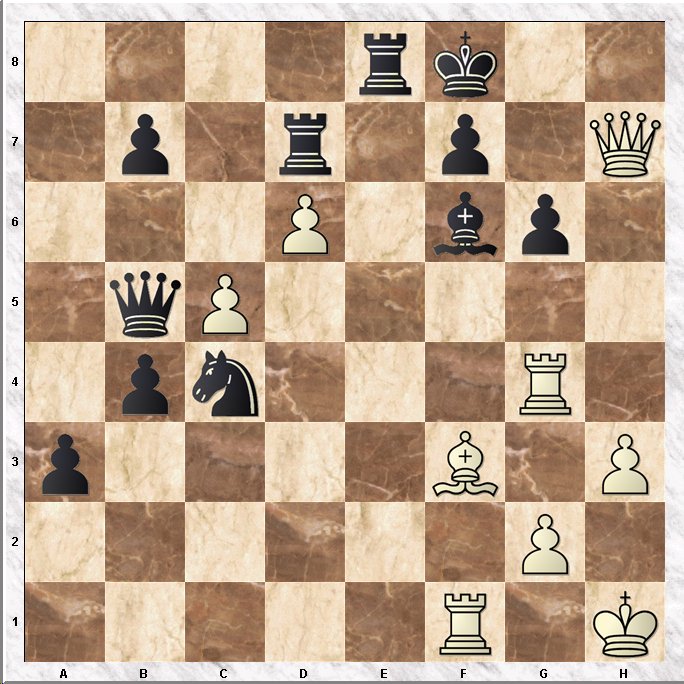
I will prefer the (already mentioned) move Lc6! I found this move when looking at the position and recognizing, that Black needs it’s bishop to prevent checkmate and the only way to attack him is to move with white bishop. Why not attack the queen at the same time. 1. Lc6 (..Qxc6 2. Rxf6 and mate on h8 will follow) Qxc5 will be the best but now just Lxd7 and big material and positional advantage ( e.g ..Qh5 3. Qxh5 gxh5 4. Rxc4)
I like 1 Bc6! This threatens the queen and gets the bishop out of the way for the pin of the black bishop on f6. If black takes the biship 1… Qxc6, then 2. Rxg6!! If 2… fxg6 then 3. Rxf6+. If not, then Qg8 mate cannot be stopped.
yes the mate can be prevented. white cant win this unless black makes a mistake. that isnt a forced mate its a mate because black played bad moves. once again somene mentions this being an easy problem. this is no easy problem!!!!
this is ridiculous. thinking you can get a mate in three from this position. if your very good you might be able to mate in say 15 moves. if your a very good player. to say oh this is an easy mate in three is freaking laughable. i dont think white can mate at all in this position if black plays the right moves.
Nicely put Vohaul! It looks like there are several ways to work this problem.
Along with many here, I like the look of Bc6, but I can’t quite finish it off. For example: 1. Bc6 QxBc6 2. RxBf6 Nxd6 (preventing immediate mate with Qh8, as suggested by anon at 11:32) 3. cxNd6 and now it seems necessary for black to sacrifice the queen to prevent mate, with 3…Qxd6, (Rxd6 leads to Qxf7#). So white is looking good, but it still needs work. If instead we try 2. Rxg6 as suggested by Yuly, we still seem to run into the problem of Nxd6. So: 1. Bc6 QxBc6 2. Rxg6 Nxd6 (instead of fxRg6) Now 3. RxBf6 and then perhaps the king could make a break for it with Ke7 and after 4. cxNd6+ Kd8
I reckon Bc6 is right, but I have missed something in my analysis, and I would love to know what! Good luck with it, my head hurts, so I’m taking a break…
1. Bc6…Qxc6 (or bxc6) 2. Rxf6…Nxd6 3. cxd6… which threatens 4. Qh8++ or 4. Qxf7++ (if the rook guarding the f-pawn moves).
I think black’s best response becomes 1…Qxc5, but I think (not sure) that comes at significant material loss. Those passed pawns on a3 and b4 tend to worry me, though, since a promoted pawn pretty much negates any material advantage. With my playing skills, I’d probably lose anyway.
As for Rxg6 (my first thought), what if black declines the sacrifice?
1. Rxg6…Nxd6 and now the white rook on f1 is threatened by the black queen, and Rg8+ doesn’t produce mate. The proposed 1. Be2 might solve this problem… I hadn’t thought about that move.
I’ve had another look, and this is the best I can come up with. It looks to me as though Rxg6 and Bc6 should both work, and I am not sure about Be2. So starting with Be2: 1. Be2 RxBe2 2. Rxg6 Nxd6 (fxRg6, 3.RxBf6 Rf7 4.QxRf7#) 3. Nxd6 cxNd6 4. Rxd6 RgxBf6 (RfxBf6, 5.Re1+) 5. RxRf6 Qh8+ 6. Ke7 QxRf6+ and though white has the upper hand for sure, the win is not clear cut.
Now Bc6 (still my favourite!) 1. Bc6 QxBc6 (alternatives such as Qxc5 don’t look so good, with the bishop picking up the rook on d7, and probably the one on e8 too). 2. RxBf6 (as I suggested earlier, Rxg6 here seems to run into problems after Nxd6, and then if 3. cxNd6, simply Rxd6, and the bishop is covered, and white is in trouble. After 3. RgxBf6 Qxc5 and white doesn’t have enough for a decisive attack)2…Nxd6 3. cxNd6 Qxd6 (the only option to prevent Qh8#) 4. RxQd6 RxRd6 Now white is clearly ahead, but has some work to do. Eliminating the threatening passers looks like a good way to start, and after Rxb4, there is nothing much black can do to prevent the a pawn dropping too.
So to the final variation, Rxg6 1. Rxg6 Nxd6 (fxRg6 loses to 2.Qh6+ [after Qxg6 as suggested early in the thread, Rf7 appears to spoil the party] 2…Rg7 3.Qh8+ Kf7 [Rg8 Qxf6#] 4. Bd5+ Re6 5.Qd8! and it’s complicated, but white will definitely get there!) 2. Rg8+ (not cxNd6 due to Qxf1+) Ke7 3. Re1+ Kd8 4. cxNd6 Rxd6 5. RxRe8+ QxRe8 6. Qxf7 QxRg8 7. QxQg8+ and white should be able to finish the job from here. But, there is another defense for black. Instead of 1…Nxd6, what about 1…Rxd6?! Then if 2. cxRd6 Nxd6 3. Be2 RxBe2 4. RgxBf6 Qd5 and it is difficult to see how to proceed for white. If instead 2. Rg8+ Ke7 3. Bh5 (not sure aboout this, but 3. dxRd6 still doesn’t seem to work as after 3…Nxd6 4. Re1+ Be5 white seems to be running out of steam) 3…Rxg8 (Rd2 or similar runs into 4.Qxf7+ Kd8, 5.RxRd8+ forcing QxRd8, then QxQd8+ and mate can’t be far away) 4. Qxf7+ Kd8 5. dxRd6 (at last!) Nxd6 (avoiding Qc7#) 6. QxBf6 and the knight will follow. However, with both queens still on the board, this will not be such a simple finish, and for that reason I favour the initial move Bc6.
I hope you can make out my annotation. Reading it back, it all sounds convincing enough, but I am not sure how much of it is right, so please go ahead, and bust some of these lines! And whoever said this was easy, really wasn’t looking that closely – don’t assume you’ve got it because it looks pretty 😉


Just got to work – I would play
1. Rxg6 fxg6
2. Bd5 Rg7
3. Rxf7
any good?
1. Rxg6 fxg6
2. Bd5 Rg7
3. Rxf7
make that
3.Rxf6
should have had a cup of tea first
😀
Lc6
the problem with 2 Bd5 is that it leaves the queen hanging to 2… Rxh7
so maybe 1. Rxg6 fxg6 2 Qxg6! threatening Qxf6 and Bd5
e.g. 2…. Rf7 3 Bd5 Qd7 4. Rxf6 +-
in fact black may have 1 Rg6 fg6 2 Qxg6 Rf7 3 Bd5 Ne5!?
so white should play 2 Qh6+ Rg7 3 Bd5 Nxd6 (what else?) 4 Rxf6+ Ke7 5 Qxg7+ Kd8 6 Rxd6+ +-
1. Rxg6 fxg6
2. Qh6+
if 2. … Rg7 then
3. Qh8+ Kf7
4. Bd5+ Rd6
5. Qd8! and Black is dropping too much material
I will prefer the (already mentioned) move Lc6!
I found this move when looking at the position and recognizing, that Black needs it’s bishop to prevent checkmate and the only way to attack him is to move with white bishop. Why not attack the queen at the same time.
1. Lc6 (..Qxc6 2. Rxf6 and mate on h8 will follow) Qxc5 will be the best but now just Lxd7 and big material and positional advantage ( e.g ..Qh5 3. Qxh5 gxh5 4. Rxc4)
What about Bd5 immediately, how will black answer?
2. Txf6, 2.Txg6 are both threatenings, can black defend against both?
Greetings,
Jochen
1.Bc6! +-
I like 1.Bc6 either. For example:
1.Bc6 Qxc6
2.Rxf6 Re1+
3.Kh2
And there are no more checks available for black.
This is also a nice variation that I spotted:
1.Bc6 Re1!? (some kind of desperado)
2.Rxe1 Qxc6
3.Re8+ Kxe8
4.Qg8#
Probably 1. … Qxc5 is the best move, but after 2.Bxd7 white should be winning (maybe some variations are required here)
Greetings from Holland
@ Jochen
I don’t think 1.Bd5 is very good, athough it looks very tempting on first sight.
1.Bd5 Nxd6!
This move takes a very important pawn, and at the same time the black queeen attakcs the rook on f1. On d6 the knight also defends f7.
2.Rxf6
This seems like the only reasonable move to me.
and now black plays:
2. … Re1+
3.Kh2 Qxc5
And now Black is theatening also something on g1, while everything is defended.
4.Qh8+ ke7
This seems like a win for black
I got one! Thanks Susan for putting up an easy problem (how about some help with the previous problem).
I like Be5
1 Bc6 bxc6 2 Rxf6 nxd6 where is the mate?
Bc6 Qxc5 Txg6
+-
NSP
I like Be2, attacking the knight. If Rxe2 then Rxg6 threatening mate. If fxg6 then Rxf6+ and mate is unavoidable.
I don’t see what Black has to avoid great material loss (or mate) after Be2.
1. Bc6 Qxc6 [or bxc6]
2. Rxg6
[threatening 3. Qg8 or 3. Rg8 checkmate]
2 … fxg6
3. Rxf6+ Rf7
4. Qxf7 checkmate
I like 1 Bc6! This threatens the queen and gets the bishop out of the way for the pin of the black bishop on f6. If black takes the biship 1… Qxc6, then 2. Rxg6!! If 2… fxg6 then 3. Rxf6+. If not, then Qg8 mate cannot be stopped.
Brad Hoehne
yes the mate can be prevented. white cant win this unless black makes a mistake. that isnt a forced mate its a mate because black played bad moves. once again somene mentions this being an easy problem. this is no easy problem!!!!
wolverine
1.Bc6
Loose the queen or mate in two..
this is ridiculous. thinking you can get a mate in three from this position. if your very good you might be able to mate in say 15 moves. if your a very good player. to say oh this is an easy mate in three is freaking laughable. i dont think white can mate at all in this position if black plays the right moves.
wolverine
Why not Rh4? I don’t know I’m just an average player.
finally my two pence:
a puzzle with no mate in the end after – let’s say – 5-7 moves… a puzzle with at least three winning moves
1.Rxg6 (the most impressive one)
1.Bc6 (the most sophisticated one)
1.Be2 (the most humble one)
is not a real puzzle at all. it is a teacher’s lesson – and by the way a great one.
thanks to GM Susan Polgar!
greetings
Nicely put Vohaul! It looks like there are several ways to work this problem.
Along with many here, I like the look of Bc6, but I can’t quite finish it off. For example:
1. Bc6 QxBc6
2. RxBf6 Nxd6 (preventing immediate mate with Qh8, as suggested by anon at 11:32)
3. cxNd6 and now it seems necessary for black to sacrifice the queen to prevent mate, with 3…Qxd6, (Rxd6 leads to Qxf7#). So white is looking good, but it still needs work.
If instead we try 2. Rxg6 as suggested by Yuly, we still seem to run into the problem of Nxd6. So:
1. Bc6 QxBc6
2. Rxg6 Nxd6 (instead of fxRg6)
Now
3. RxBf6 and then perhaps the king could make a break for it with Ke7
and after 4. cxNd6+ Kd8
I reckon Bc6 is right, but I have missed something in my analysis, and I would love to know what!
Good luck with it, my head hurts, so I’m taking a break…
Like some of the previous posters, I like Bc6.
1. Bc6…Qxc6 (or bxc6)
2. Rxf6…Nxd6
3. cxd6…
which threatens 4. Qh8++ or 4. Qxf7++ (if the rook guarding the f-pawn moves).
I think black’s best response becomes 1…Qxc5, but I think (not sure) that comes at significant material loss. Those passed pawns on a3 and b4 tend to worry me, though, since a promoted pawn pretty much negates any material advantage. With my playing skills, I’d probably lose anyway.
As for Rxg6 (my first thought), what if black declines the sacrifice?
1. Rxg6…Nxd6
and now the white rook on f1 is threatened by the black queen, and Rg8+ doesn’t produce mate. The proposed 1. Be2 might solve this problem… I hadn’t thought about that move.
-Bill
I’ve had another look, and this is the best I can come up with. It looks to me as though Rxg6 and Bc6 should both work, and I am not sure about Be2. So starting with Be2:
1. Be2 RxBe2
2. Rxg6 Nxd6 (fxRg6, 3.RxBf6 Rf7 4.QxRf7#)
3. Nxd6 cxNd6
4. Rxd6 RgxBf6 (RfxBf6, 5.Re1+)
5. RxRf6 Qh8+
6. Ke7 QxRf6+ and though white has the upper hand for sure, the win is not clear cut.
Now Bc6 (still my favourite!)
1. Bc6 QxBc6 (alternatives such as Qxc5 don’t look so good, with the bishop picking up the rook on d7, and probably the one on e8 too).
2. RxBf6 (as I suggested earlier, Rxg6 here seems to run into problems after Nxd6, and then if 3. cxNd6, simply Rxd6, and the bishop is covered, and white is in trouble. After 3. RgxBf6 Qxc5 and white doesn’t have enough for a decisive attack)2…Nxd6
3. cxNd6 Qxd6 (the only option to prevent Qh8#)
4. RxQd6 RxRd6
Now white is clearly ahead, but has some work to do. Eliminating the threatening passers looks like a good way to start, and after Rxb4, there is nothing much black can do to prevent the a pawn dropping too.
So to the final variation, Rxg6
1. Rxg6 Nxd6 (fxRg6 loses to 2.Qh6+ [after Qxg6 as suggested early in the thread, Rf7 appears to spoil the party] 2…Rg7 3.Qh8+ Kf7 [Rg8 Qxf6#] 4. Bd5+ Re6 5.Qd8! and it’s complicated, but white will definitely get there!)
2. Rg8+ (not cxNd6 due to Qxf1+) Ke7
3. Re1+ Kd8
4. cxNd6 Rxd6
5. RxRe8+ QxRe8
6. Qxf7 QxRg8
7. QxQg8+ and white should be able to finish the job from here.
But, there is another defense for black. Instead of 1…Nxd6, what about 1…Rxd6?! Then if
2. cxRd6 Nxd6
3. Be2 RxBe2
4. RgxBf6 Qd5 and it is difficult to see how to proceed for white. If instead
2. Rg8+ Ke7
3. Bh5 (not sure aboout this, but 3. dxRd6 still doesn’t seem to work as after 3…Nxd6 4. Re1+ Be5 white seems to be running out of steam) 3…Rxg8 (Rd2 or similar runs into 4.Qxf7+ Kd8, 5.RxRd8+ forcing QxRd8, then QxQd8+ and mate can’t be far away)
4. Qxf7+ Kd8
5. dxRd6 (at last!) Nxd6 (avoiding Qc7#)
6. QxBf6 and the knight will follow. However, with both queens still on the board, this will not be such a simple finish, and for that reason I favour the initial move Bc6.
I hope you can make out my annotation. Reading it back, it all sounds convincing enough, but I am not sure how much of it is right, so please go ahead, and bust some of these lines!
And whoever said this was easy, really wasn’t looking that closely – don’t assume you’ve got it because it looks pretty 😉
Nice training exercise thanks Susan.