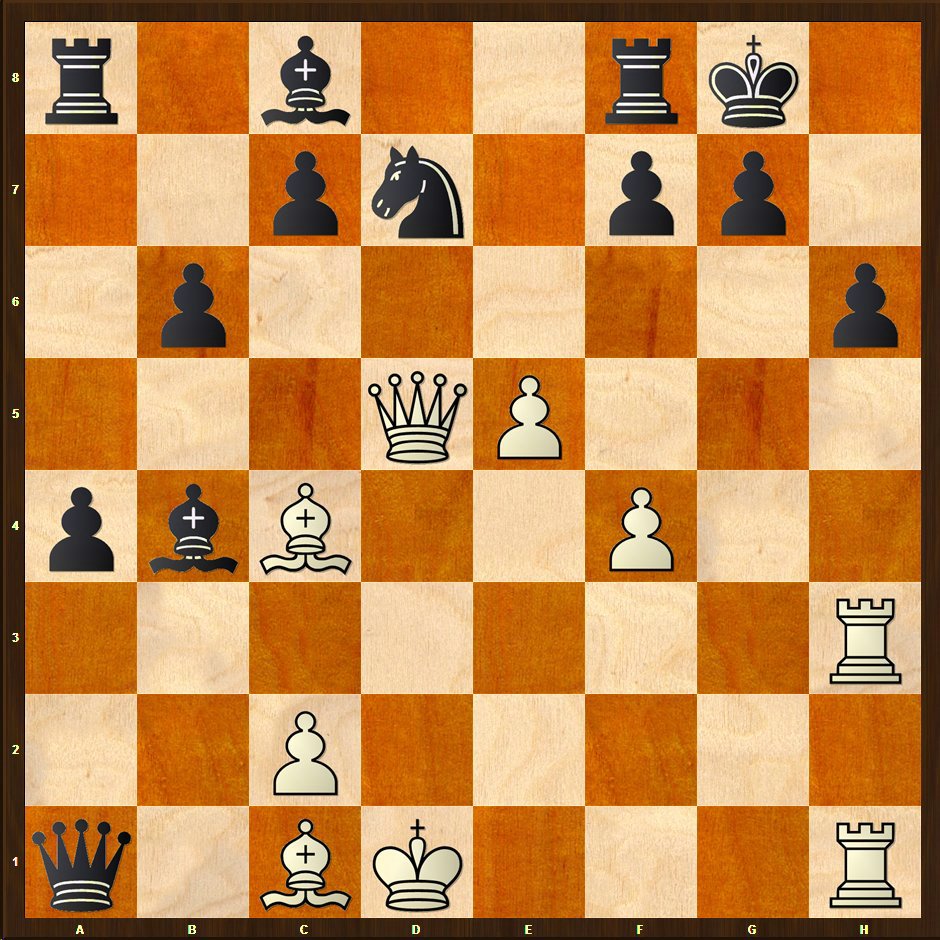
White to move. Does White have an attack or has White sacrificed too much? How should White proceed?
Chess Daily News from Susan Polgar


White to move. Does White have an attack or has White sacrificed too much? How should White proceed?
“Does White have an attack or has White sacrificed too much?”
Nah, hasn’t sacrificed enough is more like it. Mate in 5 or 6 moves here, I think:
1. Rh6! gh6 (g6 and g5 shorter #s)
2. Qg2 Kh7 (Kh8 3.Rh6#)
3. Bd3 f5
4. ef6 Kh8
5. Rh6#
Moves like Qc1 at move 1 might delay things a move or two, but I don’t see them saving black from mate.
In the initial position, white is down a knight and 3 pawns. The only option left after sacrificing so much material is to go all out for an attack and sacrifice more material with
1.Rxh6 threatening 2.Rh8# and this forces black to accept this sacrifice with
1…gxh6 (1…g6 fails to 2.Rh8+ and 3.R1h7#)
2.Qg2+ Kh7 (2…Kh8 3.Rxh6#)
3.Be3+ f5
4.exf5+ e.p. Kh8
5.Rxh6# (or 5.Qg7#)
Black could delay mate by sacrificing his queen on the first move but that does not allow black to avoid mate.
1…Qxc1+
2.Kxc1 Ba3+
3.Kb1/d1 and black still has to face the same problems
1…Qe4+
2.Qxe4 and now white uses the g1 square for his queen instead of g2.
The black pieces are simply too congested and disorganized to put up a real defence and it will take several moves to unravel his forces – time which white does not give him.
Conversely, every white piece seems to serve a purpose.
The queen coordinating with the light square bishop to attack f7 and has the flexibility to access the g file.
The light square bishop backing up the queen and pinning the f7 pawn to prevent the king from fleeing and also having the flexibility to get to the sensitive b1-h7 diagonal.
The 2 rooks doubled on the h file attacking the weak kingside.
The dark square bishop screening the king from the black queen.
The e5 pawn screening the black queen from protecting the h8 square with 1…g6. It also cuts off the f6 escape square for the black king.
The f4 pawn protecting and backing up the e5 pawn.
The c2 pawn is the only white piece not really serving a purpose (it would have been useful if there was not a black pawn on a4) but I suppose that would be too much to ask from a real game as opposed to a composed puzzle.
1.Rxh6 gxh6
2.Qg2+ Kh7
3.Bd3+ f5
4.exf6 e.p. Kh8
5.Rxh6# but it is not mate in 5.some delaying moves like … Qxc1+ etc. are not taken into account.
Of course not, White wins with:
1. Rxh6!! gxh6 (else Rh8+#)
2. Qg2+ Kh7 (else Rxh6+#)
3. Bd3+ f5
4. exf6+! Kh8
5. Qg7+#
White has enough for a mate!
1.Rxh6 gxh6 forced else mate by Rh8+ and R1h7#
2.Rxh6 Kg7 forced else mate by Qg2#
3.Qg2+! Kxh6 forced only move
4.Qg5+ Kh7 forced only move
5.Bd3+ Kh8
6.Qh5+ Kg7
7.Qh7#
If
5….. f5
6.exf6+ Kh8
7.Qg7#
Interposing Qxc8+ and Ba3 does not help change the outcome!
Moving rook does not help due to Qxf7
Interposing Knight at f6 doesnot help too!
Harry
Rh6 gh6 (don’t see what else)
Qg2 Kh7 (Kh8 Rh6#)
Bd3 f5
ef6 Kh8
Rh6#
I was revisiting previous studies.I think the study of April 1,2014 can be modified with the stalemate theme in mind as 1K6/1P6/8/8/4P2b/3k1P2/1p6/7B w – – 0 1 .i hope it is correct but one can never be sure.I used today’s forum to catch your attention as otherwise nobody would go back to the archives.
I think most people found the solution but I’d point out you have to be careful to also consider 1…g5 as a reply by Black, creating an additional flight square for the King so that it isn’t mate after Rh8+ Kg7; R(1)h7+. White probably still wins but White probably has better than the immediate Rook check:
1) Rxh6 g5
2) Qd3
With K still on g8, the f-pawn is still pinned, preventing something like …f7-f5. White now threatens mate again with the two-Rook invasion but also Qh7. If 2)…Nf6, 3)Rh8+ Kg7, 4)R(1)h7+ Nxh7(forced), 5)Qxh7#
Even seeing the correct initial move, it’s easy to overlook potential defenses in the position. I myself made the mistake of thinking the solution was
1) Rxh6 gxh6
2) Qxg2+ kh7 and instead of Bd3, I thought
3) Qg5 was the quick solution (the h-pawn is pinned and Rxh6 mate is threatened) but it allows complications after 3)… Qd4+
Also, one commenter thought 2) Rxh6 threatening Qg2 was the solution but that may give Black time to sac his Knight to create complications
2)Rxh6?! Nxe5 I haven’t looked at this thoroughly but this could be a problem for White
A3) Qg2+ Bg4+!?
4) Be2 and either …Qd4+ or …R(a)d8+
B3) fxe5 Bg4+
4)Be2 R(a)d8 pins the Queen
– Craigaroo
SG Bhat,
As it turns out my idea for “fixing” the April 1 problem was not original at all as I eventually found exactly that position was the one intended for the April 1 study. Yours, however appears to be original as far as I can tell.
Craigaroo,
1. Rh6 g5
2. Rg6 is mate.
The f7 pawn is pinned.
Yancey Ward –
Very nice. 2. Rg6 is indeed mate. This is also true (!) after 1…g6 as well as 1… g5. No one (!) caught that in their comments on 1…g6.
– Craigaroo
Craigaroo,
I caught it in the first comment in the parenthetical note following the first move.
Yancey Ward:
No credit given for not giving the move to a mate-in-one! Besides others seemed to have missed it
-Craigaroo