
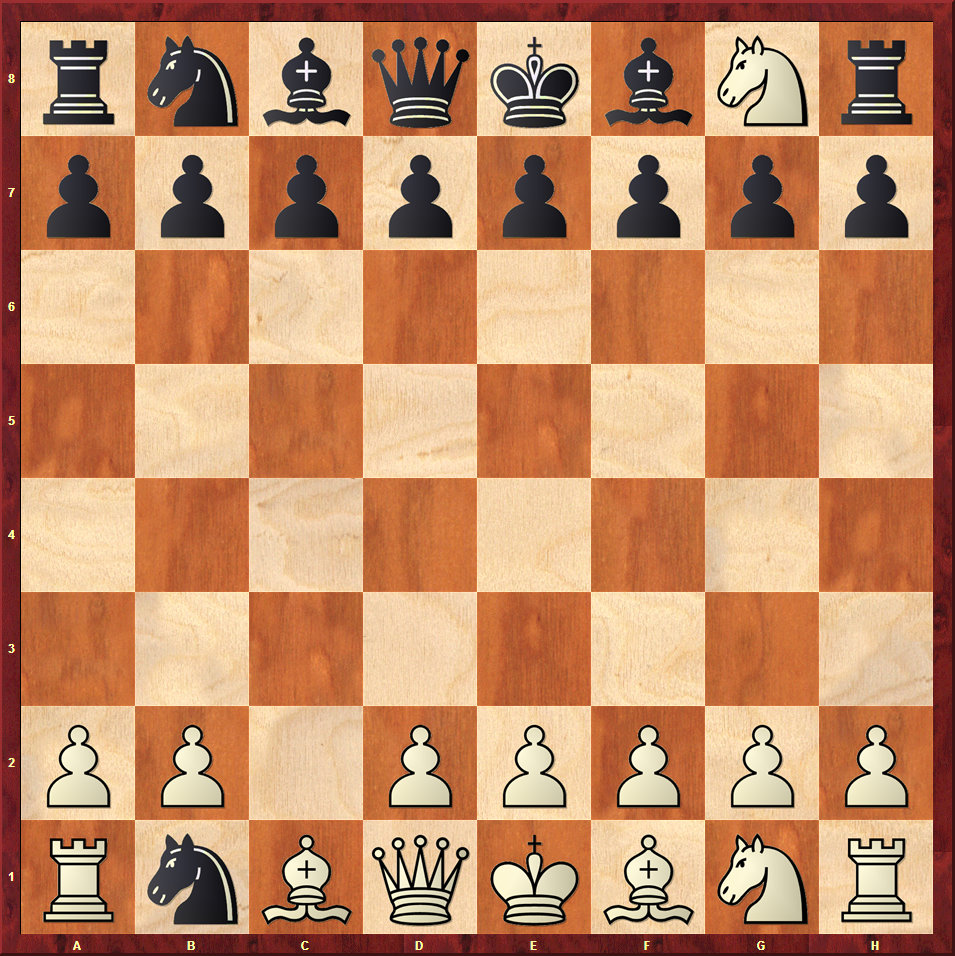
This puzzle is created by my long time friend GM Pal Benko. It is the third one of the Holiday series.
The first part of the question is how do you reach this position in 4.5 moves ? The second part of the question is there is one more pawn missing. Can you guess which pawn it is?
(5 white moves , 4 Black moves) Enjoy!

Chess Daily News from Susan Polgar
Shenanigans! Can’t be done! 😛
1.Nc3 Nf6
2.Ne4 Nd5
3.c3 Nxc3
4.Nf6 Nb1
5.Ng8
1.Nc3 Nf6
2.Ne4 Nd5
3.c3 Nxc3
4.Nf6 Nb1
5.Ng8
I suggest that we change coulours to make the problem easier. And dont be so negative about Benkö’s problems.
So you knew Pål Benkö (and maybe still does). He was often in sweden and played
with his friend Gideon Stålberg, so i heard a lot of him when i was a child.
Susan i must confess tahat i made a terrible misstake in a email last week.
Instead of putting a link to your “Brilliant Brain” i did click in a link to National Geographics “Brilliant Beasts”. I am really sorry for that.
Well… First I tried to figure out the white sequence of his 5 moves.
A pawn move and 4 knight moves needed to be made.
The Knight had to come from b1 to g8, so b1-c3-e4-f6-g8.
Black needs to move his knight 4 times to reach b1. g8-f6-d5-c3-b1. The pawn needs to drop on the way, the only square that can be done is c3, so the pawn needs to be there…. That made up the following “opening”.
1. Nc3, Nf6
2. Ne4, Nd5
3. c3, Nxc3
4. Nf6, Nb1
5. Ng8
🙂
1. nc3 nf6
2. nd5 ne4
3. c3 nxc3
4. nf6 nb1
5. ng8
I’ve been going over this for a while, and I suspect that either:
A) the position has been improperly set up or;
B) the solution is very gimmicky and will annoy rather than amaze.
Or I could just be dense…
Brilliant idea! 🙂
1. Nc3 Nf6
2. Ne4 Nd5
3. c3 Nxc3
4. Nf6 Nb1
5. Ng8
1.Nc3 Nf6 2.Ne4 Nd5 3.c3 Nc3 4.Nf6 Nb8 5.Ng8
This one is either impossible, or has some amazing trick. Natural looking is:
1. Nc3 Nf6
2. Ne4 Nd5
3. c3 Nxc3
4. Nf6 Nb1
5. Ng8
but this fails as 4.Nf6+ is check, so black is obliged to capture exf6 or gxf6. So, white knight comes to g8 via h6, but I can’t see how arrives from b1 ro h6 in only 3 moves.
1. Nc3 Nf6
2. Nd5 Ne4
3. c3 Nxc3
4. Nf6 Nb1
5. Ng8
can’t be done?
This puzzle cannot be solved. However, if you remove the black pawn on e7, there is a unique solution.
This is a terrible problem. I cannot even get my knight to g8 in less than 6 moves, because Nf6 gives check. This puzzle will puzzle me for the rest of the day! Will anyone get the sollution, please?!
This looks impossible becauce whites Ng8 would be preceeded by the check Nf6+ and black would be enforced to take it. Coming via Nh6 takes longer time…
its only possible if check on black king can be ignored
1. Nc3 Nf6
2. Ne4 Nd5
3. c3 Nxc3
4. Nf6 Nb1
5, Ng8
This was easy…
1. Nc3 Nf6
2. Ne4 Nd5
3. c3 Nxc3
4. Nf6 Nb1
5. Ng8
I love these puzzles. They frustrate you with an apparent impossibility and then delight you with the surprise solution. I thought I knew all the tricks for this type of puzzle, but I don’t know this one.
I don’t see a solution, period. I can’t get a white knight to g8 from b1 in less than 6 moves without having to ignore a check from f6, and white must play at least one pawn move, or I am forced to ignore a check from c2, as well. If there is a solution to this, I am dying to see it.
The trick to these puzzle (since I’ve read in here that is deem impossible) might be to figure out how the position started. It might have not started with a “brand” new position.
Since most of the people i’ve read try to guess a new set of rules for making this puzzle ‘solvable’, i’ll give mine:
if the white knight can make move like b5-h6, as if in a ‘snake’ game, then the solution is easy! 🙂
I can’t find a solution.
henryk must be right. If White starts giving pawn odds but has two moves to start it can be done!
This puzzle is impossible unless there are some new rules about chess that just came out!
Black’s 4 moves are easy.
Nf6 Nd5 (or Ne4) Nxc3 and finally Nb1
White must spend one of his 5 half moves playing c3 so that leaves 4 half moves.
The important question is which square did was the white knight on before going to g8.
it could not have come from e7 because the black pawn is on that square.And it could not have come from f6 because that would have checked the black king and with the pawns on their original squares the black queen or bishop had to be on their original squares. So that leaves h6. White needs 5 half moves to reach h6 and 1 more to land on g8. So white needs a total of 7 half moves for this to work out.
I know Susan would not give an impossible puzzle just to waste our time but there does not seem to be a solution. So the only other possibility is that the puzzle was misprinted but i really can not think of any misprint that would result in a solution.
If there is a solution i would be very happy to see it.
All of the people who think they’ve got it (and claim it was easy) simply miss that 4-Nf6 is check, forcing black to capture the knight with a pawn.
I maintain that Susan made some honest mistake in setting up the position. As it is, there is no credible solution, unless the game is being played under the rules of some obscure chess variant. Which would be a big disappointment.
This one is again simple though I like the final position:
1. Nc3 Nf6 2. Nd5 Ne4 3. c3 Nxc3 4. Nf6 Nb1 5. Ng8 q.e.d
It seems however, that 2. Ne4 Nd5 amounts to the same and this would be a cook, or isn’t it?
I think that it is a legal position arrived at by way of an illegal move. If white did not notice that Nf6 was check, and Black did not notice that he was in check and instead moved his Knight, then the position can be reached – with no one calling the illegal move.
I’d like to add my indignant voice to the chorus of people who point out that 4… Nb1 is an illegal move because the black king is in check!
I’m confused. This puzzle seemed impossible at first, with several posts pointing this out. Then the post went away for awhile on Susan’s main page here, but was still discoverable through a search for it, where a number of solutions were posted – each one apparently overlooking (or ignoring) that 4. Nf6 is a checking move. Now the post is back, complete with all of those posts, but without the checking problem addressed…
Unless…
CFDinCLE is correct, but that would be greatly disappointing.
Oh, wait… no one ever said what game we’re playing. If it were, say, BUGHOUSE, it’d go like this:
1. Nc3 Nf6
2. Nd5 Nxd5
3. c3 Nxc3
4. (“Hey, I need a knight…) Plonks down Knight on h6 Nb1
5. Nf8.
Brad Hoehne
Hi Susan. Could you please post either a solution or correction to this problem?
I like many others on here cannot solve it and in fact believe I can prove it cannot be solved under the normnal rules of chess.
Technically, checks can be ignored, but your opponent can take your king on his next move and win the game. However, I suppose one could ignore that, too.
Yancey is right, checks can be ignore… this is a puzzle on which it was just asking how it was arrived on that position, but unless Susan will post a correction or a solution, it will be indeed a disappointment to many of us.
Yes, can’t understand why Susan hasn’t quipped in. Maybe the post just got old.
Yancey? dominic? I know all readers and contributors to this blog are frustrated with this one, but “Checks can be ignored”? FIDE article 3.9 in part reads: “No piece can be moved that will either expose the king of the same colour to check or leave that king in check.”
If the rules can be ignored, if that’s what it takes to solve this puzzle, then I offer another solution from the notorious Topalov-Kramnik match.
1. Nc3 Nf6
2. Nd5 Nxd5
3. c3 Nxc3
4. Nh6* Nb1
5. Ng8
*At this point, Topalov placed the captured knight back on the board while Kramnik was in the bathroom. When Kramnik returned, he looked at the board, paused as if confused, and asked the arbitrator if the position was correct. The arbitrator said that he had not seen anything suspicious. Kramnik then said, “Well at least I’m not in check,” and play resumed.
True story.
Do not blame Susan for this puzzle, blame Benkö!
Jcheyne,
I just know over-the-board rules- ignore a check, get your king decapitated and end of game.
To the others,
Consider that the solution is to know that the problem can’t be solved.
Actually, this one is quite easy. You’re all missing the point raised by part (b)
1. Nc3 Nf6
2. Nd5 Ne4
3. c3 N:c3
4. N:e7 Nb1
5. Ng8
And the pawn that should be missing id black’s e-pawn.
CraigB, people weren’t missing the point raised by (b). Rather, part (b) was added after all those comments were made.
Something is rotten in the state of Denmark. The way that this problem is articulated is flawed. Usually Part a of a problem stands independently by itself. Here, part b is a must condition for part a to be solved. Therefore the amendment is still misleading.
I thought it was Christmas, not Carnival! I also didn’t notice the points (a) and (b) and i suspect they were added after…
easy