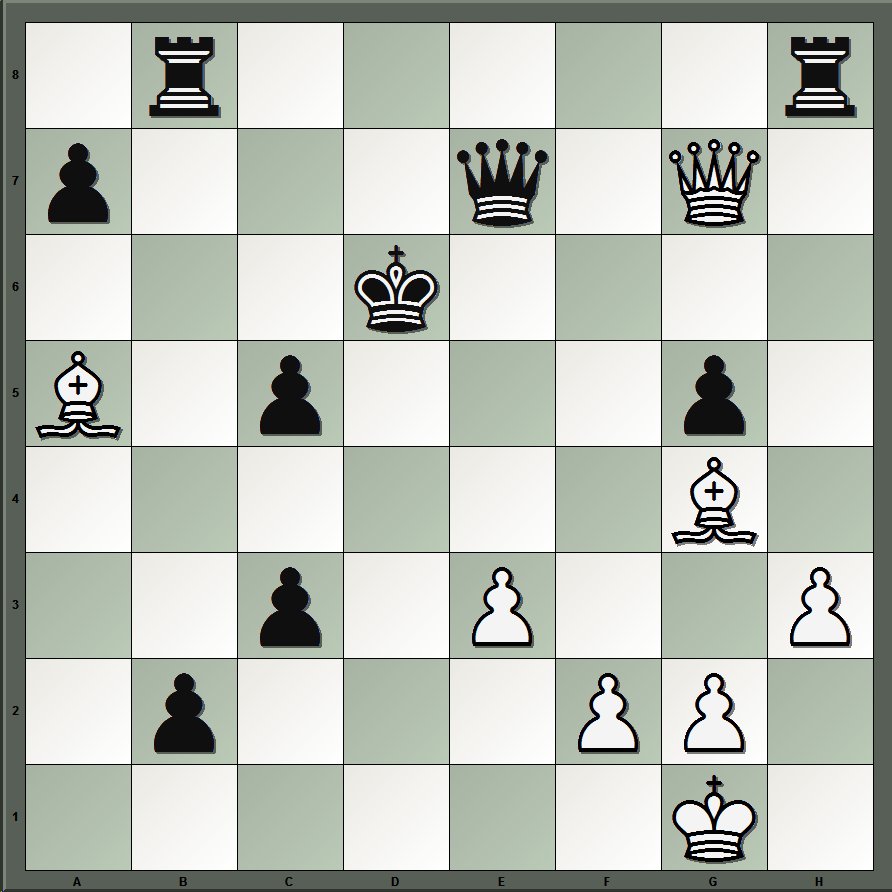
White to move. How should White proceed?
1r5r/p3q1Q1/3k4/B1p3p1/6B1/2p1P2P/1p3PP1/6K1 w – – 0 1

Chess Daily News from Susan Polgar

White to move. How should White proceed?
1r5r/p3q1Q1/3k4/B1p3p1/6B1/2p1P2P/1p3PP1/6K1 w – – 0 1
Bc7 1-0
Bc7+ looks like a good start.
The deviation 1-Bc7 wins the house 1- …Qxc7 (Kxc7 is of course hopeless) 2- Qf6+ Kd5 3 Qd5#
Fernando
Qg6+
i think we need to play 1. Bc7+. Now if
1. … Kxc7, then
2. Qxe7+ Kc6
3. Qd7+ Kb6
4. Bf5 a5
5. Bb8: Queen controls the situation and will pick up the dangerous pawns in time, checking the king when needed.
If 1. … Qxc7, then obviously
2. Qf6+ Kd5
3. Qe6#
i’m not sure, how to proceed, if the king tries to run to the queenside via c6-b5 or d5-c4-b4/5. How to block these squares?
greets, jan
Qg6+
1. Qg6+ Kd5 (Qe6 2. Qe6#)
2. Qd3+ Kc6
3. Bf3#
2. … Ke5 3. Bc3#
I think, Qg6+
I do see that after Qg6+, black king has to move to the 5th rank, further separating it from the Queen. After that, while there are clear threats, I don’t see a very clear line.
Im 14:00AM sorry
I did not watch B2
1 Qg6+ Kd5
2 Qd3+ Kc6
3 Bf3#
Funny position:
What’s about 1. Qg6+?
1. Qg6+ 1. Kd5
2. Qd3+ 2. Kc6
3. Bf3+ 3. Qe4 (here the latest it appears that the black position is weak …)
4. Bxe4 mate
or:
2. Qd3+ 2. Ke5
3. Bxc3 mate
Well, the 1st idea that pops up, is that it would be nice to be able to deflect the Black queen by playing Bc7, in order to give mate with the White queen on e6. That’s easy to do after:
1. Qg6+ Ke5
2. Bc7+? Qxc7?
3. Qe6#
but Black can play 2… Kd5, after which I don’t see anything strong for White. So much for 2. Bc7+, at least after 1… Ke5. But 1. Qg6+ still looks like a good try.
Let’s try this again:
1. Qg6+ Ke5
2. Qf5+ Kd6
3. Qd3+ Kc6 [ Ke5 4. Bxc3# ]
4. Bf3+ and it’s just about over.
Black can also try 1… Kd5:
1. Qg6+ Kd5
2. Qd3+ Ke5 [ Kc6 3. Bf3+ ]
3. Bxc3#
OK, that does it. But darn, I never got a chance to play Bc7.
Hmm, I was thinking Qg6+, it leads to mate i think.
Note for Anonymous (Sept 8 3:50 CDT):
After 1. Bc7+?, Black does better to play 1… Kc6, since then Black can promote the b-pawn with check:
2. Qxe7 b1=Q+
3. Kh2 and since White is threatening Qd7+, Black would probably play
3… Qd3
and it’s still a real fight, although I believe Black has the advantage.
The fact that the king is barred from the seventh rank by the bishops leads me to want to draw the king away from his sole defender by driving him into white territory:
1. Qg6
And black has 4 replies- Qe6, Qf6, Kd5 and Ke5. I will take the latter two only since they seem to be the only important ones as the first two just drop the queen with check and black must still play Kd5 or Ke5 subsequently:
1. …..Kd5
2. Bf3 Kc4 (Ke5 3.Bc3#;Qe4 below)
3. Qa6 Rb5 (Kb3 is below)
4. Be2 Kd5 (Kb3 is below)
And, here, the best continuation I can find for white is to take the rook. White is still threatening the black king (who is still badly exposed), has b1 queening square covered, and is threatening to win the connected passers with Bc3 and Qb2 or Bb2 Cont.:
5. Qb5 Rh4 (covers c4- best IMO)
6. Bf3 Ke6 (Re4 7.Qd3+-)
7. Qc6 Kf7
8. Bd5 Kg7 (Kf8 is below)
9. Bc3 Kh7 (Rd4 10.Bb2+-)
And, here, I think white wins with Bb2 rather easily, but Ba2, continuing the attack and covering the b1 square seems a bit stronger to me, especially after I solved the problem with move 12 below:
10.Ba2 Rb4 (what else?)
11.Bb1 Kg8
And, here, it took me a while to find the most powerful line for white- it wasn’t easy for me to see that the black queen has only two squares to move to:
12.Bf6!
Drives the black queen from her best defensive square:
12. ….Qf7 (Qf8 below)
13.Qc8 Qf8
14.Qe6 Qf7
15.Bh7 Kh7(Kf8 16.Qd6 Ke8 17.Qd8#)
16.Qf7 Kh6
17.Qg7 Kh5
18.Qg5# At move 12, black does no better with
12. ….Qf8
13.Qe6 Qf7
14.Bh7 and the mate follows like before from this position. At move 8, black still loses after
8. …..Kf8
9. Qc8 Qe8 (Kg7 10.Bc3 as before)
10.Qf5 Kg7 (Ke7 11.Qe6 Kf8 12.Qf6)
11.Bc3 Kh6
12.Qf6 Kh5 (Qg6 13.Qf8 Kh5 14.Qh8)
13.Bf7 Qf7
14.Qf7 Kh6
15.Qg7 Kh5
16.Qh7# At move 4, black does no better with
4. …..Kb3
5. Qb5 Kc2 (Ka2 and Ka3 follow)
6. Qa4 Kb1 (otherwise Qd1#)
7. Qd1 Ka2
8. Bc4 Ka3
9. Qb3# Or, at move 5 immediately above
5. …..Ka2
6. Qa4 Kb1
7. Qd1 with mate like above, or
5. …..Ka3
6. Bc4! Rb8 (everything is # in 2?)
7. Bb4 cb4
8. Qa5# At move 3 above, black does no better with
3. …..Kb3
4. Bd5 Kc2 (c4 5.Qc4 Kc2 6.Qc3)
5. Qe2 Kc1 (Kb1 6.Qd1#)
6. Qe1 Kc2
7. Qc3 Kb1
8. Qe1 Kc2
9. Qd2 Kb1
10.Qd1# At move 2 above, black does no better with
2. …..Qe4
3. Qe4 Kd6
4. Qg6! Ke7 (Kd7 5.Qf7 Kd6 6.Bc7#)
5. Qg7 Ke6 (Kd6 6.Qf6 Kd7 7.Bc6)
6. Bg4 Kd6 (Kd5 7.Qd7 # in 1)
7. Qf6 Kd5
8. Qe6#
So, the last question to address is the effect of black’s second option at his first move, but it is clearly a shorter line even at a cursory glance:
1. …..Ke5
2. Qf5 Kd6
3. Qd3 Kc6 (Ke5 4.Bc3#)
4. Bf3 Qe4
5. Be4#
So, this line looks winning in all variations I can see. I have to admit, I would have great difficulty playing this out over the board in any efficient manner-I can only analyze this deeply with access to a board and pieces, but 1.Qg6 suggests itself easily due to the fact that the king is barred from the 7th rank.
1. Qg6+ Kd5 2. Qd3+ Kc6 3. Bf3+ Qe4 4. Bxe4# 1-0
As the hint said, bishop power!
As pointed out Bc7 is attractive but has real problems.
On the other hand Qg6+ leads to a quick mate, with 2 elegant variations.
LOL!!!
Can’t believe I missed the shortest line after 1. …Kd5. I looked at that position for 15 minutes, and I even looked at 2.Qd3, too.
Yikes!!