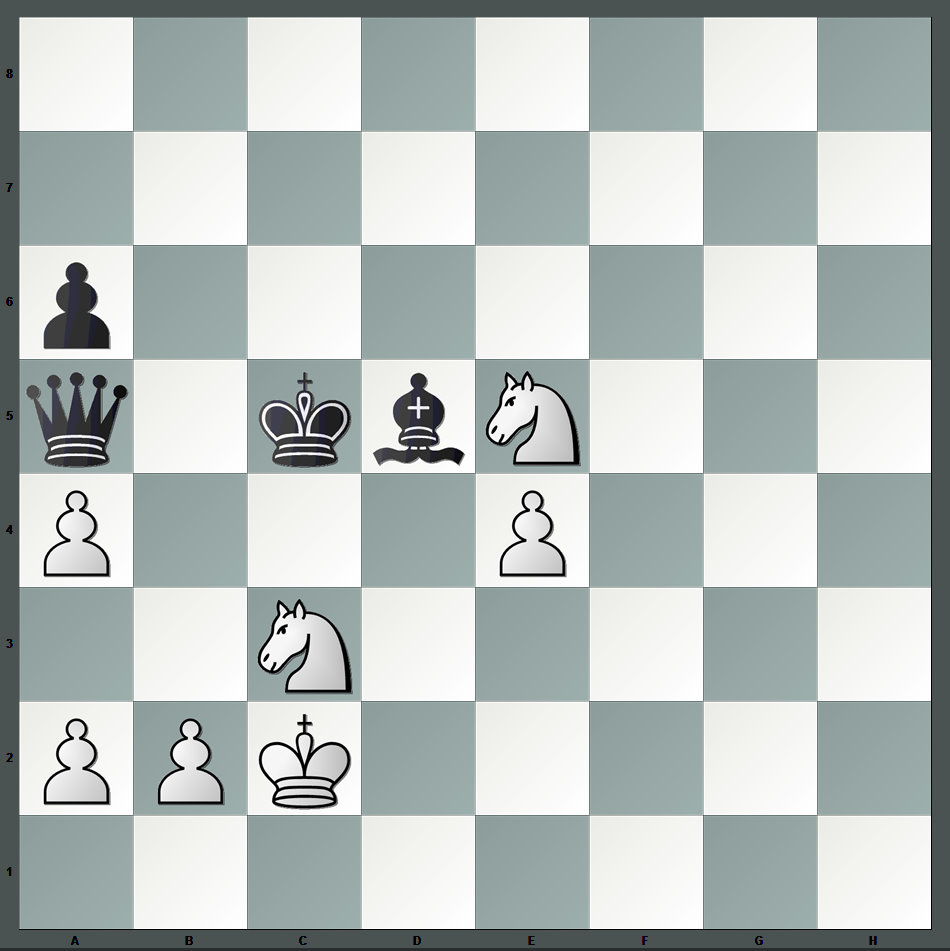
White to move. How should white proceed?
8/8/p7/q1kbN3/P3P3/2N5/PPK5/8 w – – 0 1
Horwitz
Chess Daily News from Susan Polgar


White to move. How should white proceed?
8/8/p7/q1kbN3/P3P3/2N5/PPK5/8 w – – 0 1
Horwitz
We’ve seen this puzzle before, haven’t we?
Almost without thinking, I would play
1. b4 Kb4 (Qb4 2.Nd3 Kc4 3.Nb4+-)
2. Nd5
Now, we branch off into what look like losing moves for black:
2. …..Ka3
3. Nc4 Ka4
4. Na5+-
Or
2. …..Ka4
3. Nc3! Ka3 (Kb4 4.Nc6+-)
4. Nc4+-
Or
2. …..Kc5 (the trickiest)
3. Nb6!!
I am now sure I have seen this puzzle before, maybe not here (though I think so), but somewhere. I found this move far too quickly for it not be something I have seen before. This position is an amazing example of zugzwang- every move loses to a knight fork, or drops the queen directly at a4, c3, or d2:
3. …..Qb6
4. Nd7 Kc6
5. Nb6 Kb6
6. Kc3 and this is an easy win for white.
Or
3. …..Qb4
4. Nd3 Kb6
5. Nb4+-
Or
3. …..Qe1
4. Nd3+-
Or
3. …..Kb6/d6
4. Nc4+-
Or
3. …..Kb4/d4
4. Nc6+-
b4 kb4, nd5 kc5, nb6 qb6, nd7
b4+
1b4+Kxp 2nxb+ k+p 3nc3+ $knight fork
3kc5 nb6 zugzwang
Historical note:
Horwitz was a pioneer for modern studies with his friend and co-composer Kling, and has made beautiful studies and theoretical breakthroughs in difficult endings such as wrong Bishop and rook Pawn versus rook pawn.
This study shows that those time-consuming and nerve-wasting researches didn’t alter fantasy in the endgame.
Complete source: Horwitz, The Westminster Club Papers, 1870, #015
version: Neue Berliner Schachzeitung/12 1870.
Congratulations for the complete solution certainly already delivered by the unavoidable Yancey Ward!
*******
WARNING SPOILER for the other solvers:
A real fork festival, as one can expect with two Knights versus a Queen.
One long variation after the key, and many short ones after the superb third move, a little surprizing because at that time (1870), the studies were check-check-check and skewer, or check-check-check and mate…
NxD5, Qc8 (avoiding pins). b2-b4 – and I think wherever King goes, there’s a knight pin.
Beautiful!
The 2 first moves taking the bishop are rather easy to see, but in one line the third move winning the queen is certainly unexpected!
1. b4+ Kxb4 (Qxb4 Nd3+ wins queen)
2. Nxd5+
Removing the bishop creates nice knight fields on c4 and c6.
A)
2. … Kxa4
3. Nc3+
A1)
3. … Ka3
4. Nc4
A2)
3. … Kb4
4. Nc6+
B)
2. … Kc5
I suppose black feels pretty safe here, but
3. Nb6!!
This knight sack is also zugzwang!
And it locks up the queen, and it protects a4. A very rare move!
B1)
3. … Qxb6
4. Nd7+
B2)
3. … Qb4
4. Nd3+
B3)
3. … Kxb6
4. Nc4+
B4)
3. … Kd6
4. Nc4+
B5)
3. … Kb4
4. Nc6+
B6)
3. … Kc4
4. Nc6+
B7)
3. … Qe1
4. Nd3+
p-b4 wins, but it’s not clear to me that pxb doesn’t also win
Hmmm… How about:
1. b4+
Only reasonable move for Black would be 1. .. Qxb4, which is answered by 2. Nd3+
So, White wins Black’s Queen. Enough to win?
Nxd5 puts black in a zugzwang . But The interesting line is
Nxd5 Qd8
b4+
Nxd4 black cannot hide anywhere (zugzwang). The interesting line is
Nxd4 Qd8
b4+
P. Anandh
Hi Susan Polgar,
Very good – every dive increases the depth of this chess puzzle,I am trying hard to find transfix but it gets one move away from it,which means those line of approach will not lead to transfix in favor of White piece.
Let me show here,one out of few combination,how narrowly Black piece eludes a transfix from White piece.
1.b4+ K*b4
2.N*Bd4+ K*a4
3.Nc4 Qe1/Qc5
4.Nc3+ Kb4 [ There ends the transfix trying by White piece for this combination ]
In the above example,in third move if Black piece queen moves other than “Qe1/Qc5” then its a cake walk for white piece – that leads to mate in next two moves to the maximum.
Am I terribly missing the combination for white piece to win the game ? Well,that combination may be pawn maneuvering.
Brainy minds of this blog,I am awaiting to know the White piece wining combination for this puzzle.
Hope you guys come out with it.
By
Venky [ India – Chennai ]
1. b4 Kb4
2. Nd5 Kc5
3. Nb6!
Cute!
Davey,
Cortex would have pointed out a cook or bust like that, I am sure. However, it probably doesn’t lose simply by material weight as 2N+4P vs Q+P is probably drawish most of the time, and almost certainly in this case.
The other alternative mentioned by Anandh should lose for white:
1. Nd5 Qd8??
2. b4! followed by a knight fork. However, black need not cooperate:
1. …..Qa4!
2. Kc1
Here, Kb1 is mate after Qd1, and Kd3/d1 loses a knight after Qd4+, and Kd2 is much like the line that follows. Continuing:
2. …..Qe4
And white will lose at least one fo the knights on black’s next move, and the game certainly.
Hi Yancey, how about something like
1. exd5, Qd8
2. b4+, Kb6
3. a5+, Kc7
4. Nc6, Qh4
5. Kb3, Qf4
6. a4, Kc8
7. b5, …
isn’t white winning?!
Davey,
I looked at the final position in your line. How does white make progress from there? It might continue:
7. …..ab5
8. ab5 Kc7
And, now, white needs to find a way to get the king involved. Pushing a pawn at move 9- either a6 or b6 doesn’t do much (on a6 black blockades with Kb6, and on b6 with Kb7). All I can really see here is the move Nb4:
9. Nb4 Qd4
Attacking the knight at c3 and threatening a check from d1 if white tries moving this knight. The main problem is the inability to protect everything from the queen while trying to push forward against the black king holding up the pawns. I would suggest you plug this into a high powered chess engine and let us know. In any case, I wouldn’t play 1. …Qd8 in that line you mentioned- Qc7 looks better to me since it is more active (attacks the knight at e5 and has a path to the second rank from c7):
1. ed5 Qc7
2. Nd3 Kc4 and now white can’t play b3 without losing a knight to Kd4, and black is going to harass white on the second rank, now. I can’t say for sure that white doesn’t have much better move than 2.Nd3, but I don’t see anything that leaps out at me. I still say draw with best play.
@Davey
Your line is nothing more (but nothing less) than a technical try. Only a strong player or an engine can hold the Endgame for Black, but, fortunately, he can.
Let’s see
1.exd5 Qd8
2.b4+ Kb6
3.a5+ Kc7
4.Nc6 Qh4
5.Kb3 Qf4
6.a4 Kc8
7.b5 Qc7
8.bxa6 Qd6
9.a7 Kb7
and it seems, despite the heterogene material, that black holds.
Furthermore, the line is not forced and Black can try other moves till their seventh one.
But I never will be black in such positions: White have a very remote chance to lose, and Black can’t afford being narrow-minded.
Caught off-guard, they may lose.
But not with steel nerves.
Regards!
Cortex.
Hi Susan Polgar,
Brilliant move is “Nb6” – thats a transfix – applause to “Yancey ward”.
Before my earlier comment,I had tried,down the line,most of the combination given here,which were eluded by black but the “3rd move – Nb6” by White piece is really interesting – its bad that I had failed to notice this combination but its wonderful that fellow blog commenter “Yancey Ward’ did see the combination and extended to share it with us,Great man.
Let me wipe my wandering concentration,so pierce into the pin hole – lol.
By the by Susan – try to post chess puzzles of this nature often,its very interesting and awaiting to crack that out.
{ I never ever use any computer assistance for the simple reason that it evades the interest for the game – Just my view .}
Once again “Yancey Ward’ deserves applause.
By
Venky [ India – Chennai ]
Yancey and Cortex: OK!