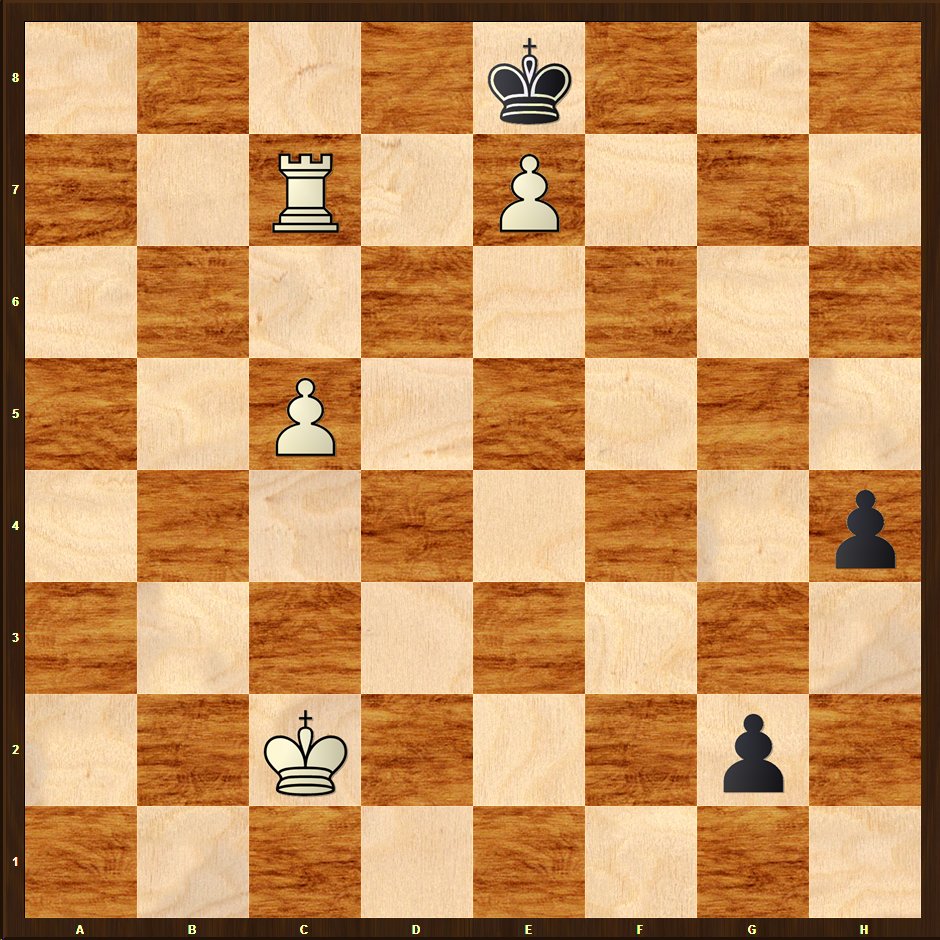
White to move and draw. No computer please.
Hint: It is not an easy puzzle.
4k3/2R1P3/8/2P5/7p/8/2K3p1/8 w – – 0 0

Chess Daily News from Susan Polgar

White to move and draw. No computer please.
Hint: It is not an easy puzzle.
4k3/2R1P3/8/2P5/7p/8/2K3p1/8 w – – 0 0
Taking it on faith that this really is a draw, I can say what the 1st 5 moves have to be, but after that it really gets tough.
1. Rc8+ Kxe7 2. Rg8 h3 3. Rg7+
At this point, calculating the consequences of all these moves (3. .. Kf8, 3. .. Kf6, 3. .. Ke8, 3. .. Ke6, and 3. .. Kd8) is pretty daunting.
Let’s just try 3. .. Kf8, which is probably the easiest line to look at from this point. It seems a certainty that White must sacrifice the rook here in order to promote the c-pawn:
4. c6 Kxg7 5. c7 g1=Q 6. c8=Q h2
I take it that this has to be a drawn position, but it might take me a long time to prove it.
Also, Black didn’t have to take the rook, and that leads to another whole tree of sub-variations.
All in all, I’m coming to the conclusion that I want to get some sleep tonight….
zzzzzzzzzzzz
Too hard
The beginning really can’t be anything else:
1. Rc8 Ke7
2. Rg8 h6
So, now black is threatening h2 and h1/g1 to queen a pawn. The white king is too far away to stop this, so this seems to leave only the pawn advance:
3. c6 h2 (Kd6 is below)
4. c7 g1(Q)
I am not 100% sure, but I think black loses with h1(q). For example: [4. …h1Q 5.c8Q g1Q 6.Qc7 Ke6 7.Re8 Kf6 8.Qd6 Kg5 9.Rg8 Kf5 10.Rf8 Kg5 11.Qf6 Kh5 12.Rh8 Kg4 13.Rg8 and mate on the edge of the board can’t be avoided. In this line, I think black may need to try a move like 5. …Qh7+, and try for perpetual, but after 6.Kc3 white has one move to start the attack on the king and I don’t see how black survives, but I haven’t looked at it in detail.] Continuing from 4. …g1Q above:
5. Rg1 hg1(Q)
6. c8Q with a draw.
So, can black stop the c-pawn by playing Kd6 at move 3 above:
3. …..Kd6
4. Rg6 Kc7
So, now, what for white? All I can see is to go for the R+P vs Q ending which is sometimes a draw- so white must play Kb2 immediately:
5. Kb2 h2
6. Rg2 h1(Q)
7. Rc2
So, white has his pawn protected from behind keeping black’s king tied up way up the board. I don’t really need study this to know it is drawn.
LOL.
Susan, that “hint” is not needed.
I’ve been racking my brains for the last 10 mins and am still clueless.
You cannot stop both black pawns, nor can white queen one of his, but not all such outcomes are wins for black- there are certain R vs Q endings that are draws, and easily demonstrated draws at that.
white has to give a check and activate the rook in the eight rank.
Probably something about Q vs K & bishop’s pawn.
1.Rc8+ Kxe7 2.Rg8 h3 3.Kb2 Kd7 (3…h2 4.Rxg2 h1Q 5.Rc2) 4.Rg3 Kc6 5.Rxh3 g1Q 6.Rc3. This is a positional draw. One of Black’s pieces must blockade White’s pawn, so he cannot execute the standard winning procedure of Q vs R.
Maybe like this:
1. Rc8+ Kxe7
2. Rg8 h3
3. c6 Kf7 (3.. Kd6! then what?)
4. Rg3 h2
5. c7 h1Q
6. c8Q Qh7+
7. Kb2=
1. Rc8+ Kxe7
2. Rg8 h3
3. c6 Kf7??
4. c7 and white wins
Let’s take another gander at this.
After 1. Rc8+ Kxe7 2. Rg8 h3 the reason I rejected 3. c6 initially was that after 3. .. Kd6 4. Rg6+ Kc7 5. Kb2 h2 6. Rxg2 h1=Q 7. Rc2 I evaluated this position as a win for Black. Now I see that this position has to be a draw. (So there is no good reason to waste a move with the rook by playing 3. Rg7+ as I had played previously.)
So after 1. Rc8+ Kxe7 2. Rg8 h3 3. c6! Black can also try 3. .. h2 That leads to:
4. c7 g1=Q
(4. .. h1=Q? probably loses after 5. c8=Q g1=Q 6. Qd8+)
5. Rxg1 hxg1=Q 6. c8=Q draw.
Rc8, Kxe7
Rg8, h3
Kc3! h2
Rxg2 h1=Q
Rg6 and set up fortress on d6
Black doesn’t have to push h2 straightaway, but I don’t think he can improve his king position, because the rook on d6 gives both horizontal and vertical fortress preventing the king’s entry.
1. Rc8+ Kxe7 2. Rg8 h3 and the only move leading to a draw is 3. c6! Kd6 4. Rg6+ (again only move) Kc7 and now the whole point of this study and another sole drawing move 5. Kb2!! h2 6. Rxg2 h1Q 7. Rc2! and black can’t make any progress, draw
I have no idea if this line really is reasonable, but, though long, it leads to a draw. I don’t see any major blunder. Please correct me if wrong.
1. Rc8+ Kxe7
2. Rg8 h3
3. Rg3 h2
4. Rxg2 h1=Q
5. Rd2 Qc6
Cat and mouse chase begins.
6. Re2+ Kd7
7. Re5 Qa4+
8. Kc3 Qf4
9. Rd5+ Ke6
Black king’s vulnerability to check causes problems.
10. Rd4 Qf2
11. Kc4 Ke5
White king escapes to 4th rank.
12. Rd5+ Kf4
13. Kb5 Qa2
White king escapes to 5th rank. Now life becomes more difficult for black.
14. Rd6 Qb2+
15. Kc6 Qe2
Now white king can hide from the pursuing queen behind his rook and pawn and gradually work the pawn forward.
16. Kd7 Qg4+
17. Kc6 Ke3
18. Kc7 Qf4
19. c6 Qg3
20. Kb8 Qg2
21. c7 Qb2+
22. Kc8 Qb5
23. Kd8 Qg5+
24. Kd7 Qb5+
25. Kc8 Qa5
26. Kb7 Qb4+
27. Rb6 Qe4+
28. Kb8 Qf4
29. Kc8 Qf8+
Here thrice repetition begins to get us a draw.
30. Kb7 Qg7
31. Kb8 Qe5
32. Kb7 Qg7
33. Kb8 Qe5
34. Kb7 Qe7
35. Kb8 Qe5
1/2-1/2
Position repeated 3 times.
The line I proposed above falls apart if 6 Re2+ Kf6 rather than Kd7. Not worth considering, then.
Lucymarie’s solution seems straightforward.