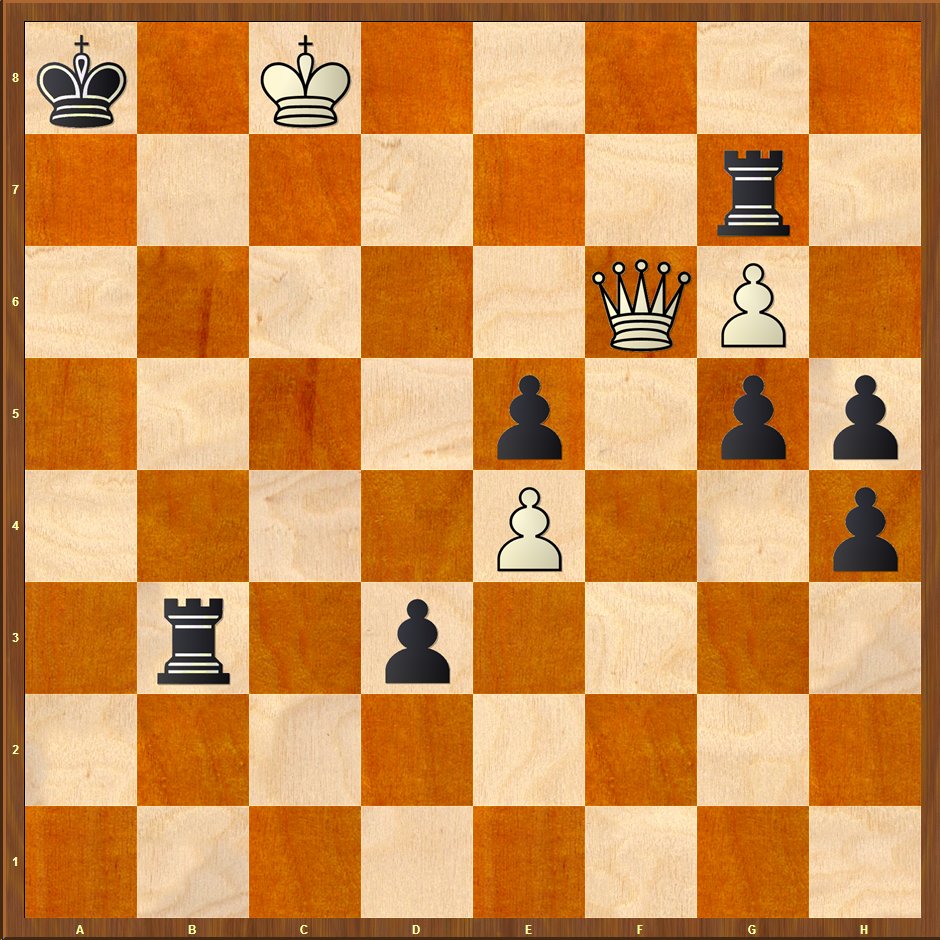
Razumenko, 1999
White to move and checkmate in 17!! This is one of the most difficult puzzles I have posted. Enjoy!
k1K5/6r1/5QP1/4p1pp/4P2p/1r1p4/8/8 w – – 0 1
Chess Daily News from Susan Polgar


Razumenko, 1999
White to move and checkmate in 17!! This is one of the most difficult puzzles I have posted. Enjoy!
k1K5/6r1/5QP1/4p1pp/4P2p/1r1p4/8/8 w – – 0 1
1 Qa6+ ra7
2 Qf3+ rgb7 (if rab7, 3 Qa4 ra7 4) Q*b3 and mates)
3 g7 d2
4 g8=Q d1=q
5 Qd5 6 q*d5 (if qb4+ 6 Kd8 and mates)
6 ed e4
7 d6 e3
8 d7 e2
9 d8=Q e1=q
10 Qd6! qe8+
11 Q*q rc7+
12 q*r r*Q
13 K*r+ and mates next
A huge hint is in the title
Once you realize that 17 moves is quite a few and to mate in 17 moves white will probably need a forcing sequence that ties black up, promotes a pawn or two;
then the solution is easy to find.
White to move and win would have been much harder than mate in 17.
17 is a large number to count to, but the idea must be based around
Qa6 Ra7 Qc6 Rbb7 pin the Rb7 rook and leave the Ra7 rook unable to move as well.
Looking at that position putting a queen on b8 is mate, so try get that by queen the g pawn, black queens on d1 then Qgd5 maybe the key move? My first idea of Qa2 threat Qxb7 failed to …Qd7, so blocking the d file and trying to get the e4 pawn free must be part of the solution, otherwise why have a pawn on e4 in the puzzle?
From there mate with Qxe5-b8 or Qd6-b8 looks the nice idea, and if black swaps queens on d5, capture with exd5, get another queen on d8 and come back to d6 with same idea. Qxb7-Qa6-Qc6xb7 also a threat.
However the head hurts in imagining all the black queen moves.
The only other sensible first move of Qxg7 loses to ..Rb8-b7+.
On the right track?
1. Qa6+ Ra7 2. Qc6+ Rbb7 3. g7 d2 4. g8 =Q d1=Q 5. Qgd5 Qxd5 6. exd5
White can then promote e pawn can see the victory from here.
My first notice here is that Qxg7?? would be an impossible move.
Due to Rb8+ and Rb7+.
The obvious try is 1.Qa6+ Ra7
2.Qc6+ and the Rb3 has to go to b7
and gets pinned. But when I see
‘mate in 17’ it reminds me I have other things to do!
So I stuck the fen in Stockfish 4
(Fritz 11 gui) and after about a minute it came up with mate in 14
using the starting moves as above!!
Can anyone confirm that it can be done in less than 17? Or is the fish up a creek?
0-0-0
-0-0-
1. Qa6+ Rga7
2. Qc6+ Rbb7 (2…Rab7 3. Qa4+)
3. g7 d2
4. g8=Q d1=Q
5. Qgd5 Qxd5
6. exd5 should mate Black in 17 moves.
I am not an expert, but see Queen move to A6 as good move to finish in 3. Am I wrong?
1. Qa6+ Ra7 2. Qc6+ Rbb7 3. g7 d2 4. g8=Q d1=R 5. Qgd5 Rxd5 6. exd5 h3 7. d6 e4 8. d7 h2 9. d8=Q h1=Q 10. Qxb7+ Rxb7 11. Qa5+ Ra7 12. Qd5+ Rb7 13. Qxb7++
Actually, in a super-twist ending worthy of Vishy Anand’s countryman Manoj Shyamalan, there’s actually a MATE IN 15! I’ll submit the actual mating sequence as a separate comment to be posted at the moderator’s discretion.
Question: Was the title an intentional misdirection?
Actually, in a super-twist ending worthy of Vishy Anand’s countryman Manoj Shyamalan, there’s actually a MATE IN 15!
1. Qa6+ Ra7
2. Qc6+ Rbb7
3. g7 d2
4. g8=Q d1=Q
5. Qgd5 Qxd5
6. exd5 g4
7. d6 g3
8. d7 g2
9. Qxg2 h3
10. Qc6 h2
11. d8=Q h1=B
12. Qxh1 h4
13. Qdxh4 e4
14. Q1xe4 Ra6
15. Qxb7#
This sort of problem, for me at least, is best attempted by just trying what is left over after eliminating the obvious stuff
Obviously, black is threatening Rb8#. White cannot take the rook at g7 because black will check from b8 followed by a check from b7 to skewer the queen and king. So, white seems to be left with the two checks and the guard of b8 with the queen from d6. Let’s get rid of 1.Qd6 first:
1. Qd6 d2 and this is clearly lost for white. White can check from d5, but black blocks with the attacked rook and is still threatening Rb8# if white takes the pawn at either d2 or later at d1. Also, after 1. …Rbb7, white can no longer check from a5 since black blocks again, and then blocks the check from d5 with the other rook- mate is still threatened along with d1Q.
So, we are left with the two checks from c6 and a6 on the first move. Let’s take the second one first since I can already see a way to tie black up (like the anonymous commenter above suggested when he/she wrote of “forced lines”:
1. Qa6 Ra7 (only move)
2. Qc6 Rbb7
Here, if black tries Rab7, he gets mated quickly: [2. …Rab7 3.Qa4 Ra7 4.Qb3 and there is no answer to the various mating threats. So, we now have black’s king and his two rooks tied up. The rook on b7 is pinned to the king, and the rook at a7 is tied down defending the rook on b7. Black now has only pawn moves. The obvious thing to try now for white is to push the g-pawn:
3. g7 d2
What else can black do? If he pushes one of the other pawns, white is going to queen and then play the new queen to the 7th rank or to d5 to triple attack the pinned rook at b7 leading to mate. Black must push the d-pawn to attempt to dislodge the queen at c6:
4. g8Q d1Q (else, 5.Qd5 wins)
Now, I am pretty sure this is the correct line up to this point, but the rest is definitely unclear to me. The most forcing looking move here is Qgd5 tripling up on the b7 rook. Let’s see where this takes us:
5. Qgd5 Qd5
Here, protecting the rook with Qb1 is going to fail since white will take at e5 followed by the unstoppable Qb8#. The option of checking from g4 I will deal with later since I don’t have a good line in mind yet for that. Continuing:
6. ed5
Here, white really does need a passer, so this move is easy to find. Continuing:
6. …..g4
I won’t cover all the pawn pushes here since they are pretty irrelevant, but this one looks immediately the longest line to me since it forces white to take at g2 and h1 later. Continuing:
7. d6 g3
8. d7 g2
9. Qg2!
I don’t think any other move can win here for white. There isn’t time to queen the d-pawn nor to underpromote to a knight to triple the attack on b7 immediately since the new black queen can check the white king after Nxb7 and she can guard the rook quite well from g7, too. In any case, 9.Qg2 is obvious- the rooks are still tied down. Continuing:
9. …..h3 (if e4 10.Qxe4)
10.Qe4 h2
11.d8Q
I had thought around move 6 that white might need an underpromotion here to a knight, but I don’t see how that could be a shorter line now, though it is surely mate, too. Continuing:
11. ….h1Q (nothing better now)
12.Qh1 h4 (or e4 13.Qxe4)
13.Qdd5 e4
14.Qh2 and 15.Qb8# on the next move.
So, I will end this comment here, and in the next one, will cover black’s alternatives at move 5.
In my first comment, I covered the basically forced line…
1. Qa6 Ra7
2. Qc6 Rbb7
3. g7 d2
4. g8Q d1Q
5. Qgd5
And I showed that black gets mated if he tries to protect the b7 rook with the queen, and if he takes the white queen at d5. Left is the line where he checks from g4:
5. …..Qg4
6. Kd8 Kb8
I will cover the alternatives in a moment since I am not yet quite clear on what to do here. Continuing:
7. Qdd6
I think Qxe5 also should win here for white, but this line is clearer in my head. Continuing:
7. …..Rc7 (alternatives later)
8. Qb6 Ka8 (Rb7 9.Qdc7+ wins)
9. Qbc7
Threatening Qb8#. Black has no checks and no way to guard the square of b8 but with Rb7, but then white will mate in 2 starting with Qa6+, so he must take the c7Q now:
9. …..Rc7
10.Kc7
And now white is threatening mate with Qa6 and starting a mate with Qc6+ followed by Qb7#- black can’t prevent both of these without conceding his queen at c8 or d7. So, mate will definitely come long before move 17 here.
Now, we need to back up in this line to move 7 where black could retreat the king to a8:
7. …..Ka8
8.Ke8!
There may be other moves here for white, but this one seems obvious to me. White is now threatening Qd8+ followed by mate. The black queen can’t leave the c8 square unguarded either. This leaves only moves of the rook on a7:
8. …..Ra2 (any better?)
9. Qd8 Ka7
10.Qc5 Ka6 (Rb6 11.Qcb6#)
11.Qa8 Ra7
12.Qaa7#
Now, let’s back up to move 6 in the line above:
6. …..Qh3
7. Ke8
As before, threatening Qd8+ followed by mate. Black can give up the queen at e6 or at d7, but neither can prevent the mate, and we already showed that moves of the a7 rook are futile. Also, white will play 7.Ke8 if black pushes the h-pawn on the sixth move.
So, I think that covers it thoroughly. White wins in 17 or less after 1.Qa6+.
I hate to disagree with Susan, but this problem is far from the hardest ever posted here. I remember at least 20 puzzles harder than this one.
I agree. I suspect it begins (1) Qa6+ and (2) Qc6+, drawing one of the Rooks to B7, where it will be pinned. This should permit White time to try (3) g7, but I must confess that I cannot see the next 14 moves. Does anyone have ideas from here? Many thanks!
this is nuts 🙂 … all I can figure out is Qc6+ rook blocks on b7 Qd5 pins the rook , and white won’t get checkmated for now!