B4 and king is trapped… If queen takes rook white gives mate with bishop. If queen takes knight white gives mate with rook. By the way black queen cannot give a check to white king because of the position of the white material. Hi from greece (bill)
My first thought is b4 with the double threat of Ra3 and Nb8, and, at first, I thought I had it right away, but then I noticed that black can check with the bishop from f3:
1. b4?? Bf3! 2. Bf3 Qd7!
And white’s own bishop blocks the rook’s access to a3. I don’t see any way to prevent the mate on the next black move. Also, at move 2, it does white no good to play any other move- they all look like mates in 3:
2. Rf3 Qd5 (Qe4, too) 3. Kb8 Bb7#
Or
2. Kb8 Qd7 and black mates with either Qd8 or Qb7 depending on what black does.
So, white needs to address Bf3+ right from the start. This leads me immediately to a simple knight maneuver:
1. Nb8 Ka5 2. Nc6 Ka6 3. b4
Now, white is threatening both Nb8# and Ra3#. Of course, moving the knight off of d7 has opened up the checks on the back rank, so I will go over those first since they are the easiest to deal with:
So, we have eliminated every line but the following. From the top:
1. Nb8 Ka5 2. Nc6 Ka6 3. b4 Bf3
So, black has pinned the knight and blocked off Ra3#. With the pin, black has reopened the checks from the back rank, so, the first moves you should look at are the captures at f3. Let’s look at the wrong one first since it brings in the stalemate theme really beautifully:
4. Rf3? Qf8! (or Qc8) 5. Rf8 = since black is left with no legal move, and playing 5.Nb8 won’t help since black just sacrifices at b8 for the same stalemate.
So, at move 4 in this line, white must capture with the bishop to give black the possibility of playing h1 at some point:
4. Bf3
Unpins the knight and threatens Nb8# again. Black cannot capture at f3 since Rxf3 threatens mate two different ways after h1Q/B or h1R/N. So, black must either cover b8 from f4 or e5 or play the checks from f8/c8. Let’s cover the easy ones first:
4. …..Qe5 5. Bd5
Lots of winning moves here, but the idea is all the same- free the rook’s access to a3 without blocking the h-pawn. In these lines, all black can do is allow Nb8, sacrifice for the knight, then play h1 and lose to Ra3:
5. …..Qe8 6. Nb8 Qb8 7. Kb8 h1Q 8. Ra3# and 4. …Qf4 is no different.
So, now let’s cover the 4th move options where black checks from the back rank since these are a bit trickier:
4. …..Qc8 5. Nb8 Qb8 6. Kb8 h1(Q)
Now, of course, white cannot capture at h1 without stalemating black. White cannot play a move like Rh7 threatening Ra7 since black just captures at h7 and still has b7 covered. Nor can white play Rh2 since black captures there with check to win. So, it has to be a bishop move that threatens Ra3 again, but which one? Let’s look at a wrong one first to see the problem:
7. Bc6 Qh2! 8. Rh2 stalemates, and 8.Ka8 is met by Qb8+ that also leads to stalemate. So, white must find a bishop move that foils these two stalemating ideas, and it isn’t too much work to find the right one:
7. Bg2!! Qh2 (else mate in 1) 8. Kc8!!
Not sure it deserves two exclamation points since there really could be no other move that wins, but it isn’t trivial to see that this wins:
8. …..Qh3
No other move is better. Ra3# is still the threat, so either black needs to check from b8, block with Qg3, or take the rook. On Qg3, white just captures and wins easily since black has a7 to move to on the next move. On 8. …Qb8, the white king moves to d7: [8. …Qb8 9.Kd7 Qa7 10.Ke6! and Ra3# can only be delayed, not prevented. Continuing from 8. …Qh3 above:
9. Bh3 Ka7 10.Bd7 Ka6 (Ka8 11.Bb5 wins, too) 11.Kc7 Ka7 12.Bb5 Ka8 13.Kb6 and the rest is trivial.
The three threats, Ra3#, Nb8# and Bb7# can’t be parried. The presence of the black h pawn prevents stalemate in variations where the B on h1 moves, as below.
Fir example: 1. …, Bf3+ 2. B*f3, Q*f3 3. R*f3 and mate next move.
An immediate b4 is not a good idea… black can play Bf3 and ouch!! Ravi states that after Bxf3, Black will play Qxf3… but stronger is Qxd2 and black wins.
Instead white should first play Nb8+ – Ka5, Nc6+ and only then b4! It seems to me that there is no defence left.
I’ve discovered that this is considerably more difficult than it looks on the surface. Of course b4 is attractive (boxing-in black’s king and creating no less than 3 mate threats), but it is still premature. Let’s examine why…
1- b4 ; Bf3+ and neither of the two possible captures work. (2- Bxf3 ; Qxd7, now white no longer has any threats: the knight’s gone, the bishop is in the way of the rook and black’s queen is well positioned) (2- Rxf3; Qe4+, 3- Kb8 ; Qxb4, white has squandered his advantage.)
So instead of the immediate b4, some maneuvering is in order :
1- Nb8+ ; Ka5 2- Nc6+ ; Ka6 3- b4 ;
Now’s the right time. Notice how the knight is placed in a way that prevents checks on the long diagonal.
3- … ; Bf3 (still the best response, as far as I can tell.) 4- Bxf3 ;
Giving the h pawn some wiggle room so as to avoid stalemate after black sacrifices his queen. For this reason, Rxf3 would be wrong.
4- … ; Qc8+ (or Qf8+, no matter) 5- Nb8+ ; Qxb8+ 6- Kxb8 ; h1=Q (only move) 7- Bg2 (remember that stalemate is a concern, so capturing the new queen at this point is a no-no.) 7- … ; Qh2+ (the queen makes full use of her immunity) 8- Kc8 ; Qxh3+ (Qb8+; Kd7 leads black nowhere as he soon runs out of checks and is unable to prevent Ra3#.) 9- Bxh3 ; Ka7 (stalemate is no longer an issue)
The final position is a bit of a let-down, as far as I’m concerned (or maybe I’m missing something), despite all the clever ideas that come prior. Instead of an elegant mate, you’re left with something very pedestrian : the plan is to gobble up black pawns and then to queen on b8. Still a fine puzzle, though. And certainly the longest post I’ve written here.
1. B4 and threatens mate at 3 different places. 1. … Qf8+ Hoping for 2. Nf8 which draws. 2. Nb8+! and wins. Hello from Myres Domilies of Baguio City, Philippines.
I got it! 1. Nb8+ Ka5 2. Nc6+ Ka6 3. b4 Bf3 Forced. Any queen move forces the lose of the queen in the next move. 4. Bf3 (4.Rf3 is a draw after 4. … Qf8+) 4. … Qc8+ 5. Nb8+ Qb8+ 6. Kb8 a1=Q 7. Bg2+ Qh2+! 8. Kc8 Qb8+ 9. Kd7 Qa7+ 10.Ke6 and wins. Myres Domilies of Baguio City, Philippines. My first blog was wrong.
However, Nb8 puts the black king under immediate pressure: 1. Nb8+ Ka5 2. Nc6+ Ka6 3. b4 {Tightens the noose around the black king and threatens Nb8#, but gives black a chance to break up the attack.} 3… Bf3 {Pins the knight.} 4. Bxf3 Qf8+ {Since Qxf3, Rxf3 doesn’t prevent mate.} 5. Nb8+ Qxb8+ 6. Kxb8 and now an easy win for white.
The first move whan thinks about here, is of course: 1. b4? Threats Ra3#, Bb7# and Nb8# and looks overwhelming, so the question is, can black sack Q+B+p checking in the long diagonal and end up with a stalemate? 1. … Bf3+! 2. Bxf3 (enforced, Rxf3?? Qd4+ Kb8 Qb7#, or Kb8? Qxh3 wins since there is no check) Following this path, the threat Nb8# will be the big challenge, so therefore black now drops Qf3+? and instead plays: 2. … Qf8+! 3. Nxf8 Or Nb8 Qxb8+ Kxb8 h8=Q! wins. 3. … h8=Q 4. Bxh8 stalemate (Bb7+?? Qxb7#)
So this is why 1. b4? is not correct, it has to be something else!
Actually, it’s not such an easy win for white after move 6. Kxb8, since many combinations lead to stalemate. 6. Kxb8 h1=Q 7. Bg2 (7. Rxh1 {Stalemate!}) (7. Ba8 Qxa8+ 8. Kxa8 Stalemate!}) 7… Qh2+ 8. Kc8 (8. Ka8 Qxg2+ 9. Rf3 Qxf3+ 10. Kb8 Qb7# {Black wins!}) 8… Qxh3+ 9. Bxh3 Ka7 {One would think it would be easy from here, but, no, stalemate still is a very strong possibility. There probably are several ways the rest of the game could play out. Here are a few.} 10. Kc7 Ka8 11. Bd7 Ka7 {White needs the pawn’s help to prevent stalemate, so the remaining black pawns must be eliminated.} 12. Bxb5 (12. Bc6 Ka6 13. Kb8 {Stalemate!}) 12… Ka8 13. Kxb6 Kb8 14. Ba6 Ka8 15. Kc7 Ka7 16. b5 Ka8 17. Bb7+ Ka7 18. b6# {White wins.}
There is a problem with b4. Black plays Bf3. If Rxf3 obviously black mates ith a check on the long diagonal. At first I thought Bxf3 wins for white, but black plays Qxd7, and again it is black who mates.
I’m going to look further and see what else white has. I’m thinking start with Nb8+ and Nc6+ and see if that changes anything.
1.Nb8+ Ka5 2.Nc6+ Ka6 3.b4 with the same threats as in the previous comments. If 3…Qc8+ (or Qf8+) 4.Nb8+ Qxb8 5.Bf3 Kc7 leaving a7 for black kings wins. If 3…Bf3 4.Rxf3 and there is no Qxd7. If 3…Qxf3 4.Bxf3 h1=Q 5.Nb8++
The likely solution is: 1. Nb8+! Ka5 2. Nc6+! Ka6 The only new in the position after those two moves is that the knight now prevents all black’s stalemate ieas, so:
3. b4 and there are too many mate threats, black resigns.
TOO HARD TO SOLVE….!!! BUT its simple and easy for IM…!! WHITE TO PLAY AND WIN…!!! Same puzzle still alive on net elsewhere since 14 hrs.nobody can solved it. It’s Proud of Gujarat, Ankit Rajpara who illustrated all possibilty and the solution.
Solution By : ANKIT RAJPARA IM (GUJ.) 1.Nb8+ Ka5 2.Nc6+ Ka6 3.b4 (threatening Nb8 mate and Ra3 mate) (Now Qf8 and Qc8+ loses to 4. Nb8+) (Qf3 loses to 4. Rf3 Bf3 5.Bf3 and Nb8 mate) strongest move for black is 3…Bf3! 4.Bf3 Qc8+ 5.Nb8+ Qb8 6.Kb8 h1=Q 7. Bg2! (threatening Ra3 mate) Qh2+ (only move) 8. Kc8! (if 8.Ka8 than Qb8+! stalemate) Qb8+ 9.Kd7! (Ra3 mate threat) Qa7+ 10.Ke6 (no more checks now) and mate threat Ra3 is unstoppable!
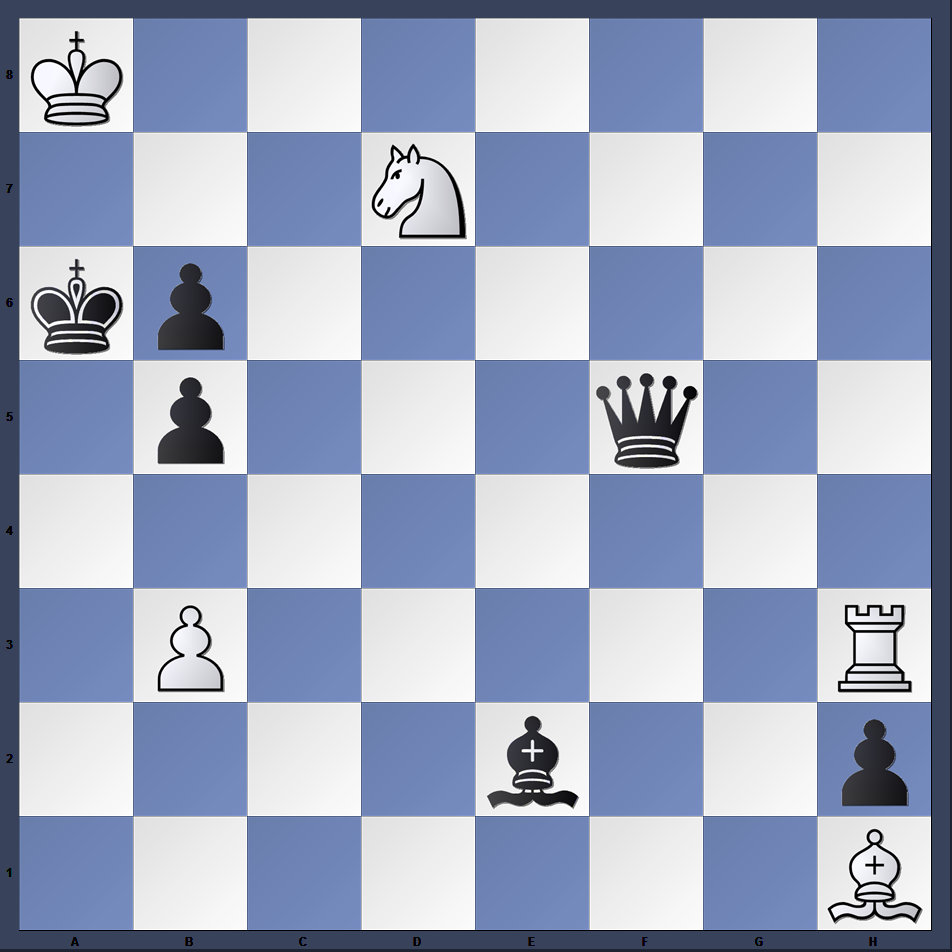


B4 and king is trapped… If queen takes rook white gives mate with bishop. If queen takes knight white gives mate with rook. By the way black queen cannot give a check to white king because of the position of the white material. Hi from greece (bill)
1.b4! seals the deal….
if 1…Qxh3 2.Bb7 mate
1…Bd3 2.Bb7 mate
otherwise, 2.Ra3 mate
Kamalakanta
My first thought is b4 with the double threat of Ra3 and Nb8, and, at first, I thought I had it right away, but then I noticed that black can check with the bishop from f3:
1. b4?? Bf3!
2. Bf3 Qd7!
And white’s own bishop blocks the rook’s access to a3. I don’t see any way to prevent the mate on the next black move. Also, at move 2, it does white no good to play any other move- they all look like mates in 3:
2. Rf3 Qd5 (Qe4, too)
3. Kb8 Bb7#
Or
2. Kb8 Qd7 and black mates with either Qd8 or Qb7 depending on what black does.
So, white needs to address Bf3+ right from the start. This leads me immediately to a simple knight maneuver:
1. Nb8 Ka5
2. Nc6 Ka6
3. b4
Now, white is threatening both Nb8# and Ra3#. Of course, moving the knight off of d7 has opened up the checks on the back rank, so I will go over those first since they are the easiest to deal with:
3. …..Qc8/f8
4. Nb8 Qb8
5. Kb8 Bf3 (else Ra3 or Bb7#)
6. Rh7
Not R or Bxf3, to stalemate. Now the mate is unpreventable.
So, at move 3, black must play either Bf3 or Qf3. Let’s cover the latter first since it, too, is easily dealt with:
3. …..Qf3
4. Rf3 Bf3 (pinning the knight)
5. Bf3 h1Q
6. Nb8#
So, we have eliminated every line but the following. From the top:
1. Nb8 Ka5
2. Nc6 Ka6
3. b4 Bf3
So, black has pinned the knight and blocked off Ra3#. With the pin, black has reopened the checks from the back rank, so, the first moves you should look at are the captures at f3. Let’s look at the wrong one first since it brings in the stalemate theme really beautifully:
4. Rf3? Qf8! (or Qc8)
5. Rf8 = since black is left with no legal move, and playing 5.Nb8 won’t help since black just sacrifices at b8 for the same stalemate.
So, at move 4 in this line, white must capture with the bishop to give black the possibility of playing h1 at some point:
4. Bf3
Unpins the knight and threatens Nb8# again. Black cannot capture at f3 since Rxf3 threatens mate two different ways after h1Q/B or h1R/N. So, black must either cover b8 from f4 or e5 or play the checks from f8/c8. Let’s cover the easy ones first:
4. …..Qe5
5. Bd5
Lots of winning moves here, but the idea is all the same- free the rook’s access to a3 without blocking the h-pawn. In these lines, all black can do is allow Nb8, sacrifice for the knight, then play h1 and lose to Ra3:
5. …..Qe8
6. Nb8 Qb8
7. Kb8 h1Q
8. Ra3# and 4. …Qf4 is no different.
So, now let’s cover the 4th move options where black checks from the back rank since these are a bit trickier:
4. …..Qc8
5. Nb8 Qb8
6. Kb8 h1(Q)
Now, of course, white cannot capture at h1 without stalemating black. White cannot play a move like Rh7 threatening Ra7 since black just captures at h7 and still has b7 covered. Nor can white play Rh2 since black captures there with check to win. So, it has to be a bishop move that threatens Ra3 again, but which one? Let’s look at a wrong one first to see the problem:
7. Bc6 Qh2!
8. Rh2 stalemates, and 8.Ka8 is met by Qb8+ that also leads to stalemate. So, white must find a bishop move that foils these two stalemating ideas, and it isn’t too much work to find the right one:
7. Bg2!! Qh2 (else mate in 1)
8. Kc8!!
Not sure it deserves two exclamation points since there really could be no other move that wins, but it isn’t trivial to see that this wins:
8. …..Qh3
No other move is better. Ra3# is still the threat, so either black needs to check from b8, block with Qg3, or take the rook. On Qg3, white just captures and wins easily since black has a7 to move to on the next move. On 8. …Qb8, the white king moves to d7: [8. …Qb8 9.Kd7 Qa7 10.Ke6! and Ra3# can only be delayed, not prevented. Continuing from 8. …Qh3 above:
9. Bh3 Ka7
10.Bd7 Ka6 (Ka8 11.Bb5 wins, too)
11.Kc7 Ka7
12.Bb5 Ka8
13.Kb6 and the rest is trivial.
1 b4 with threats of Nb8#, Bb7# and Ra3#
1. b4
The three threats, Ra3#, Nb8# and Bb7# can’t be parried. The presence of the black h pawn prevents stalemate in variations where the B on h1 moves, as below.
Fir example:
1. …, Bf3+
2. B*f3, Q*f3
3. R*f3 and mate next move.
Other variations lead to mate, too.
An immediate b4 is not a good idea… black can play Bf3 and ouch!! Ravi states that after Bxf3, Black will play Qxf3… but stronger is Qxd2 and black wins.
Instead white should first play Nb8+ – Ka5, Nc6+ and only then b4! It seems to me that there is no defence left.
b4( white pawn moves to b4)foce mate or force win if black sacrifices the queen.
1. Nb8+ Ka5
2. Nc6+ Ka6
3. b4
if 3. … Qc8+ (or Qf8+)
4. Nb8#
if 3. … Bf3
4. Bxf3 Qxf3
5. Rxf3 h1(=Q)
6. Nb8#
Others posted 1. b4, but that doesn’t work, for
1. b4 bf3+
if 2. Bxf3 Qxd7 and White can’t avoid being mated:
3. Bb7+ Qxb7# or 3. Rh7 Qc8# or 3. Rh8 Qa7# or …
if 2. Rxf3 Qd5+
3. Kb8 Qb7#
if 2. Kb8 Qxd7 and again White can’t avoid being mated.
White must get the Knight on c6 before advancing the pawn.
I thought b4! was the solution. But it turns out b4 is ?? a blunder. It’s mate after b4. Houdini gives the fallowing line.
FEN: K7/3N4/kp6/1p3q2/8/1P5R/4b2p/7B w – – 0 1
Houdini 3 w32:
8/25 00:00 885 110,000 +4.34 Nd7-b8+ Ka6-a5 Nb8-c6+ Ka5-a6 b3-b4 Be2-f3 Bh1xf3 Qf5-f8+ Nc6-b8+ Qf8xb8+ Ka8xb8 h2-h1Q Bf3-g2 Qh1-h2+ Kb8-c8 Qh2xh3+ Bg2xh3 Ka6-a7 Kc8-c7 Ka7-a6 Bh3-d7 Ka6-a7 Bd7xb5 Ka7-a8
So Nb8!!! is winning. Clever!
1.b4 Bf3!
2. Bxf3 Qxd7
and Black wins.
mate in a3 is blocked, and the queen defends mate on b7, threatening mate on b7 and c8.
I’ve discovered that this is considerably more difficult than it looks on the surface. Of course b4 is attractive (boxing-in black’s king and creating no less than 3 mate threats), but it is still premature. Let’s examine why…
1- b4 ; Bf3+
and neither of the two possible captures work.
(2- Bxf3 ; Qxd7, now white no longer has any
threats: the knight’s gone, the bishop is in
the way of the rook and black’s queen is well
positioned)
(2- Rxf3; Qe4+, 3- Kb8 ; Qxb4, white has
squandered his advantage.)
So instead of the immediate b4, some maneuvering is in order :
1- Nb8+ ; Ka5
2- Nc6+ ; Ka6
3- b4 ;
Now’s the right time. Notice how the knight is placed in a way that prevents checks on the long diagonal.
3- … ; Bf3 (still the best response, as far as I can
tell.)
4- Bxf3 ;
Giving the h pawn some wiggle room so as to avoid stalemate after black sacrifices his queen. For this reason, Rxf3 would be wrong.
4- … ; Qc8+ (or Qf8+, no matter)
5- Nb8+ ; Qxb8+
6- Kxb8 ; h1=Q (only move)
7- Bg2 (remember that stalemate is a concern, so
capturing the new queen at this point is a
no-no.)
7- … ; Qh2+ (the queen makes full use of her
immunity)
8- Kc8 ; Qxh3+ (Qb8+; Kd7 leads black nowhere as
he soon runs out of checks and is
unable to prevent Ra3#.)
9- Bxh3 ; Ka7 (stalemate is no longer an issue)
The final position is a bit of a let-down, as far as I’m concerned (or maybe I’m missing something), despite all the clever ideas that come prior. Instead of an elegant mate, you’re left with something very pedestrian : the plan is to gobble up black pawns and then to queen on b8. Still a fine puzzle, though. And certainly the longest post I’ve written here.
1.b4! Bxf3 2.Rxf3! Qxf3 3.Bxf3 h1(Q) 4.Nb8 mate!
1. B4 and threatens mate at 3 different places.
1. … Qf8+ Hoping for 2. Nf8 which draws.
2. Nb8+! and wins.
Hello from Myres Domilies of Baguio City, Philippines.
I got it!
1. Nb8+ Ka5
2. Nc6+ Ka6
3. b4 Bf3
Forced. Any queen move forces the lose of the queen in the next move.
4. Bf3
(4.Rf3 is a draw after 4. … Qf8+)
4. … Qc8+
5. Nb8+ Qb8+
6. Kb8 a1=Q
7. Bg2+ Qh2+!
8. Kc8 Qb8+
9. Kd7 Qa7+
10.Ke6 and wins.
Myres Domilies of Baguio City, Philippines. My first blog was wrong.
b4 Bf3
RXf3 Qe4+
Kb8 Qb7+ mate
Nope, not b4, since
1. b4 Bf3+
2. Bxf3 Qxd7
3. Rxh2 (3. Rh8 Qa7# {Black wins.}) 3… Qe8# {Black wins.}
However, Nb8 puts the black king under immediate pressure:
1. Nb8+ Ka5
2. Nc6+ Ka6
3. b4 {Tightens the noose around the black king and threatens Nb8#, but gives black a chance to break up the attack.}
3… Bf3 {Pins the knight.}
4. Bxf3 Qf8+ {Since Qxf3, Rxf3 doesn’t prevent mate.}
5. Nb8+ Qxb8+
6. Kxb8
and now an easy win for white.
The first move whan thinks about here, is of course:
1. b4?
Threats Ra3#, Bb7# and Nb8# and looks overwhelming, so the question is, can black sack Q+B+p checking in the long diagonal and end up with a stalemate?
1. … Bf3+!
2. Bxf3 (enforced, Rxf3?? Qd4+ Kb8 Qb7#, or Kb8? Qxh3 wins since there is no check)
Following this path, the threat Nb8# will be the big challenge, so therefore black now drops Qf3+? and instead plays:
2. … Qf8+!
3. Nxf8
Or Nb8 Qxb8+ Kxb8 h8=Q! wins.
3. … h8=Q
4. Bxh8 stalemate (Bb7+?? Qxb7#)
So this is why 1. b4? is not correct, it has to be something else!
Actually, it’s not such an easy win for white after move 6. Kxb8, since many combinations lead to stalemate.
6. Kxb8 h1=Q
7. Bg2
(7. Rxh1 {Stalemate!})
(7. Ba8 Qxa8+ 8. Kxa8 Stalemate!})
7… Qh2+
8. Kc8
(8. Ka8 Qxg2+ 9. Rf3 Qxf3+ 10. Kb8 Qb7# {Black wins!})
8… Qxh3+
9. Bxh3 Ka7 {One would think it would be easy from here, but, no, stalemate still is a very strong possibility. There probably are several ways the rest of the game could play out. Here are a few.}
10. Kc7 Ka8
11. Bd7 Ka7 {White needs the pawn’s help to prevent stalemate, so the remaining black pawns must be eliminated.}
12. Bxb5
(12. Bc6 Ka6 13. Kb8 {Stalemate!})
12… Ka8
13. Kxb6 Kb8
14. Ba6 Ka8
15. Kc7 Ka7
16. b5 Ka8
17. Bb7+ Ka7
18. b6# {White wins.}
Nb8+ Ka5
Nc6+ Ka6
b4
(mate either by Nb8+ or by Ra3+)
Nb8+ Ka5
Nc6+ Ka6
b4
(mate either by Nb8+ or by Ra3+)
There is a problem with b4.
Black plays Bf3. If Rxf3 obviously black mates ith a check on the long diagonal. At first I thought Bxf3 wins for white, but black plays Qxd7, and again it is black who mates.
I’m going to look further and see what else white has. I’m thinking start with Nb8+ and Nc6+ and see if that changes anything.
1.Nb8+ Ka5 2.Nc6+ Ka6 3.b4 with the same threats as in the previous comments. If 3…Qc8+ (or Qf8+) 4.Nb8+ Qxb8 5.Bf3 Kc7 leaving a7 for black kings wins. If 3…Bf3 4.Rxf3 and there is no Qxd7. If 3…Qxf3 4.Bxf3 h1=Q 5.Nb8++
1. Nb8+, Ka5
2. Nc6+, Ka6,
3. b4, Bf3
4. Bxf3, Qc8+
5. Nb8+, Wxb8+
6. Kxb8
After this it should be a win for white.
1. Nb8+, Ka5
2. Nc6+, Ka6,
3. b4, Bf3
4. Bxf3, Qc8+
5. Nb8+, Wxb8+
6. Kxb8
After this it should be a win for white.
The likely solution is:
1. Nb8+! Ka5
2. Nc6+! Ka6
The only new in the position after those two moves is that the knight now prevents all black’s stalemate ieas, so:
3. b4
and there are too many mate threats, black resigns.
Erroneous was:
1. b4? Bf3+!
2. Bxf3 (must take with bishop) Qf8+! (to deflect knight)
3. Nxf8 h1=Q!
4. Bxf8 enforced, stalemate
TOO HARD TO SOLVE….!!! BUT its simple and easy for IM…!!
WHITE TO PLAY AND WIN…!!!
Same puzzle still alive on net elsewhere since 14 hrs.nobody can solved it.
It’s Proud of Gujarat, Ankit Rajpara who illustrated all possibilty and the solution.
Solution By : ANKIT RAJPARA IM (GUJ.)
1.Nb8+ Ka5 2.Nc6+ Ka6 3.b4 (threatening Nb8 mate and Ra3 mate) (Now Qf8 and Qc8+ loses to 4. Nb8+) (Qf3 loses to 4. Rf3 Bf3 5.Bf3 and Nb8 mate) strongest move for black is 3…Bf3! 4.Bf3 Qc8+ 5.Nb8+ Qb8 6.Kb8 h1=Q 7. Bg2! (threatening Ra3 mate) Qh2+ (only move) 8. Kc8! (if 8.Ka8 than Qb8+! stalemate) Qb8+ 9.Kd7! (Ra3 mate threat) Qa7+ 10.Ke6 (no more checks now) and mate threat Ra3 is unstoppable!
Before.