Menu   ≡ ╳
  • News
    • Major Tournaments
    • General News
    • USA Chess
  • Puzzles
  • Improvement
  • Event
  • College
  • Scholastic
  • Women
  • Search

        More results...

        Or you can try to:
        Search in Shop
        Exact matches only
        Search in title
        Search in content
        Search in comments
        Search in excerpt
        Search for News
        Search in pages
        Search in groups
        Search in users
        Search in forums
        Filter by Categories

        Try these: Sicilian Defense, Empire Chess, USA Chess

    • SPICE
    • Videos
    • Susan’s Blog
    • About Us
    • Contact Us
    • SPICE
    • Videos
    • Susan’s Blog
    • About Us
    • Contact Us
    Menu   ≡ ╳
    • News
      • Major Tournaments
      • General News
      • USA Chess
    • Puzzles
    • Improvement
    • Event
    • College
    • Scholastic
    • Women
    • Search

          More results...

          Or you can try to:
          Search in Shop
          Exact matches only
          Search in title
          Search in content
          Search in comments
          Search in excerpt
          Search for News
          Search in pages
          Search in groups
          Search in users
          Search in forums
          Filter by Categories

          Try these: Sicilian Defense, Empire Chess, USA Chess

      Home  >  Chess Improvement • Chess Puzzles  >  Brilliant endgame improvement

      Brilliant endgame improvement

      Chess tactic, Endgame Improvement, Puzzle Solving


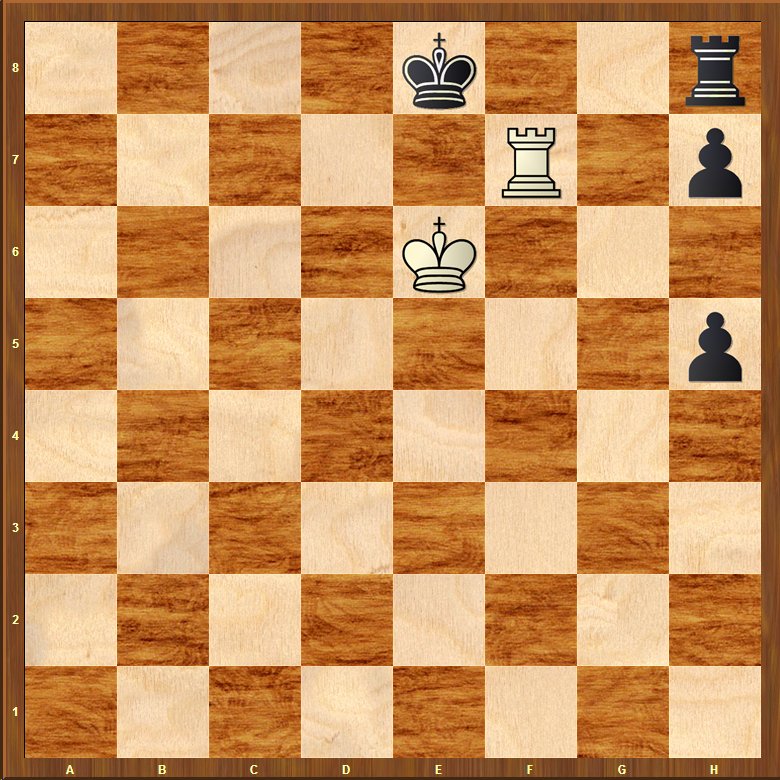
      White to move and win. How should White proceed?

      4k2r/5R1p/4K3/7p/8/8/8/8 w k – 0 1

      Pogosiants, 1977

      Chess Daily News from Susan Polgar
      Previous Article Webster dominates, Texas Tech takes 5th
      Next Article Karpov vs Timman!

      About Author

      Susan Polgar

      Related Posts

      • More Special Endgame!

        January 3, 2021
      • Critical Endgame Improvement!

        December 28, 2020
      • Precision Chess Tactic

        December 27, 2020

      14 Comments

      1. jcheyne Reply
        December 31, 2013 at 7:24 am

        Since Black can castle, White first gives check with 1. Re7+ and then 2. Ra8, threatening mate or a skewer to capture the rook.

      2. Oleg Mezjuev Reply
        December 31, 2013 at 9:18 am

        1. Ra7 Kf8 2. Kf6 Ke8 3. Ra8+ Ke7 4. Rxh8 1-0

      3. Banjan Reply
        December 31, 2013 at 10:45 am

        Its pretty simple it seems… 1.Ra7 Kf8 2.Kf6 +- maybe?! 🙂

      4. Anonymous Reply
        December 31, 2013 at 11:11 am

        It seems easy!
        1. Ra7 Kd8
        2. Ra8+ Kc7
        3. Rxh8 followed by eating both black h pawns

        If 1….Kf8
        2. Kf6 Ke8 (any other move allows 3. Ra8 mate)
        3. Ra8+ Kd7
        4. Rxh8 followed by eating both black h pawns.

        Any move other than 1…Kd8/Kf8 allows 2. Ra8 mate.

        Harry

      5. Anonymous Reply
        December 31, 2013 at 11:22 am

        Ra7

      6. Anonymous Reply
        December 31, 2013 at 11:25 am

        Ra7

      7. Alchemos Reply
        December 31, 2013 at 11:36 am

        1 Ra7 (threatening mate) Kf8
        2 Kf6 Ke8
        3 Ra8+ wins Rook

      8. Anonymous Reply
        December 31, 2013 at 12:07 pm

        1. Ra7 Kf8 2. Kf6 Ke8 3. Ra8+ Kd7 4. Rxh8 wins

      9. Pranav Dandekar Reply
        December 31, 2013 at 1:25 pm

        1. Ra7 Kf8

        (If black moves either the rook or the pawns, then 2.Ra8#)
        (If 1…Kd8 then 2 Ra8+ loses the rook).

        2. Kf6 Ke8 (again moving the rook or the pawns, or playing Kg8 leads to mate).

        3. Ra8+ Kd7
        4. Rxh8 is winning for white.

      10. Yancey Ward Reply
        December 31, 2013 at 4:26 pm

        It helps if you know what the uncapitalized “k” in the FEN stands for (it indicates black can still castle kingside), but obviously this wouldn’t be much of a puzzle if black couldn’t castle. So, the first thing that occurs to me is to make sure black can no longer castle by making him move the king immediately, then go for the mate/skewer on the 8th rank:

        1. Re7 Kf8

        Black will lose if the tries Kd8: [1. …Kd8 2.Ra7! Re8 3.Kd6 and white will skewer the king and rook to win, or black can give up the rook at e6. Continuing:

        2. Rf7! Kg8

        If black returns the king to e8, white wins with Ra7/b7 with the unstoppable threat of Ra8/b8+ to win. Continuing:

        3. Kf6 h6 (h4 4.Rg7 Kf8 5.Ra7+-)
        4. Rg7 Kf8
        5. Ra7 Kg8
        6. Kg6 Kf8 (or get mated)
        7. Ra8 wins.

      11. Yancey Ward Reply
        December 31, 2013 at 4:53 pm

        A quick FEN tutorial:

        Each piece is designated by the first letter of it’s common English name except for the knights which is “N”. The different fields are separated by a space and they describe in order the locations of the pieces, which side is to move, who can castle and in which direction, any en passant squares, the half-move clock, and full move number.

        Black pieces are designated with uncapitalized letters and white pieces are designated with capitalized letters.

        So, let’s examine the present puzzle’s FEN:

        4k2r/5R1p/4K3/7p/8/8/8/8 w k – 0 1

        Field one are different ranks from rank 8 to rank 1 with each separated by the slash symbol. So, rank 8, read from the a-file to the h-file has 4 empty squares, then a black king, 2 more empty squares and a black rook. Rank 7 has 5 empty squares, a white rook, then 1 empty square, then a black pawn. And so on, until you reach ranks 4-1 which just contain 8 empty squares each.

        After that, there is a space, then a “w” which indicates it is white to move. Another space and a “k” which indicates that black can castle kingside still. If black could castle queenside, too, it would read kq, and if white could also castle in both directions, it would read KQkq.

        After another space, the field for en passant target squares is empty, but if there were such squares, they would indicated by the typical algebraic notation like d4, for example, and they are indicated even if there are no opponent pawns capable of such a capture.

        The half-move clock is “0” in the present FEN, and this indicates the numbers of half moves since the last capture or pawn move, and is used to determine whether or not someone can claim a draw by the 50 move rule.

        And the last field is “1”, and indicates the the full move number. For compositions, this is usually going to “1”, but a position for the game will indicate what move the position was taken from.

      12. Anonymous Reply
        December 31, 2013 at 6:46 pm

        1. Ra7

      13. Anonymous Reply
        December 31, 2013 at 7:29 pm

        Yancey, that’s really nice. I never paid attention to FEN, thanks to you I will know how to read it in future!

      14. Ein Steppenwolf Reply
        December 31, 2013 at 10:23 pm

        @Yancey Ward, 2013-12-31 10:53:00 AM CST:

        Thanks for the tutorial!

      Leave a Reply to Anonymous Cancel reply

      Improvement

      • Important Scholastic Coaching Tips
      • My Chess Quotes Over The Years
      • My kids know chess rules. What’s next?
      • Chess Parenting

      Events

      • My Top 10 Most Memorable Moments in Chess (Part 3) May 13, 2021
      • My Top 10 Most Memorable Moments in Chess (Part 2) May 12, 2021
      • My Top 10 Most Memorable Moments in Chess (Part 1) May 10, 2021
      • About Susan Polgar April 9, 2021
      • About Us
      • Contact Us
      • Daily News
      • My Account
      • Terms & Conditions
      • Privacy Policy

      Anand Armenia Breaking News Chess Club and Scholastic Center of St Louis Chess interview Chess Olympiad Chess tactic Chess tournament chess trivia China FIDE Grand Prix Holland India Khanty-Mansiysk LIVE games Lubbock Magnus Carlsen Moscow National Championship Norway OnlineChessLessons Philippines Puzzle Solving Russia Scholastic chess Spain SPF SPICE SPICE Cup St Louis Susan Polgar Tata Steel Chess Texas Tech Tromsø TTU Turkey Webster University Wesley So Wijk aan Zee Women's Chess Women's Grand Prix Women's World Championship World Championship World Cup

      April 2026
      M T W T F S S
       12345
      6789101112
      13141516171819
      20212223242526
      27282930  
      « Sep