This surely has to be a really brilliant tactic because even though there are only a few legal moves for each side I have only found part of the solution after more than an hour of analysing.
Both sides have a pawn 2 sqares from promotion however the white king is blocking his own pawn.
here is an elegant variation that I found that saves the game for white 1.Ka8 b2 2.b7 Bg3 (2… b1=Q 3.b8=Q looks drawn) 3.f4 screening the queening square 3…Bxf4 4.e5 Bxe5 5.b8=Q Bxb8 5.Bd5! the lifeless bishop explodes energetically and finds its optimum square if 5…b1=Q 6.Be4+ Kxe4 stalemate (otherwise 7.Bxb1) if 5…any other move then 6.Ba2 controlling the queening square and drawing
That truly was a beautiful variation however there seems to be a flaw in it as black can improve his response 1.Ka8 Bd8 2.b7 Bc7 and now white can not queen nor prevent black from queening. Additionally white is in a mating net unless he sacrifices the pawn by queening it.
So it seems that I am stuck here with maybe half a solution. I have either missed the continuation after 1.Ka8 Bd8 or 1.Ka8 is not the correct move. But what else is there? 1.Ka6/c6 does not control the queening square 1.Ka7 Bf2 and black can sacrifice his bishop for the b pawn 1.Kc7 Bg3 looks completely winning.
I hope I am not being blinded by the elegance of the initial variation but I do think that 1.Ka8 must be the right move but I can noe see what to do after 1…Bd8
Only possible alternative to resign is to play e5, f4, Bc6! and Kc7. Black will then for ever be up with queen, but the white king is nicely protected by his bishop.
Black bishop is out of play. If it tries early to attack b6, this gives white tempo to play e6.
A black win should probably start with attacking f4, but this might give white tempo to play b7 and b8=Q, and if black allowed that, white would win.
1. Ka8!..b2 2. b7!.. If A. 2……b1=Q 3. b8=Q draw! If B 2…..Bg3 3. f4!…Bxf4 forced (If 3…b1=Q then 4. b8=Q and draws as in variation B) 4. e5!…Bxe5 again forced (If 4..b1=Q then 5. b8=Q and draws as in variation B) 5. b8=Q!.Bxb8 forced as otherwise draw as in variation B. 6. Bd5!!.b1=Q forced (otherwise 7. Ba2 stops the b pawn from queening; the black king can attack the bishop only from a3 when the bishop can hide in b1. the black bishop is unfortunately of the opposite color.) 7.Be4+!!.Kxe4 stalemate On other 7……Kmoves 8. Bxb1 drawn! It is to be noted that 1. Ka7?? does not work as it black refutes it by:- • 1….Bf2!! to knock off the white b pawn next move and queen his own b pawn for a black win! • or 5……Bxb8+ spoiling white’s chances of stalemate for a black win
Let me state up front, I think this might be a flawed problem.
White can get his queen on the board in 3 moves, black in 2, so it isn’t a question of speed of the pawns- the problem lies in preventing black from covering the queening square while losing the minimal time in doing so. This can’t be accomplished by pushing the kingside pawns immediately because white simply doesn’t have the time for this at the moment:
1. e5?? b2! 2. Kc8 b1Q 3. b7 Qc2 4. Kd7 Qa4 5. Kc7 Qa5 (attacking e5) 6. Kd7 Qd5 7. Kc7 Bd8 8. Kc8 Ba5 and white will get mated here, even if he queens or underpromotes the pawn, details left to the curious.
Now, can white move his bishop to try to cover black’s queening square? I don’t see how- the bishop has only g2 open, and from g2 I don’t see a plausible path:
1. Bg2 b2 2. Bf1 Kd4 3. Kc8 b1Q 4. b7 Bg3 and it is over.
So, white must move the king, but where to? The king cannot move to c6 or a6 since the king must support the new white queen on b8 since black will queen the half move ahead. If the white king plays to c7, black can check from g3 in several variations to skewer the king and queen/queening square, and if the king plays to a7, black can play Bf2 and take white’s pawn off the board immediately by pinning it to the king. This leaves Ka8 and Kc8. Let’s look at Ka8 first since I can already see the problem black might have, and how black might solve it:
1. Ka8 Bg3 (alternatives later) 2. f4!
Not e5 here- white must move the pawns in this order since white needs to get rid of both of them without losing a tempo, as we will see:
2. …..Bf4 3. e5! Be5 4. Bd5
I think even Bc6 or Bf3 are ok here. Continuing:
4. …..b2 5. Ba2 and this is clearly drawn- the black king cannot both drive away the white bishop from a2 and prevent the bishop from taking up residence on the b1/h7 diagonal. This is the problem of bishops of opposite color.
However, black doesn’t have to try a hasty Bg3 at move 1 in this line- there is another way to cover b8 without allowing white the time to clear the pawns out of the way of his bishop:
1. Ka8 Bd8!!
Gains a tempo to allow Bc7:
2. b7
Or [2.e5 b2! 3.b7 Bc7! 4.b8Q Bb8 5.Kb8 b1Q-+]. Continuing:
2. …..Bc7 3. b8Q
If white doesn’t clear the pawn, black can threaten to queen and mate on the a-file. Continuing:
3. …..Bb8 4. Kb8 b2 5. Kc7 b1Q with a decisive edge.
Clearly, white must hope 1.Kc8, preventing Bd8 is the right move, but I am just not seeing how this holds:
I have tried every variation I can think of here, and find no draws for white.
Another reason I think this might be flawed is that I think idea is a stalemate theme with the king on a8, the black bishop on b8, a new black queen on b1, the white pawns gone, and the white bishop sacrificed at e4. I just don’t see how this position arises after 1.Ka8 Bd8.
I will keep trying, but right now my conclusion is black wins this.
I tried constructing a position where the stalemate theme operates after giving up on the present position which I am convinced is flawed. I came up with this one which takes away the possibility of Bd8, but I also had to move one the white pawns. I think white draw via stalemate after 1.Ka8 in this variation, but am not yet 100% sure:
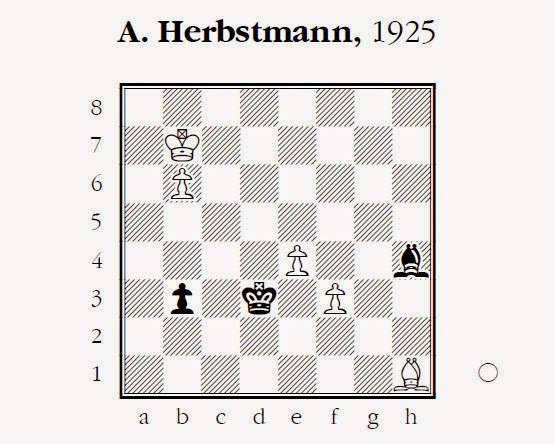


This surely has to be a really brilliant tactic because even though there are only a few legal moves for each side I have only found part of the solution after more than an hour of analysing.
Both sides have a pawn 2 sqares from promotion however the white king is blocking his own pawn.
here is an elegant variation that I found that saves the game for white
1.Ka8 b2
2.b7 Bg3 (2… b1=Q 3.b8=Q looks drawn)
3.f4 screening the queening square
3…Bxf4
4.e5 Bxe5
5.b8=Q Bxb8
5.Bd5! the lifeless bishop explodes energetically and finds its optimum square
if 5…b1=Q
6.Be4+ Kxe4 stalemate (otherwise 7.Bxb1)
if 5…any other move then
6.Ba2 controlling the queening square and drawing
That truly was a beautiful variation however there seems to be a flaw in it as black can improve his response
1.Ka8 Bd8
2.b7 Bc7 and now white can not queen nor prevent black from queening. Additionally white is in a mating net unless he sacrifices the pawn by queening it.
So it seems that I am stuck here with maybe half a solution. I have either missed the continuation after 1.Ka8 Bd8 or 1.Ka8 is not the correct move. But what else is there?
1.Ka6/c6 does not control the queening square
1.Ka7 Bf2 and black can sacrifice his bishop for the b pawn
1.Kc7 Bg3 looks completely winning.
I hope I am not being blinded by the elegance of the initial variation but I do think that 1.Ka8 must be the right move but I can noe see what to do after 1…Bd8
e5,b2;
Kc7,b1=Q;
b7,QC1+;
Kd7,Qb1
Kc7,qc1+
Kd7……
e5,b2;
kc7,b1=Q;
b7,QC1+;
Kd7,Qb1;
Kc7…..
Only possible alternative to resign is to play e5, f4, Bc6! and Kc7. Black will then for ever be up with queen, but the white king is nicely protected by his bishop.
Black bishop is out of play. If it tries early to attack b6, this gives white tempo to play e6.
A black win should probably start with attacking f4, but this might give white tempo to play b7 and b8=Q, and if black allowed that, white would win.
I think best play from black is to not be in a hurry queening, but to concentrate on preventing white from building a fortress:
1. e5 Bg3! (trying to prevent white from building a fortress)
2. e6 (enforced) Bh4
The alternative was:
2. … Bd6(?)
3. Kc6 b2 (Bf8?? b7 white wins)
4. Kxd6 b1=Q
5. e7 Qb5+ (only move)
6. Bc6!
Very interesting….
So black’s best here would be:
1. e5 Bg3
2. e6 Bh4
This makes the e6 pawn weak, it will be attacked from behind with Qe1.
Can white still keep a draw here?
It looks unlikely…
1. Ka8!..b2
2. b7!..
If A. 2……b1=Q
3. b8=Q draw!
If B 2…..Bg3
3. f4!…Bxf4 forced (If 3…b1=Q then 4. b8=Q and draws as in variation B)
4. e5!…Bxe5 again forced (If 4..b1=Q then 5. b8=Q and draws as in variation B)
5. b8=Q!.Bxb8 forced as otherwise draw as in variation B.
6. Bd5!!.b1=Q forced (otherwise 7. Ba2 stops the b pawn from queening; the black king can attack the bishop only from a3 when the bishop can hide in b1. the black bishop is unfortunately of the opposite color.)
7.Be4+!!.Kxe4 stalemate
On other 7……Kmoves 8. Bxb1 drawn!
It is to be noted that 1. Ka7?? does not work as it black refutes it by:-
• 1….Bf2!! to knock off the white b pawn next move and queen his own b pawn for a black win!
• or 5……Bxb8+ spoiling white’s chances of stalemate for a black win
Harry
Looks like a first April prank lol
That’s nice!
1.Ka8!
Very nice 🙂
1.Ka8!
Let me state up front, I think this might be a flawed problem.
White can get his queen on the board in 3 moves, black in 2, so it isn’t a question of speed of the pawns- the problem lies in preventing black from covering the queening square while losing the minimal time in doing so. This can’t be accomplished by pushing the kingside pawns immediately because white simply doesn’t have the time for this at the moment:
1. e5?? b2!
2. Kc8 b1Q
3. b7 Qc2
4. Kd7 Qa4
5. Kc7 Qa5 (attacking e5)
6. Kd7 Qd5
7. Kc7 Bd8
8. Kc8 Ba5 and white will get mated here, even if he queens or underpromotes the pawn, details left to the curious.
Now, can white move his bishop to try to cover black’s queening square? I don’t see how- the bishop has only g2 open, and from g2 I don’t see a plausible path:
1. Bg2 b2
2. Bf1 Kd4
3. Kc8 b1Q
4. b7 Bg3 and it is over.
So, white must move the king, but where to? The king cannot move to c6 or a6 since the king must support the new white queen on b8 since black will queen the half move ahead. If the white king plays to c7, black can check from g3 in several variations to skewer the king and queen/queening square, and if the king plays to a7, black can play Bf2 and take white’s pawn off the board immediately by pinning it to the king. This leaves Ka8 and Kc8. Let’s look at Ka8 first since I can already see the problem black might have, and how black might solve it:
1. Ka8 Bg3 (alternatives later)
2. f4!
Not e5 here- white must move the pawns in this order since white needs to get rid of both of them without losing a tempo, as we will see:
2. …..Bf4
3. e5! Be5
4. Bd5
I think even Bc6 or Bf3 are ok here. Continuing:
4. …..b2
5. Ba2 and this is clearly drawn- the black king cannot both drive away the white bishop from a2 and prevent the bishop from taking up residence on the b1/h7 diagonal. This is the problem of bishops of opposite color.
However, black doesn’t have to try a hasty Bg3 at move 1 in this line- there is another way to cover b8 without allowing white the time to clear the pawns out of the way of his bishop:
1. Ka8 Bd8!!
Gains a tempo to allow Bc7:
2. b7
Or [2.e5 b2! 3.b7 Bc7! 4.b8Q Bb8 5.Kb8 b1Q-+]. Continuing:
2. …..Bc7
3. b8Q
If white doesn’t clear the pawn, black can threaten to queen and mate on the a-file. Continuing:
3. …..Bb8
4. Kb8 b2
5. Kc7 b1Q with a decisive edge.
Clearly, white must hope 1.Kc8, preventing Bd8 is the right move, but I am just not seeing how this holds:
1. Kc8 b2
2. f4 b1Q
3. b7 Qc1
4. Kd7 Qf4 wins easily.
I have tried every variation I can think of here, and find no draws for white.
Another reason I think this might be flawed is that I think idea is a stalemate theme with the king on a8, the black bishop on b8, a new black queen on b1, the white pawns gone, and the white bishop sacrificed at e4. I just don’t see how this position arises after 1.Ka8 Bd8.
I will keep trying, but right now my conclusion is black wins this.
Is this position correct? The classic stalemate routine with 1.Ka8 does not work here because of 1…Bd8 or am I missing something?
To Anonymous at 1:11:00 PM,
I tried constructing a position where the stalemate theme operates after giving up on the present position which I am convinced is flawed. I came up with this one which takes away the possibility of Bd8, but I also had to move one the white pawns. I think white draw via stalemate after 1.Ka8 in this variation, but am not yet 100% sure:
8/1K6/1P6/8/4P3/1p1k4/5P2/6bB w – – 0 1