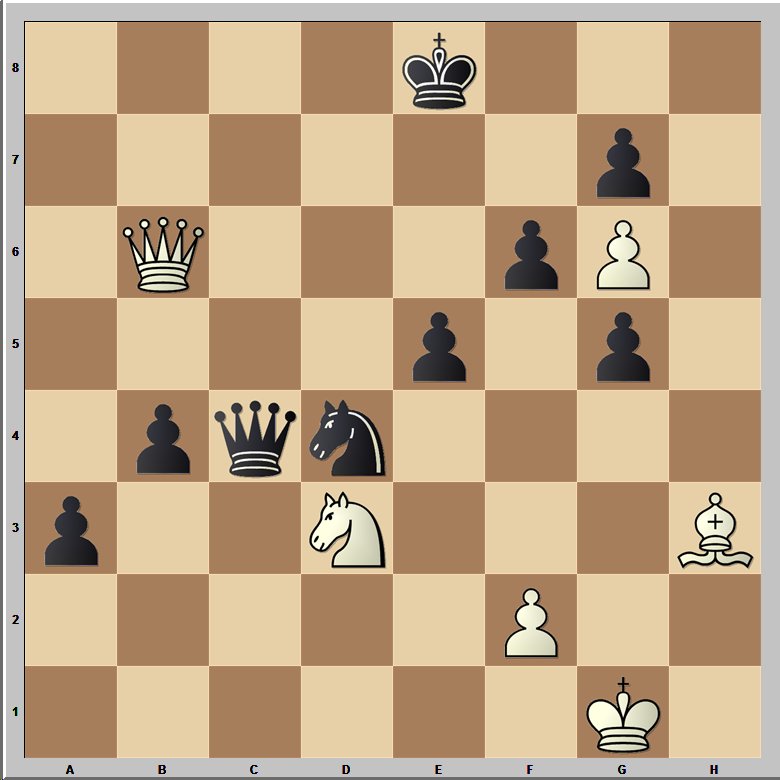
4k3/6p1/1Q3pP1/4p1p1/1pqn4/p2N3B/5P2/6K1 w – – 0 1
White to move. Assess the position. How should White continue?
Level of difficulty: 3 out of 4

Chess Daily News from Susan Polgar

4k3/6p1/1Q3pP1/4p1p1/1pqn4/p2N3B/5P2/6K1 w – – 0 1
White to move. Assess the position. How should White continue?
Level of difficulty: 3 out of 4
1. Qb8+ Ke7 (only)
2. Qb7+ Kf8 (Kd6/Kd8 Qd7#, Ke8 Qd7+ Kf8 Qd8#)
And now, if I think I shall win this, I shall probably continue with 3. Qd7 threating Qd8#.
But, is this too vulnerable to Q and N checks from black? I’m afraid of Nf3+ Kg2 Nh4+ etc.
I guess I settle with a draw here.
3. Qb8+ Ke7 drawing.
Sorry!
In my previous comment I had strangely and ridiculously moved the d3 knight to c5 (witheout this move being visible in my line). This changes everything (no Q checks on c1/f4), so now I change my mind and go for a win!
1. Qb8+ Ke7
2. Qb7+ Kf8
3. Qd7!
3. … Nf3+ 4. Kh8! mate in 2 more
3. … Ne2+ 4. Kh2! mate in 2 more
3. … Nc6 (seems critical)
4. Be6! Qxe6
5. Qxe6 Nd8
6. Qd7! a2 (Nc6 Qf7#)
7. Qxd8#
Looks like mate in 7.
.Qb8 Ke7 2.Qb7 Kf8 3.Qd7 and mate on d8 or f7 If 3…Ne2+ then 4 Kh2 and if 3…Nf3+ then 4 Kh1
White has draw by perpetual in hand at the very least:
1. Qb8 Ke7
2. Qb7 Kd8 (Kd6?? 3.Qd7#)
3. Qb8 Ke7 etc.
So, the question is this- can white find a winning line? At move 2, he might try Qh8 with the idea of Qxg7. The idea I have in mind is to force an exchange of queens at f7 and queen the g-pawn to win the game, or to win at g7 and push the g-pawn. Let’s take a look at this in a little more detail:
1. Qb8 Ke7
2. Qh8 Qd3
Black could try different things here, but I don’t really care if some of them actually win- I just want to determine whether or not black can’t just force a draw on white in this line. I think black can draw with a2 or even Ne6 here, but I have not given it more than a few seconds consideration. If I were black here, I would just take the knight anyway. Continuing:
3. Qg7 Kd6!(Ke8 4.Qd7; Kd8 4.Qd7#)
4. Qf6
I don’t see anything better. There is going to be no mate starting with Qd7 since the black king can just avoid any white squares ensuring that black will have a needed tempo to arrange more defense for the king when needed (remember, the bishop at h3 is hanging right now). Continuing:
4. …..Kc5
5. g7 Qh3
I think black might not win a pawn race here: [5. …a2?? 6.Qf8 Kc6 7.Qa8 Kc5 8.Qa7 Kb5 9.g8Q should be winning for white, though I haven’t done an exhaustive analysis of this line, it is hard for me to see what black could do that would be better- it doesn’t seem possible to avoid the checks from the a-file in the end.] With 5. …Qh3, black has his own threats of mate. Continuing:
6. Qe5 Kc6!
The only move- Kb6 allows Qxd4 with check, and Kc4 allows g8Q with check. Continuing:
7. Qd4
I can’t imagine there is anything better here. Black need only avoid allowing the capture of the knight with check, or allowing the pawn to queen with check. To make any progress, white must eliminate the mating threat black is holding over him. Continuing:
7. …..Qe6! and white has no checks available on the next move, and black will have time to push a2 and get a draw at minimum.
So, I don’t think my plan with 2.Qh8 has any winning chances, and may have many dangers for white losing. Back to the drawing board.
My next thought is a quieter first move:
1. Qb7
This threatens Qd7+. Black can block the bishop with f5, or he can just go for the perpetual himself:
1. …..Ne2
2. Kh2
Or 2.Kf1 Qd3 protects d7 and threatens Nf4. Continuing:
2. …..g4
I don’t like Qd3 now since white has an extra tempo in hand that he didn’t in the sideline above: [2…Qd3? 3.Qg7! Nf4 4.Qh8+! Ke7 5.g7 and black is going to have to try to hold the position with N+5P vs Q+P (exchanging at h3 with 5. …Qxh3). I have no idea just how easy or hard it is to win this for white, but I would rather be white.] Continuing:
3. Bg2 Nd4
I don’t see how you deal with the threat of Bc6+- for example: [3. …a2 4.Bc6 Qc6 (or 4. …Kf8 5.Qc8 Ke7 6.Qe8 Kd6 7.Qd7#) 5.Qc6 Kd8 6.Nc5 with mate coming no matter what black does.] Continuing:
4. Bd5 Qb5
I don’t know what else black has here. 4. …Nf3 seems well met by Kg3, and 4. …g3 is well met by Kg2 giving white the time he needs to press his attack. Continuing:
5. Qf7 Kd8
6. Qf8 Qe8 (Kd7/c7 7.Qg7 still)
7. Qg7
I don’t think white can win the ending that starts with 7.Qe8- both white pieces will be needed to hold up the queenside passers, so white will not be able to bring a knight over to g7. Continuing:
7. …..a2
What else here? The threats of Qf6 with check must be met, and Qe7 fails to Qh8+ followed by g7. 7. …a2 at least deflects the bishop for a bit. Continuing:
8. Qf6 Qe7 (nothing better now)
9. Qh8 Kc7
10.Ba2 Nf5 (hopeless now)
11.Qe5 and this ending is surely winning.
There are a few loose threads in this line- I simply can’t cover them all, but I think black is going lose with 1. …Ne2. So, now let’s look at 1. …f5:
1. Qb7 f5
2. Qb8 Ke7 (Kd7?! 3.Ne5+ wins)
3. Qe5 Ne6
The alternatives looks worse to me- Kd7 allows Nc5 with check and a later Bg2 with check (or black gets mated otherwise); Kd8 allows Qd6+ followed by Ne5 with a strong attack, and the same goes for Kf8. For example: [3. …Kd8 4.Qd6 Kc8 5.Ne5! Qc7 (or 5. …Qc1 6.Bf1 Ne2 7.Kg2 Nf4 8.Kh2! Qf1 9.Qd7 Kb8 10.Nc6 Ka8 11.Qa7#) 6.Qd4 and this should be winning for white up two pieces for 4 pawns and an attack on the black king to boot]. Continuing:
4. Bf5 a2 (need counterplay)
5. Nb4 a1Q
6. Qa1 Qb4
7. Be6 Ke6
8. Qg7 Qg4 and I have played this sort of ending so many times that I don’t even need to analyze it to know that the white king can never escape the checks effectively- the black queen just checks from g4, h4, and e1 when needed, the white king can’t get out of that corner.
Right now, I have to say that 1.Qb7 can’t win either, but this is analysis might well have holes I haven’t seen. Right now, I have to conclude this starting position is drawn with proper play.
1.Qb8+ Ke7
2.Nxe5 fxe5
3.Qxe5+ Kd8
4.Qd6+ Ke8
5.Qe7++
and if 2…Qc1+
then 3.Kg2 and the same follows
Unless I’m missing something, I think this is easier than 3/4.
Crap, I don’t know how I missed this earlier- this puzzle is much simpler than I had thought initially- I got tricked by that difficulty rating:
1. Qb8 Ke7
2. Qb7 Kf8(Kd8 3.Qd7; Ke8 3.Qd7+-)
3. Qd7! Nc6
There are no mating or perpetual check threats on white’s king that can change things- if Nf3, white plays Kh1 and black has no checks left- if Ne2, Kh2 does the trick. Black’s queen is tied to the a2/g8 diagonal due to the Qf7# threat. There are no real defenses both Qf7# and Qe8#. Continuing:
4. Be6 and it is over.
A draw is the best I can do starting with Qb8+. This is due to the twin attack from the Queen and the Knight through which Black can force a draw
I wrote another comment yesterday, that is still not visible here.
White wins like this:
1. Qb8+ Ke7
2. Qb7+ Kf8
3. Qd7! threating Qd8#
3. … Nc6 (Ne2+ Kh2!, Nf3+ Kh1!)
4. Be6! threating Qf7#
4. … Qxe6
5. Qxe6 Nd8
6. Qd7 mating next
Alternative line with similar conclusion, less tenuously I believe, is 1. Qd6 after which White faces no real threats (Nf3+ met with simply Kg2 and then no other checks on board) — 2. Bb7+ Kd8 and then revealed check might win queen – if not, white’s close to mating anyway.