Menu   ≡ ╳
  • News
    • Major Tournaments
    • General News
    • USA Chess
  • Puzzles
  • Improvement
  • Event
  • College
  • Scholastic
  • Women
  • Search

        More results...

        Or you can try to:
        Search in Shop
        Exact matches only
        Search in title
        Search in content
        Search in comments
        Search in excerpt
        Search for News
        Search in pages
        Search in groups
        Search in users
        Search in forums
        Filter by Categories

        Try these: Sicilian Defense, Empire Chess, USA Chess

    • SPICE
    • Videos
    • Susan’s Blog
    • About Us
    • Contact Us
    • SPICE
    • Videos
    • Susan’s Blog
    • About Us
    • Contact Us
    Menu   ≡ ╳
    • News
      • Major Tournaments
      • General News
      • USA Chess
    • Puzzles
    • Improvement
    • Event
    • College
    • Scholastic
    • Women
    • Search

          More results...

          Or you can try to:
          Search in Shop
          Exact matches only
          Search in title
          Search in content
          Search in comments
          Search in excerpt
          Search for News
          Search in pages
          Search in groups
          Search in users
          Search in forums
          Filter by Categories

          Try these: Sicilian Defense, Empire Chess, USA Chess

      Home  >  Chess Improvement • Chess Puzzles  >  Checkmate in 3

      Checkmate in 3

      Chess tactic, Puzzle Solving


      Chess
      By Lubomir Kavalek
      Monday, December 21, 2009; 10:10 AM

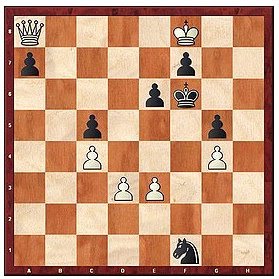
      Vasily Smyslov, 88, became the world chess champion in 1957, defeating Mikhail Botvinnik. Aside from having a great career as a practical player, Smyslov also produced more than 100 endgame studies, the most of any world champion. In his teens he tried his hand at composing problems. In 1935, at age 14, Smyslov created the following (above) problem (White: Kf8, Qa8, P:c4,d3,e3,g4; Black: Kf6,Nf1,P:a7,c5,e6,f7,g5) in which white mates in three moves.

      Source: http://www.washingtonpost.com

      Posted by Picasa
      Chess Daily News from Susan Polgar
      Previous Article Always nice to be at the pinnacle
      Next Article Breakaway Indian Chess Body

      About Author

      Susan Polgar

      Related Posts

      • More Special Endgame!

        January 3, 2021
      • Precision Chess Tactic

        December 27, 2020
      • Daily dose of tactic!

        December 21, 2020

      18 Comments

      1. Alexandre de Resende Reply
        December 22, 2009 at 8:54 am

        This comment has been removed by the author.

      2. aam Reply
        December 22, 2009 at 9:04 am

        1, Qh1! Ke5
        2. Ke7 f5
        3. Qh8#

        if black does not move 1… Ke5, e.g., if 1… Nxe3 or 1… Ng3 or 1… a5 then
        2. Qh8+, Kg6 3. Qg7#

        after 1. Qh1, Ke5 2. Ke7, if black does not move 2… f5, the threat is 3. Qe4#

        if 1. Qh1, Ke5 2. Ke7, Ng3 (guarding e4), then 3. Qa1#
        same for 2… Ne2 (instead of 2… Ng3)

        Notes:

        The following doesn’t work:

        1. Qxa7

        the threat is:
        2. Qa8+ e5, 3. Qa6#

        or
        2. Qa8+ Kg6, 3. Qg7#

        Black can only move the N, or e-pawn, or the King.

        if black moves the N on move 1 (to any square), 2. Qa8+ will mate on next move.

        if 1… e5, 2. Qa6#

        however, the following prevents mate in 3:
        1… Ke5, 2. Ke7, Nxe3
        now if 3. Qxc5+ Nd5+

        or if 3. Qa1+ Kf4 so no mate in 3.

      3. aam Reply
        December 22, 2009 at 9:07 am

        Continuing with the previous solution, after 1. Qh1, if 1… Nh2 (obstructing the h file), then

        2. Qa1+ e5, 3. Qa6#

      4. Jochen Reply
        December 22, 2009 at 9:30 am

        This theme is well known. It took me some time, though.

        1. Qh1! and here are some lines.
        The threat is 2. Qh8+, Kg6 3. Qg7

        1. -, Nh2 2. Qa1+!, Kg6/e5 2. Qg7/Qa6!#

        1. -, Ke5 2. Ke7 threatening Qe4#.
        2. -, Ng3 (or Nd2) 3. Qa1#

        The white queen appears in all four corners.

        Merry christmas to everyone there are only two days left. 🙂
        Jochen

      5. Ashoka Reply
        December 22, 2009 at 9:34 am

        1)Qh1! Ke5
        2)Ke7!

      6. Anonymous Reply
        December 22, 2009 at 9:59 am

        @Alexandre: Qa6 is followed by Rg8, it doesn’t work.
        I propose
        1. Bc4 and mate follows straightforwardly.

      7. Alexandre de Resende Reply
        December 22, 2009 at 10:29 am

        1.Qf3+ Kg6
        2.Qxf7+ Kh6
        3.Qg7#

      8. Alexandre de Resende Reply
        December 22, 2009 at 10:31 am

        focusing on mate didn’t even see the pawn…

      9. Anonymous Reply
        December 22, 2009 at 10:32 am

        Qa7, Qa1, Qg7 mate

      10. Alexandre de Resende Reply
        December 22, 2009 at 10:34 am

        1.Qf3+ Ke5
        2.Ke7 and mate follow

      11. Anonymous Reply
        December 22, 2009 at 10:34 am

        munich solution Qa7-Qa1-Qg7, greets

      12. Anonymous Reply
        December 22, 2009 at 10:48 am

        1. Qh1 Ke5
        2. Ke7 Ng3
        3. Qa1#

      13. Anonymous Reply
        December 22, 2009 at 11:14 am

        q-d8 followed by k-f7

      14. Asbjørn Reply
        December 22, 2009 at 1:10 pm

        Let’s see if I can get this right 🙂

        1 Qh1! Ke5
        (1 .. e5 2 Qc6#)
        (1 .. Ng3/Nxe3/Nd2 2. Qh8+ Kg6 3. Qg7#)
        (1 .. Nh2 2 Qa1+ e5 3 Qa6# – nice queen manouver 🙂 )
        (1 .. Nd2 2 Qa1+ Kg6 3 Qg7#)
        (1 .. Kg6 2 Qh8 and 3 Qg7#)
        2 Ke7! f5
        (2 .. Nd2/Ng3/Nh2 3 Qa1#)
        (2 .. Nxe3 3 Qe4#)
        (2 .. f6 3 Qe4#)
        3 Qh8#

      15. Anonymous Reply
        December 22, 2009 at 1:24 pm

        Qh1!

      16. Anonymous Reply
        December 22, 2009 at 1:47 pm

        Qh1! with mates on either h8, h6 or a6 (via a1)

      17. Anonymous Reply
        December 22, 2009 at 5:13 pm

        Am I missing something? Qh1 cannot possibly be white’s first move, because black can just respond with e7#. The first move should rather be Qf3, I think.

      18. Consul Reply
        December 22, 2009 at 5:43 pm

        Asbjørn has the complete solution.

      Leave a Reply to Jochen Cancel reply

      Improvement

      • Important Scholastic Coaching Tips
      • My Chess Quotes Over The Years
      • My kids know chess rules. What’s next?
      • Chess Parenting

      Events

      • My Top 10 Most Memorable Moments in Chess (Part 3) May 13, 2021
      • My Top 10 Most Memorable Moments in Chess (Part 2) May 12, 2021
      • My Top 10 Most Memorable Moments in Chess (Part 1) May 10, 2021
      • About Susan Polgar April 9, 2021
      • About Us
      • Contact Us
      • Daily News
      • My Account
      • Terms & Conditions
      • Privacy Policy

      Anand Armenia Breaking News Chess Club and Scholastic Center of St Louis Chess interview Chess Olympiad Chess tactic Chess tournament chess trivia China FIDE Grand Prix Holland India Khanty-Mansiysk LIVE games Lubbock Magnus Carlsen Moscow National Championship Norway OnlineChessLessons Philippines Puzzle Solving Russia Scholastic chess Spain SPF SPICE SPICE Cup St Louis Susan Polgar Tata Steel Chess Texas Tech Tromsø TTU Turkey Webster University Wesley So Wijk aan Zee Women's Chess Women's Grand Prix Women's World Championship World Championship World Cup

      April 2026
      M T W T F S S
       12345
      6789101112
      13141516171819
      20212223242526
      27282930  
      « Sep