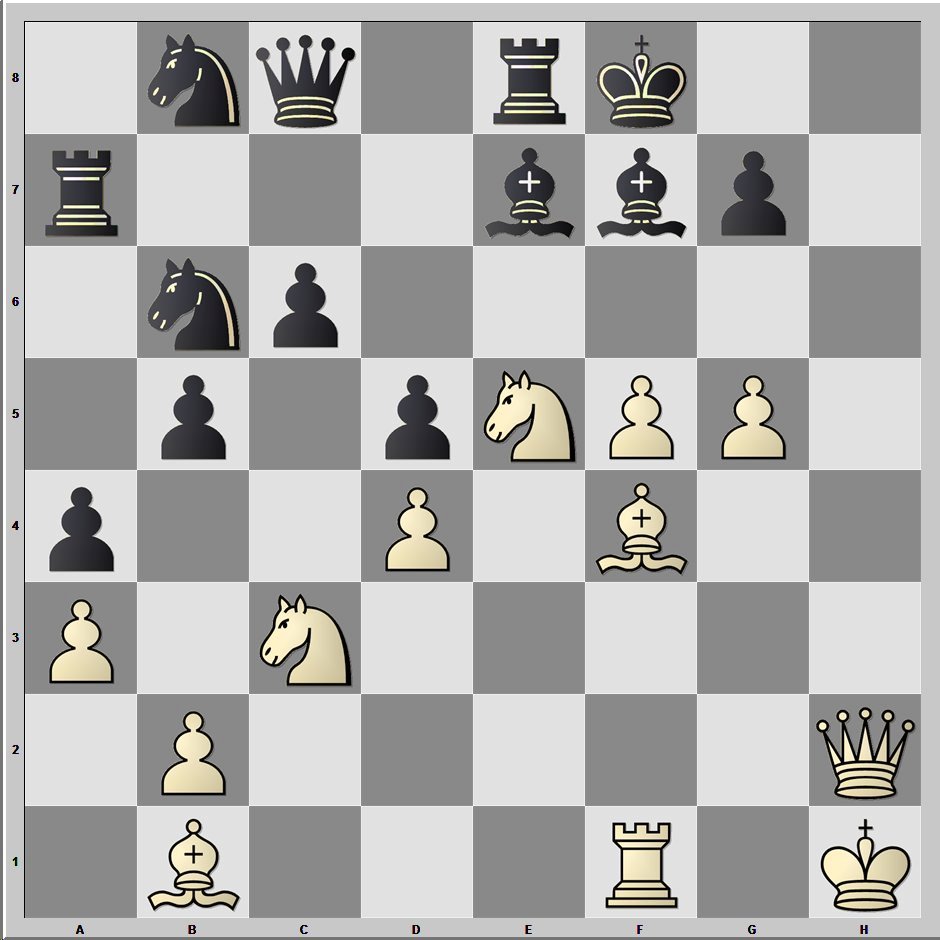
White to move and checkmate in 4
1nq1rk2/r3bbp1/1np5/1p1pNPP1/p2P1B2/P1N5/1P5Q/1B3R1K w – – 0 1
Chess Daily News from Susan Polgar


White to move and checkmate in 4
1nq1rk2/r3bbp1/1np5/1p1pNPP1/p2P1B2/P1N5/1P5Q/1B3R1K w – – 0 1
A good looking move here that I should have played without knowing about an enforced mate, is:
1. f6! Bxf6 (other moves look worse)
2. gxf6 gxf6
3. Qh8+ Bg8
4. Qxf6+ Bf7
5. Bh6#
Well, I could not make it 4 moves (and I even suspect black could have delayed more) so I must have missed something.
Beautiful solution showcasing the power of pieces across diagonal and the long reach of the Queen.
1.Ng6+.Bxg6 (else 2.Qh8#)
2.Qh8+.Kf7.
3.fxg6+.Ke6.
4.Qh3#!
Harry
Assuming black makes the following moves:
1) f5-f6 g7xf6
2) Bb1-h7 Qc8-e6
3) Qh2-h6#
Nakamura solved this in 1.4 second.
1.Ng6 Bxg6 2.fxg6 Kg8 3.Qh7+ Kf8 4.Qh8#
The bishop at f7 appears overworked, guarding g6 against the knight check and interposing at g8 upon Qh8+.
1. Ng6+ bxg6 Of course if …Kg8, 2. Qh8# supported by the Knight
2. Qh8+ … No more Bishop to interpose. On the other hand, by capturing the Knight, Black also created a flight square at f7. Tempting also is 2. fxg6 first, taking a way the flight sqaure and renewing the threat of mate-on-the move with Qh8. The pawn capture also opens the file for the Rook and creates a possible discovered attack with a Bishop move. In a real over-the-board game, this is something White would have to cnsider also if he or she didn’t spot the clear mate that follows 2. Qh8+
2. … Kf7
3. fxg6+ Ke6 Uh-oh isn’t the King starting to run away?
4. Qh3 mate Perhaps the psychological difficulty, if there is one, in foreseeing this move is, a) it involves moving a piece twice when there seems White has other good pieces that seem waiting to do something (of course the Bishops are doing something. The light-squared one protects the pawn on g6 from recapture and the dark-squared one, after the initial Knight move, has “discovered” its control of the dark-squared flight squares., b) the Rook plays no part in the mate in spite of what seemed a thematic opening of the file for it. In addition, retreating pieces in an attack are, perhaps, a little more unexpected. The other “pattern” that helped me see the Queen check on h3 is that, after 3. fxg6 Ke6, the King is blocked from going back to where he was before so the White Queen’s covering of those squares is no longer needed and the Queen can be used for something else. That’s a “pattern” I’m slowly starting to learn to look for.
Someone certainly couldn’t be blamed for being tempted by 2. fxg6 first and I think it might win, though not mate in 4. I think it’s an interesting line to look at even if it isn’t the solution to mate-in-four
– Craigaroo
Harry gives the solution that I saw but , y’know, I wonder if it’s mate in four even if White plays 2. fxg6 instead of 2. Qh8+. I’ll have to look at it again later.
-Craigaroo
No Craigaroo! 1.Ng6+..Bxg6.2.fxg6
At a minimum it will delay white by one move – black can interpose 2……Qh3! Then
3.Qxh3.Bf6! There is no mate on the move now for white!
Harry
Harry’s right (nice find!) that the mate can be delayed by at least one move if White plays 2. fxg6. However, the tactics are quite lovely in that line as well and as far as I can see result in mate (OK in 5 not 4)and perfectly understandable for someone to be attracted to that line and try to work out the win.
– Craigaroo
Does playing the pawn capture first also lead to mate (if not in four as Harry pointed out)?
1. Ng6+ Bxg6
2. fxg6 …. Here Harry points out that Black can at least delay mate one more move by sacking the Queen with 2…Qh3 // Someone pointed out the line 2… Kg8, 3. Qh7+ Kf8, 4 Qh8#. The most thematic idea though would be for Black to create a flight square by moving the Bishop off of e7
[A]
2. … Bf6 at least trying to block the Rook’s discovered attack
3. Bd6+ R(either)e7 By interposing, the King is smothered again but if 3…Kg8, 4. Qh7#
4. Qh8#
[B]
2. … Bxa3 A “stupid” move in a sense because of course the Bishop can simply be taken, but this is a desperation move by Black to at least have the Bishop still in contact with d6
3. Bd6++ … Anyway! There’s that discovered attack we were hoping for. After 3…Kg8, 4. Qh7#
[C]
2. … Qe6 In order to interpose the Queen after 3.Qh8+
3. Qh8+ Qg8
4. Bd6 mate! Who cares if our Queen is hanging?! The discovered check wins. Bishop pins Bishop and prevents it from interposing at f6.
So I think someone whose instinct is to look at 2. fxg6 is justified in a pure chess sense. Unless I’m missing something (which of course is possible), it wins, it mates. It even does so beautifully. Just not in four moves.
Over the board it is easier to feel without deep calculation that 2.fxg6 wins sweetly. White has a) regained material b)still has a threat of Qh8# c) has option of Bxb8+ discovered check winning more material (wayward rook on a7) and d)devastating attack along the diagonals and e) no risk for white.
Hence practical play easily justifies 2.fxg6, so what if it is mate in 5 not in 4? The lines exhibiting the power of dominating white pieces against the respective corresponding black pieces which only prevent the black king from escaping instead of protecting is beautiful! Extremely effective!
However the mate in 4 line is difficult to find over the board unless told so! It is elegant for it mates across a open board without even engaging the black pieces! It is extremely efficient and meets the required mate in 4!
Harry