Menu   ≡ ╳
  • News
    • Major Tournaments
    • General News
    • USA Chess
  • Puzzles
  • Improvement
  • Event
  • College
  • Scholastic
  • Women
  • Search

        More results...

        Or you can try to:
        Search in Shop
        Exact matches only
        Search in title
        Search in content
        Search in comments
        Search in excerpt
        Search for News
        Search in pages
        Search in groups
        Search in users
        Search in forums
        Filter by Categories

        Try these: Sicilian Defense, Empire Chess, USA Chess

    • SPICE
    • Videos
    • Susan’s Blog
    • About Us
    • Contact Us
    • SPICE
    • Videos
    • Susan’s Blog
    • About Us
    • Contact Us
    Menu   ≡ ╳
    • News
      • Major Tournaments
      • General News
      • USA Chess
    • Puzzles
    • Improvement
    • Event
    • College
    • Scholastic
    • Women
    • Search

          More results...

          Or you can try to:
          Search in Shop
          Exact matches only
          Search in title
          Search in content
          Search in comments
          Search in excerpt
          Search for News
          Search in pages
          Search in groups
          Search in users
          Search in forums
          Filter by Categories

          Try these: Sicilian Defense, Empire Chess, USA Chess

      Home  >  Chess Improvement • Chess Puzzles  >  Chess composition

      Chess composition

      Chess tactic, Puzzle Solving


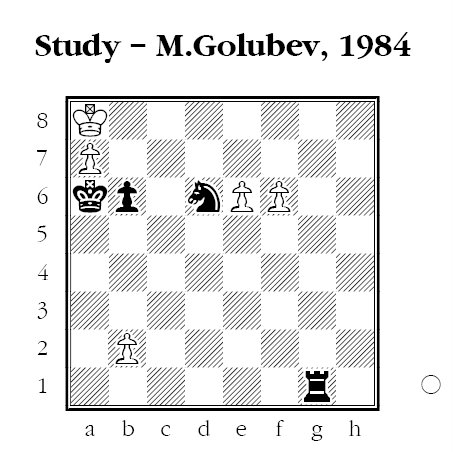
      White to move and win. This was composed by GM Golubev about 25 years ago. Enjoy 🙂

      Source: ChessToday.net

      Posted by Picasa
      Chess Daily News from Susan Polgar
      Previous Article A magical run
      Next Article The deciding games

      About Author

      Susan Polgar

      Related Posts

      • More Special Endgame!

        January 3, 2021
      • Precision Chess Tactic

        December 27, 2020
      • Daily dose of tactic!

        December 21, 2020

      12 Comments

      1. Anonymous Reply
        December 2, 2009 at 5:54 pm

        It was pretty clear that 1.f7 was the right move from the beginning:

        1.Kb8?? Rg8+ 2.Kc7 Ne8+ followed by Nxf6.

        so

        1.f7! Rc1 2.f8=Q Rc8+ 3.Qxc8 Nxc8 This is where you have to focus.

        4.Kb8 would not work after 4…Nxa7, so what’s the difference between 4.b3 and b4?

        If 4.b3?? Nxa7 5.e7 Nb5 6.e8=N it’s a draw. By reading this paragraph you’ve hopefully understood what happens after 4.b4.

        4.b4 Nxa7 5.e7 Nb5 6.e8=N Nc7+ (forced this time because the b-pawn covers the a5 square) 7.Nxc7 mate.

        Lesson learned: when presented a problem such as this one, ask yourself what’s the difference between the similar variations.

      2. Anonymous Reply
        December 2, 2009 at 6:07 pm

        1.f7 Rc1 2.f8=Q Rc8 3.Qc8 Nc8 4.b3 b5
        5.b4 Ne7 6.Kb8 Nc6 7.Kc7 + –

      3. Anonymous Reply
        December 2, 2009 at 6:21 pm

        1.f7 Rc1 (Rf1 2.Kb8)
        2.f8:Q Rc8+
        3.Qxc8 Nxc8
        4.b3! b5 (kb5 5.Kb7)
        5.Kb8 Nxa7
        6.Kc7! now Nb5+ is no longer available thanks to b3! e7-e8 is following.

      4. Yancey Ward Reply
        December 2, 2009 at 6:28 pm

        Well, there are only two possible first moves Kb8 and f7 (only ways to stop Rg8#).

        1. Kb8 Rg8 (forced, I think)
        2. Kc7 Nf7 and, now, black has a8 covered by the rook, is threatening Ka7 immediately. Now, can the knight be taken at f7?

        3. ef7 Rh8
        4. Kd7 Ka7
        5. Ke7 and white wins; and

        3. …..Rf8 is no better in this line for black.

        So, at move two, black needs to consider another move for the knight (the more obvious one)

        1. Kb8 Rg8
        2. Kc7 Ne8
        3. Kd6 Nf6 and black should win this easily. All in all, I think Kb8 is a loser for white.

        1. f7 Rg7, and now, if
        2. f8(Q)Ra7
        3. Kb8 Rb7 with a perpetual. So, at move two, white must try something else to win in this line.

        1. f7 Rg7
        2. Kb8 Kb5 (Nf7/Rf7 loses to a8(Q)
        3. f8(Q)Rb7
        4. Ka8 Rc7
        5. e7 Rc8
        6. Qc8 Nc8
        7. e8(Q) wins. And, the other alterantive second move for black

        1. f7 Rc1
        2. f8(Q)Rc8
        3. Qc8 Nc8
        4. Kb8 Na7
        5. e7 wins for white.

      5. Yancey Ward Reply
        December 2, 2009 at 6:44 pm

        Also, I forgot:

        1. f7 Nf7
        2. ef7 Rf1
        3. Kb8 also wins for white.

      6. Lionel Davis Reply
        December 2, 2009 at 7:59 pm

        Uuughhh! (Peanuts} a white to move puzzle? Susan u didnt tell me Cost-a-Rook livin in Miami! Now we gotta swindle lil sister somehow, let me know if you come up with any ideas, the old ideas dont work ya know? Dunne hit me in the face on the U.S.C.F. website though! , i gotta tell u this, an old guy played the exchange caro vs. me at chess park, i put my pawn on f6! hehehehe. then i went to tears!!! Susan they “Mixin Me Up”! hahaha. THE CHESS GODS ARE AGAINST ME! hehe I QUIT! haha. IM SURPRISED VISHY LOST SO EASILY! hehe. UM not. hehe.

      7. Doofus Reply
        December 2, 2009 at 8:27 pm

        Not knowing whether this is a hard or an easy puzzle, I thought I had solved it, but was suspicious because some pawns seemed irrelevant. So I decided to check it with Fritz. And all I can say is WOW!! Suggest everyone keep looking until they are saying WOW!! as well

      8. Lionel Davis Reply
        December 2, 2009 at 8:42 pm

        Oh susan i just saw So- Malakhaov Wow!!! Doofus u forgot an exclaim! haha.

      9. One Brow Reply
        December 2, 2009 at 8:50 pm

        The only way to stop the mate seems to be f7.

        1. f7 Nxf7
        2. ef7 Rf1
        3. Kb8

        1. f7 Rf1
        2. Kb8

        1. f7 Rc1
        2. f8Q Rc8+
        3. Qxc8 Nxc8
        4. Bb8 Nxa7
        5. e7

        I’m probably missing a continuaton for Black somewhere

      10. Anonymous Reply
        December 2, 2009 at 11:52 pm

        Main line: 1. f7 Rc1 2. f8=Q Rc8+ 3. Qxc8 Nxc8 4. b4! Nxa7 5. e7 Nb5 6. e8=N!! ~ 7. N(x)c7#

      11. PhilF Reply
        December 3, 2009 at 12:29 am

        If white doesn’t want to get mated, then f7 must be the first move.

      12. Anonymous Reply
        December 3, 2009 at 7:17 am

        Interesting: After running 20min on a strong PC, Rybka3 could NOT find the solution on its’ own. Not even when (later in the game) the position is forced mate in 3 moves.

      Leave a Reply to Doofus Cancel reply

      Improvement

      • Important Scholastic Coaching Tips
      • My Chess Quotes Over The Years
      • My kids know chess rules. What’s next?
      • Chess Parenting

      Events

      • My Top 10 Most Memorable Moments in Chess (Part 3) May 13, 2021
      • My Top 10 Most Memorable Moments in Chess (Part 2) May 12, 2021
      • My Top 10 Most Memorable Moments in Chess (Part 1) May 10, 2021
      • About Susan Polgar April 9, 2021
      • About Us
      • Contact Us
      • Daily News
      • My Account
      • Terms & Conditions
      • Privacy Policy

      Anand Armenia Breaking News Chess Club and Scholastic Center of St Louis Chess interview Chess Olympiad Chess tactic Chess tournament chess trivia China FIDE Grand Prix Holland India Khanty-Mansiysk LIVE games Lubbock Magnus Carlsen Moscow National Championship Norway OnlineChessLessons Philippines Puzzle Solving Russia Scholastic chess Spain SPF SPICE SPICE Cup St Louis Susan Polgar Tata Steel Chess Texas Tech Tromsø TTU Turkey Webster University Wesley So Wijk aan Zee Women's Chess Women's Grand Prix Women's World Championship World Championship World Cup

      April 2026
      M T W T F S S
       12345
      6789101112
      13141516171819
      20212223242526
      27282930  
      « Sep