
Grandmasters’ Data Overcomes Artistry
By SHELBY LYMAN
August 28, 2007
Chess is rapidly changing. If professional matches and tournaments still exist 50 years from now, competing is likely to be a drastically different experience than it is today.
The opening phase of play is being continuously explored and recorded in readily accessible data bases. It is not uncommon for grandmasters to make 15 or 20 opening moves before they are on unfamiliar terrain.What will happen when the already known extends to 35 or 40 moves?
I am reminded of Balzac’s tale “The Shagreen Skin,” in which the hero’s mortality is linked to a piece of animal skin which becomes smaller each time he wishes or desires for something. In the end, it shrinks to nothing and he silently succumbs.
Incredibly, a large part of the game is disappearing from actual over-the-board combat like the diminishing skin, or a shoreline eroding before the irresistible encroachment of the sea.
Most grandmasters deplore the time-consuming data mining and drudgery which have become a necessity with the increase in accumulated chess knowledge. Many, including Bobby Fischer, have lamented the apparently diminishing role left for creativity.
The good news is that those legions of chess players who play simply for fun are not facing the dilemma of those who play professionally. They blithely continue to enjoy themselves, as they always have.
Here is the full story.

I remember Mr. Lyman from the Fischer – Spassky match.
It will be interesting to see what effect the computer has on the game of checkers: it has been shown to be a draw from the opening position. Will this kill what interest there is in checkers?
Computer capability is increasing because of better software ideas and bigger (you would be surprised how big) hardware. Computers are increasingly capable of analysing even the best games and showing them to be flawed.
If chess is seen as a game of keeping the draw you started with, and taking advantage of opponent’s mistakes, will it remain interesting? I doubt it.
Chess is also being eaten up from the back. Six man chess is a look-up job for computers and by 2020 seven man chess will be a done deal too.
Chess can be seen as good ground to develop an individual: put in 200 hours – the benefits are these … 2,000 hours, the benefits are not 10 times as much. Put in 20,000 hours: unless you are a pro competing at the top level, you may be too focussed on one small aspect of life.
Should some that 2,000 hours of childhood be spent looking at nature, playing sports with other people, becoming aware of current affairs across the world, whatever?
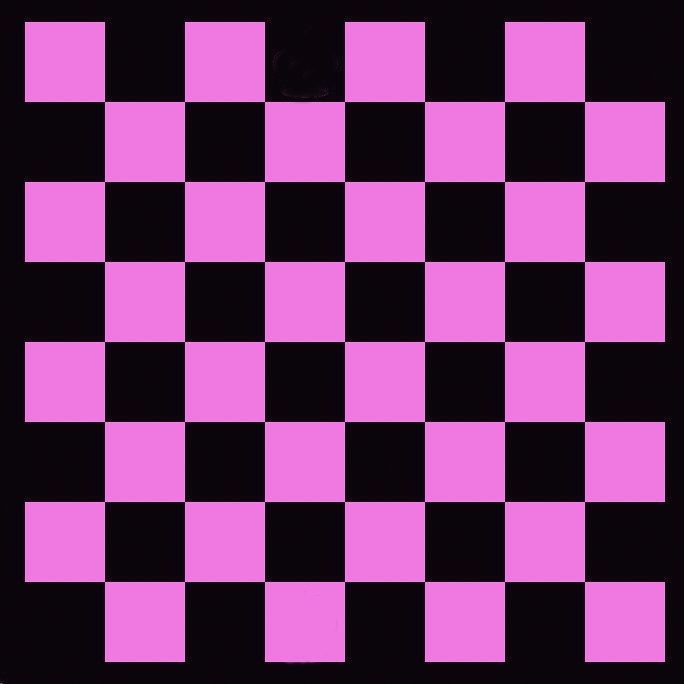
The pink on black chessboard patten that Susan has chosen for this news item has an interesting property. If you stare steadily at one point on it (I chose the very center of the board where e4 touches d5) for roughly 30 seconds and then stare away at a neutral background, the afterimage that results looks just like a standard green on white tournament board. Try it!
Brad Hoehne
Lyman wrote (of the opening and early middle game of traditional chess):
{Incredibly, a large part of the game is disappearing from actual over-the-board combat …}
True, and unfortunate.
John Watson claims that when the repetitious opening and early middle game moves are exhausted in a game, the game has a good chance of becoming unique. Watson says that great variety remains available no matter how deep into the game you get (until too many piece exchanges have occurred).
This claim by Watson seems to be generally true.
I think Watson was leading his readers to the implicit conclusion that the long phase of repetitious moves in traditional grandmaster chess therefore does Not diminish the variety in chess.
I disagree with Watson here. I say that “variety delayed is variety denied”. Chess960 brings variety much sooner, so that by the end, the total duration or amount of variety is greater in a chess960 game than in traditional chess1 game (on average among grandmasters).
Besides, which beginning would make you want to applaud more emotionally:
(aa) both GMs OTBoard reproduce a strong sequence of 34 plies, a sequence that has been known and replayed numerous times before, or…
(bb) both GMs OTBoard produce a strong sequence of 34 plies that has never been played before.
GeneM , CastleLong.com
Lyman wrote:
{Most grandmasters deplore the time-consuming data mining and drudgery which have become a necessity with the increase in accumulated chess knowledge. Many, including Bobby Fischer, have lamented the apparently diminishing role left for creativity.
False, I think.
If today’s elite grandmasters disliked having to spend most of their chess study time on openings, they would clamour for more chess960 tournaments: but they are not clamouring.
Indeed the top grandmasters are better than the GMs chasing right behind them partly because the top GMs are better at studying & memorizing the ideas of pre-planned openings.
V.Kramnik is better, perhaps much better, at traditional pre-planned openings than is L.Aronian: Kramnik is a better player of traditional chess1. But if Kramnik were to compete against Aronian in chess960, Aronian would probably win.
So Kramnik ain’t gonna lobby for chess960.
Chess players who dislike the heavy opening study needed to rise to the top in chess1 were weeded out years ago, by Darwinian forces. All of today’s top GMs do like studying the openings, or they would not be at the top. It is work and it keeps them from interacting more with their spouses and children, but to them it is fun or satisfying work.
Chess960 would take that work away from them; or so people casually and mistakenly think.
I believe that clever approaches could be, and would have to be, developed to produce new ways of understanding the opening phase of chess960. To deny this would be to imply that GMs would never get any stronger in their chess960 opening play, no matter how many years they devoted themselves to researching this topic: absurd.
The opening phase under chess960 is the very last vast unexplored area in all of chess. It is just waiting, ripe for whomever will be the first GM to research and publish its principles.
GeneM , CastleLong.com
P.S. If Lyman is right (the GMs deplore the drudgery of today’s form of opening study in chess1), then WHY don’t the GMs ask Tournament Organizers to hold more chess960 events??
I gather G.Kamsky wants more chess960 events, but I sense no widespead clamour.
In response to the second post, I recently went to a great Checkers tournament in Tennessee and can say that, though some did discuss the future of the game now that Chinook has solved one version of the game, they still play and enjoy it just as always.
I play both chess and checkers at the club level and play in some tournaments in both. The news that “American checkers” was solved (other versions such as 10’x10′ have not) was nothing new. It was a well known theory as far back as the 1890’s when (at that time) Checkers GM’s often reminded players that the game was a draw (in theory…that is, theory then, fact now).
So, considering that no human can play as well as the computer that solved checkers, its impact upon players even up to the GM level is not that great. Every day, somewhere, checkerists meet, play, and study the game. It is, I think, alive and well and will continue to be for the foreseeable future.
Computers will someday solve chess. It’s simply a matter of time. Considering that the best human players cannot defeat Rybka on even terms has already, I think, effected the chess community more than computers have have in professional checkers.
Since the vast majority of chess players are not even at the Master level, why are so many non-masters advocating Fischer Random so much?
Computer chess will continue. Humans will continue to play and that is that.
Anon wrote (Aug 29 06:30):
{
Since the vast majority of chess players are not even at the Master level, why are so many non-masters advocating Fischer Random so much?
}
Variety.
A set of traditional chess1 games suffers from repetition much more than does a set of chess960 games.
The repetition affects players at all rating levels. As just one of numerous examples — Even though details differ between several chess1 QGDeclined games, the knights still have the same basic relationship to the center and to knights of the opposing color. Ng1f3h4 still has the same relationship to Bc8f5g6.
Or, in many chess1 games of supposedly very different openings, the same repetitious N-B3 B-N5 P-R3 pin maneuver is still prevelant (such as ng8f6 Bc1g5 h76).
The chess1 setup is not the only setup that has its own esoteric and interesting tactical and positional themes. The other 959 setups each have just as much to offer, but chess1 hides all that from us.
GeneM