

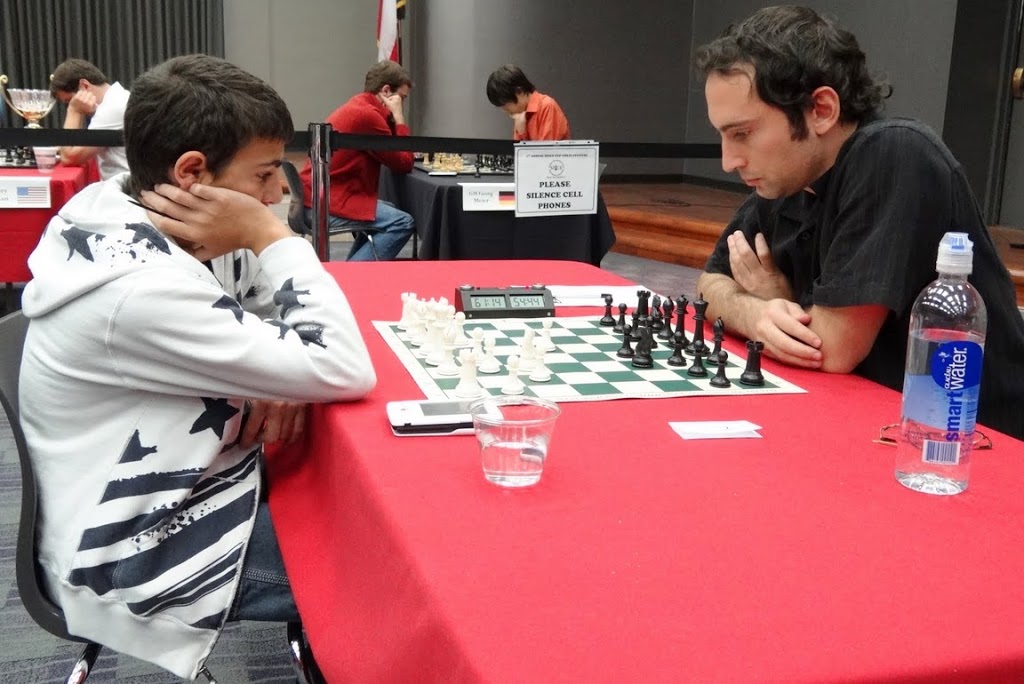
NM Lior Lapid (right) at the 2011 SPICE Cup Open
Chess players always think ahead
By Hailey Heinz / Journal Staff Writer
Tue, Nov 29, 2011
When elementary school students play chess, it looks a little different from the thoughtful, slow pace of adult chess.
Moves are made quickly, many pieces are captured, and chatter fills the room at Cien Aguas International charter school, which hosts a chess club for students every week.
The club is run by Lior Lapid, a three-time and current New Mexico chess champion. Lapid was born in Israel, but lived in Las Cruces for most of his life and recently moved to Albuquerque. He believes playing chess can help students succeed in school by increasing critical thinking, planning ahead and other mental skills.
“You can’t be successful in chess if you don’t plan ahead, but you also can’t have a successful life if you don’t plan ahead,” Lapid said.
Lapid points to a growing body of research that shows chess can improve academic outcomes for students. To control for the possibility that academically advanced students may be the ones who choose chess clubs, some research randomly assigned students to chess instruction during the school day, and found significant effects.
Lapid has started the New Mexico Chess Academy, and teaches chess clubs at a handful of schools in Albuquerque. He said he sees it as a way to give back to his home state by helping improve education.
“It’s not a panacea but I do think it can make a difference,” he said.
In Lapid’s class at Cien Aguas, a dual-language K-8 schools that integrates students from different cultures, elementary school students noisily pair off and start their games. Lapid moves throughout the room, asking questions and making suggestions. The students have been taught how all the pieces move, but some still have trouble remembering. One girl moves her knight diagonally instead of in the required L-shape. Lapid notices another student has both his bishops on dark squares.
“How did that happen?” the boy asks, looking sheepish and a little confused.
After letting students play for about 20 minutes, Lapid brings the group in for a lesson. He uses a demonstration board, which is propped sideways on an easel so students can see every move. Earlier this month, he showed the class the “Opera House Game,” a famous game played in the 1850s between American chess master Paul Morphy and two chess enthusiasts playing against him as partners. It gets its name because it was played in a private box while an opera was going on.
Lapid took his students through each move of the game, asking them questions about what Morphy’s options were and what he should do on each turn. Key lessons of the game are the importance of developing pieces early and controlling the middle of the board. Developing pieces means getting them out onto the board so they are more useful and control more spaces.
After the lesson, students returned to their games for the rest of the hour, while Lapid continued to move around the room and offer tips.
Daniel Topa, 9, said his father introduced him to the game and encouraged him to join the club.
“My dad likes me to play strategy games because they make me think,” Topa said. “I like how the pieces move.”
Lapid said he hopes to expand to more schools and to bring in additional coaches. Parents pay a fee for the club, with scholarships available for low-income families.
Lapid said he teaches at all grade levels, but he prefers to work with elementary school students. He said middle and high school students sometimes already have pre-conceived notions about chess as dull or difficult, while younger kids come to it with a fresh attitude.
“In high school, there’s already a stigma that keeps kids from trying chess,” he said. “The earlier they start, the more likely they’ll continue through their whole lives.”
Source: http://www.abqjournal.com
Great coach and nice dude.
Every human being thinks ahead, it’s not restricted to chess players.
One could even state that almost every living creature thinks ahead.
I’ve taught elementary school, middle school, and high school clubs. They are very different. The elementary kids will listen to lessons, but then they don’t follow them. Most of what you can say is over the head of most of them. In middle school they don’t listen to the lessons and they want to play bughouse instead of chess. In high school they listen to the lessons and play chess.