Bd5 plays itself. White wants to clear the path for the f-pawn:
1. Bd5 Kd7
If Bd5, 2.cd5 wins: [1. …Bd5 2.cd5 Ke8 3.d6 Nd6 4.Bd6 with a clear win]. Of course, if black moves the bishop off the g8/a2 diagonal, white just pushes f7 with an unstoppable pawn. Continuing:
2. f7 Bf7 (or the pawn queens) 3. Bf7 wins with ease.
Surprised no comments yet. haven’t tested this with a board, but 1.Bf3, forcing the black bishop out of position with 1…Bg4, else the h pawn falls and white’s f pawn advances. Then 2Bd5 and now black cannot stop the f pawn from advancing.
This solution is a bit long, but white quickly gets a decisive advantage and eventually can force a knight sacrifice. There are variations on this line, but they probably have the same outcome: 1. Bd5 Kd7 2. f7 Bxf7 3. Bxf7 a5 4. Bxh5 Kd8 5. Bf7 Ne7 6. h5 Nf5 7. Bg6 Nh6 8. Bc1 Ng4 9. Bg5+ Kc7 10. Bf5 Nh6 11. Bxh6 a4 12. Bg7 e4 13. Bxe4 a3 14. Kb3 a2 15. h6 Kb8 16. h7 Ka7 17. Bf5 Kb7 18. h8=Q Ka7 19. Be5 a1=Q 20. Qb8#
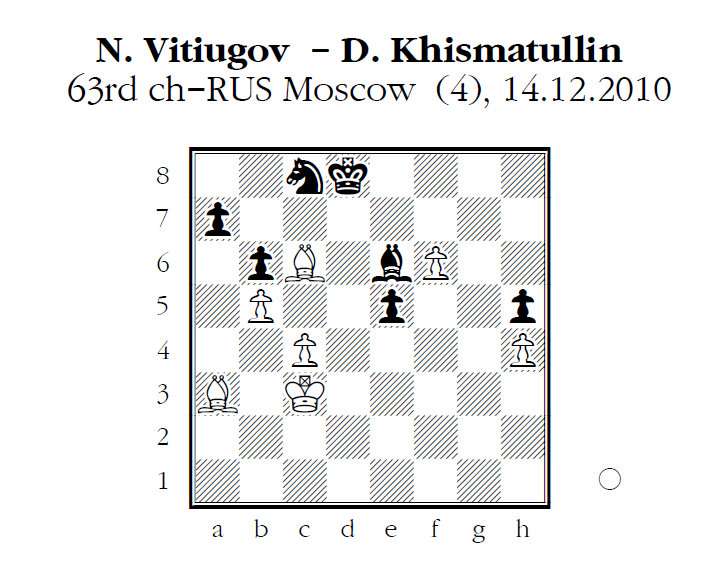


Im not so sure but here goes:
bc6-f3 if be6-g4 then f6-f7 then no way to stop the Queen
if not be6 – g4 then a passed h-pawn and a simplified ending
Im not so sure but here goes:
bc6-f3 if be6-g4 then f6-f7 then no way to stop the Queen
if not be6 – g4 then a passed h-pawn and a simplified ending
Bd5 plays itself. White wants to clear the path for the f-pawn:
1. Bd5 Kd7
If Bd5, 2.cd5 wins: [1. …Bd5 2.cd5 Ke8 3.d6 Nd6 4.Bd6 with a clear win]. Of course, if black moves the bishop off the g8/a2 diagonal, white just pushes f7 with an unstoppable pawn. Continuing:
2. f7 Bf7 (or the pawn queens)
3. Bf7 wins with ease.
Surprised no comments yet. haven’t tested this with a board, but 1.Bf3, forcing the black bishop out of position with 1…Bg4, else the h pawn falls and white’s f pawn advances. Then 2Bd5 and now black cannot stop the f pawn from advancing.
1. Bd5 Bxd5
2. cxd5 Ke8
3. d6
and one of the pawns will convert.
greets, jan
This solution is a bit long, but white quickly gets a decisive advantage and eventually can force a knight sacrifice. There are variations on this line, but they probably have the same outcome:
1. Bd5 Kd7
2. f7 Bxf7
3. Bxf7 a5
4. Bxh5 Kd8
5. Bf7 Ne7
6. h5 Nf5
7. Bg6 Nh6
8. Bc1 Ng4
9. Bg5+ Kc7
10. Bf5 Nh6
11. Bxh6 a4
12. Bg7 e4
13. Bxe4 a3
14. Kb3 a2
15. h6 Kb8
16. h7 Ka7
17. Bf5 Kb7
18. h8=Q Ka7
19. Be5 a1=Q
20. Qb8#
Alternatively, 1. … Bxd5 leads to a quick demise:
1. Bd5 Bxd5
2. cxd5 Ke8
3. d6 e4
4. d7+ Kxd7
5. f7 Nd6
6. f8=Q Nxb5+
7. Kb4
Black resigns.