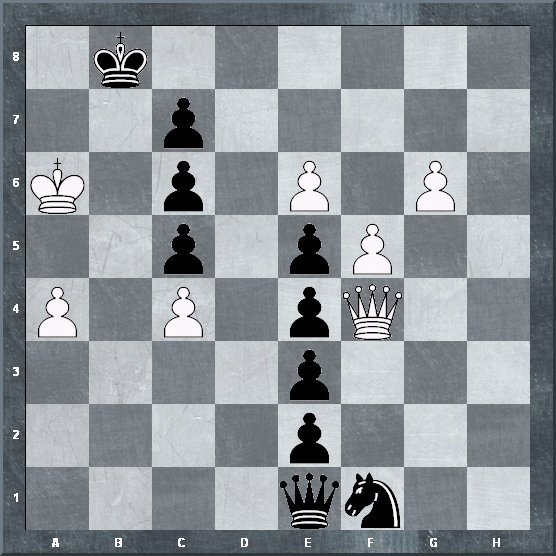
White to move. What should White do?
1k6/2p5/K1p1P1P1/2p1pP2/P1P1pQ2/4p3/4p3/4qn2 w – – 0 1
Puzzle by Korolkov and Mitrofanov, presented by Andreas
Chess Daily News from Susan Polgar


White to move. What should White do?
1k6/2p5/K1p1P1P1/2p1pP2/P1P1pQ2/4p3/4p3/4qn2 w – – 0 1
Puzzle by Korolkov and Mitrofanov, presented by Andreas
What should white do? Stop playing playing chess with other drunks. This position reminds me of the old arcade video game called Centipede.
This is the famous position from Fischer-Spassky. :o)
1 e7
I don’t really have time for this tonight, but a quick perusal of the position shows the main features- black is threatening Qa5 followed by Kb7/a7 threatening mates in two different manners- e1Q and Nd2-Nc4/b3#. A few lines:
1. Qh6
Threatening Qf8, but black is too quick for this:
1. …..Qa5
2. Ka5 Kb7 (or Ka7)
3. Qh4 Nd2 and white can’t stop both mate threats.
So, white must find a way to check the king from some other place, and all I can think of is to take one of the e-pawns:
1. Qe4 Qa5
2. Ka5 Ka7
Trickier is to play Kb7, but white can then check from b1, and push a pawn, but I don’t see this holding either: [2. …Kb7?! 3.Qb1 Ka7 4.e7 e1Q! (not 4. …Nd2?? 5.Qb8! Kb8 6.Ka6+-) 5.Qe1 Nd2-+]. Continuing:
3. Qb1 e1Q! and an stoppable Nd2 is coming like in the note above.
Let’s try 1.Qe5:
1. Qe5 Qa5
2. Ka5 Kb7 (Ka7?? 3.Qc7 Ka8 4.Ka6)
3. Qb2 Ka7
And now, all I can see here for white is to give up the queen at b8 to allow the king to reach a6:
4. Qb8 Kb8
5. Ka6
So, black will queen and try the same sacrifice at a5. I am out of time. I am guessing that if white holds this, it will involve pushing one of the pawns, queening, and sacrificing again on the back rank to give the white king breathing space. Right now, I just can’t quite see it clear to the end.
Craig Johanssen,
I left you a comment on the 12/20/2012 puzzle.
I had a bit of time this morning to take another look at this. I am pretty certain the key line is the following:
1. Qe5 Qa5
2. Ka5 Kb7
3. Qb2 Ka7
4. Qb8! Kb8
5. Ka6 e1(Q)
6. g7!
The alternative push of e7 will lose, though it took me a long while to figure out why, but getting lost did help with the main line. I will cover this line at the end of this comment. Continuing:
6. …..Qa5
7. Ka5 Kb7 (Ka7 is also ok now)
8. g8(Q)e2!
Again, Nd2 will lose: [8. …Nd2 9.Qa8! (not Qb8, otherwise the black king escapes being one move further towards the advanced white pawns!) 9. …Ka8 10.Ka6 Nc4 11.e7 Nd6 12.f6+-]. Continuing:
9. Qa8!
The only move. Even Qb8 won’t hold (see the note immediately above to understand why). Continuing:
9. …..Ka8
10.Ka6 e1(Q)
11.e7
In the alternative line I discuss at the end, it is the g-pawn that advances at this point, and that pawn could be stopped by the black queen. Continuing:
11. …..Qa5
12. Ka5 Kb7
13. e8(Q)Nd2
Black is finally out of effective pawn pushes, and must now try to get the knight involved. Continuing:
14. Qa8
I think this is an only move still. White can’t stop both mate threats of Nb3/c4 by covering those squares. In addition, taking at c6 won’t save him since the resulting ending after Nxc4+ is clearly losing. Continuing:
14. …..Ka8
15. Ka6 Nc4
I have played with every other alternative here, and they all seem to draw in pretty much the same manner, or black loses. Continuing:
16. f6 Nd6
17. f7 Nf7 (an only move now)
18. a5 and stalemate on the next move.
If anyone has a solution in which white wins, I would love to see it, even if it comes from a computer.
Finally, let’s play through the alternative line from move 6 above:
6. e7?? Qa5
7. Ka5 Kb7
8. e8(Q)e2
9. Qa8
Probably better, in a sense, is Qc8, but it still looks losing to me. Continuing:
9. …..Ka8
10.Ka6 e1(Q)
11.g7 Qg3
12.f6 Qg6
13.f7 Qf7
And black is going to prevent the stalemate since 14.g8Q is met by Qxg8 followed by Qc8, and 14.a5 is mate after Qxc4.
Now, there are a ton of holes in this at the beginning. I did not analyze every alternative beginning white had, but that was because I simply can’t even imagine any alternatives but the two captures at e5 or e4, but I might well be missing something that allows white to win this.
1 e7
Metempsychosis
Many promotions.
Q-h4 wins easily The black queen can’t prevent the pawns from queening.
Now that the solution is uncovered by Yancey Ward, a few final remarks:
In the original study, the position was without the e5 pawn, allowing perhaps 3 or 4 cooks. Once added, 1.Qxe5 is the only solution to this study. Interestingly, this correction is not yet into Van der Heijden database.
It is a DRAW study, and the main line. Black can delay the stalemate by 16…Ne5 17.f7 Nd7 but after 18.f8Q+ Nxf8 a5, it is still stalemate.
Now, as usual, full references
Korolkov/Mitrofanov, Revista de Romana de Sah, 1957, #330, first prize ex aequo, correction unknown (perhaps even by Andreas?)
BTW, the other first ex aequo prize is for sure cooked and busted by no less than Van der Heijden, the famous study collector, and John Nunn who wrote many books about studies and endgames, the last ones with alas heavy use of silicon-based brains.
Yancey Ward, I wrote about your answer on Kasparyan study. Have a look!
But fantastic work!