Menu   ≡ ╳
  • News
    • Major Tournaments
    • General News
    • USA Chess
  • Puzzles
  • Improvement
  • Event
  • College
  • Scholastic
  • Women
  • Search

        More results...

        Or you can try to:
        Search in Shop
        Exact matches only
        Search in title
        Search in content
        Search in comments
        Search in excerpt
        Search for News
        Search in pages
        Search in groups
        Search in users
        Search in forums
        Filter by Categories

        Try these: Sicilian Defense, Empire Chess, USA Chess

    • SPICE
    • Videos
    • Susan’s Blog
    • About Us
    • Contact Us
    • SPICE
    • Videos
    • Susan’s Blog
    • About Us
    • Contact Us
    Menu   ≡ ╳
    • News
      • Major Tournaments
      • General News
      • USA Chess
    • Puzzles
    • Improvement
    • Event
    • College
    • Scholastic
    • Women
    • Search

          More results...

          Or you can try to:
          Search in Shop
          Exact matches only
          Search in title
          Search in content
          Search in comments
          Search in excerpt
          Search for News
          Search in pages
          Search in groups
          Search in users
          Search in forums
          Filter by Categories

          Try these: Sicilian Defense, Empire Chess, USA Chess

      Home  >  Chess Improvement • Chess Puzzles  >  Classic chess tactic

      Classic chess tactic

      Chess tactic, Puzzle Solving


      Chess
      By Lubomir Kavalek
      Monday, December 21, 2009; 10:10 AM

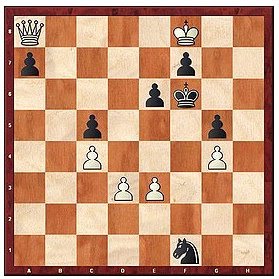
      Vasily Smyslov, 88, became the world chess champion in 1957, defeating Mikhail Botvinnik. Aside from having a great career as a practical player, Smyslov also produced more than 100 endgame studies, the most of any world champion. In his teens he tried his hand at composing problems. In 1935, at age 14, Smyslov created the following (above) problem (White: Kf8, Qa8, P:c4,d3,e3,g4; Black: Kf6,Nf1,P:a7,c5,e6,f7,g5) in which white mates in three moves.

      Source: http://www.washingtonpost.com

      Chess Daily News from Susan Polgar
      Previous Article Bringing love of chess to classroom
      Next Article Odessa TV chess program

      About Author

      Susan Polgar

      Related Posts

      • More Special Endgame!

        January 3, 2021
      • Precision Chess Tactic

        December 27, 2020
      • Daily dose of tactic!

        December 21, 2020

      8 Comments

      1. pht Reply
        December 31, 2012 at 10:17 am

        I see only 2 possible moves to handle the Kg6 escape and hope for a quick mate, namely Qh1 and Qe4.

        At first, Qh1 looks stronger since it threats Qh8# directly. But it fails to Ke5! Ke7 (only to prevent Kd6 since Qh2 isn’t possible) Ng3! Qh8 (only since Qe4 isn’t possible) f6 and king escapes.

        This leaves us with:
        1. Qe4
        Enforces a knight move, since no king move is possible, and e5? fails to Qc6#.
        1. … Ng3/Nxe3
        2. Qh7 Nf5! (e5? Qh6#)
        3. Qh8+ Ng7
        4. Qxg7#

        The difference between me and Smyslov seems to be that he found mate in 3 while I needed 4 moves:-)

        Honestly, I have no idea where the improvement is.

      2. Anonymous Reply
        December 31, 2012 at 10:39 am

        1. Qf3+!

        … Ke5
        Ke7 Ng3
        Qxg3# (or f5 Qe4#)

        … Kg6
        Qxf7+ Kh6
        Qg7#

      3. Anonymous Reply
        December 31, 2012 at 10:40 am

        Really amusing!
        The correct move seems to be the only move that I didn’t bother to investigate properly because it looked “to common”:

        1. Qf3+!

        A)
        1. … Kg6
        2. Qxf7+ Kh6
        3. Qg7#

        B)
        1. … Ke5
        2. Ke7! Ng3
        3. Qf6#

        Is it really that simple?
        I was badly fooled here by the 14 years young Smyslov:-)

      4. Lars B. Reply
        December 31, 2012 at 11:57 am

        1. Qh1 (threatening Qh8+ followed by Qg7#) Ke5 2. Ke7 (threatening Qe4#) f5 3. Qh8# (or 2. – Nxe3 3. Qe4#; on any other N move follows Qa1#). On 1. – e5 follows 2. Qc6# (or Qh6#) and on 1. – Nh2 2. Qa1+ e5 3. Qa6# (or 2. – Kg6 3. Qg7#).

      5. Pedro Q. Reply
        December 31, 2012 at 12:38 pm

        I’d say 1.Qh1 threatening 2.Qh8 Kg6 3. Qg7#

        1…Ke5 2. Ke7! threatening Qe4#

        And now if 2…Ng3 1. Qa1#

      6. Anonymous Reply
        December 31, 2012 at 12:43 pm

        Qh1

        Susan, light en up a bit on Texas Tech,

        Yea, they used the humanity thing. Give em credit for creative thinking, because in the college world that feel good crap works. Life in the college world is like living in socialism. The powers that be are total dictators, the quicker you submit to their will the less disappointed you will be.

        No one will ever be overruled for a humanitive decision in a college setting.

      7. Ein Steppenwolf Reply
        December 31, 2012 at 2:57 pm

        1. Qh1

        1. … N anywhere
        2. Qa1+

        2. … Kg6
        3. Qg7#

        2. … e5
        3. Qa6#

        1. … e5
        2. Qh6#

        1. … Kg6
        2. Qh8 anything
        3. Qg7#

        1. … a6 or a5
        2. Qh8+ Kg6
        3. Qg7#

        1. … Ke5
        2. Ke7

        2. … a6 or a5 or Nh2 or Nxe3 or f6
        3. Qe4#

        2. … Ng3 or Nd2
        3. Qa1#

        2. …f5
        3. Qh8#

      8. pht Reply
        January 2, 2013 at 9:45 am

        The 3rd post here, starting with “really amusing”, was mine.
        Now I have to wonder what is correct, Qf3+ or Qh1.

        Well, the move looking too simple was exactly that, too simple:

        1. Qf3+? Ke5
        2. Ke7 f5!
        prevents both Qe4# and Qf6#.

        So correct must be:
        1. Qh1! Ke5
        2. Ke7 Ng3 (f5 Qh8#)
        3. Qa1# (the move that I overlooked)

      Leave a Reply to pht Cancel reply

      Improvement

      • Important Scholastic Coaching Tips
      • My Chess Quotes Over The Years
      • My kids know chess rules. What’s next?
      • Chess Parenting

      Events

      • My Top 10 Most Memorable Moments in Chess (Part 3) May 13, 2021
      • My Top 10 Most Memorable Moments in Chess (Part 2) May 12, 2021
      • My Top 10 Most Memorable Moments in Chess (Part 1) May 10, 2021
      • About Susan Polgar April 9, 2021
      • About Us
      • Contact Us
      • Daily News
      • My Account
      • Terms & Conditions
      • Privacy Policy

      Anand Armenia Breaking News Chess Club and Scholastic Center of St Louis Chess interview Chess Olympiad Chess tactic Chess tournament chess trivia China FIDE Grand Prix Holland India Khanty-Mansiysk LIVE games Lubbock Magnus Carlsen Moscow National Championship Norway OnlineChessLessons Philippines Puzzle Solving Russia Scholastic chess Spain SPF SPICE SPICE Cup St Louis Susan Polgar Tata Steel Chess Texas Tech Tromsø TTU Turkey Webster University Wesley So Wijk aan Zee Women's Chess Women's Grand Prix Women's World Championship World Championship World Cup

      April 2026
      M T W T F S S
       12345
      6789101112
      13141516171819
      20212223242526
      27282930  
      « Sep