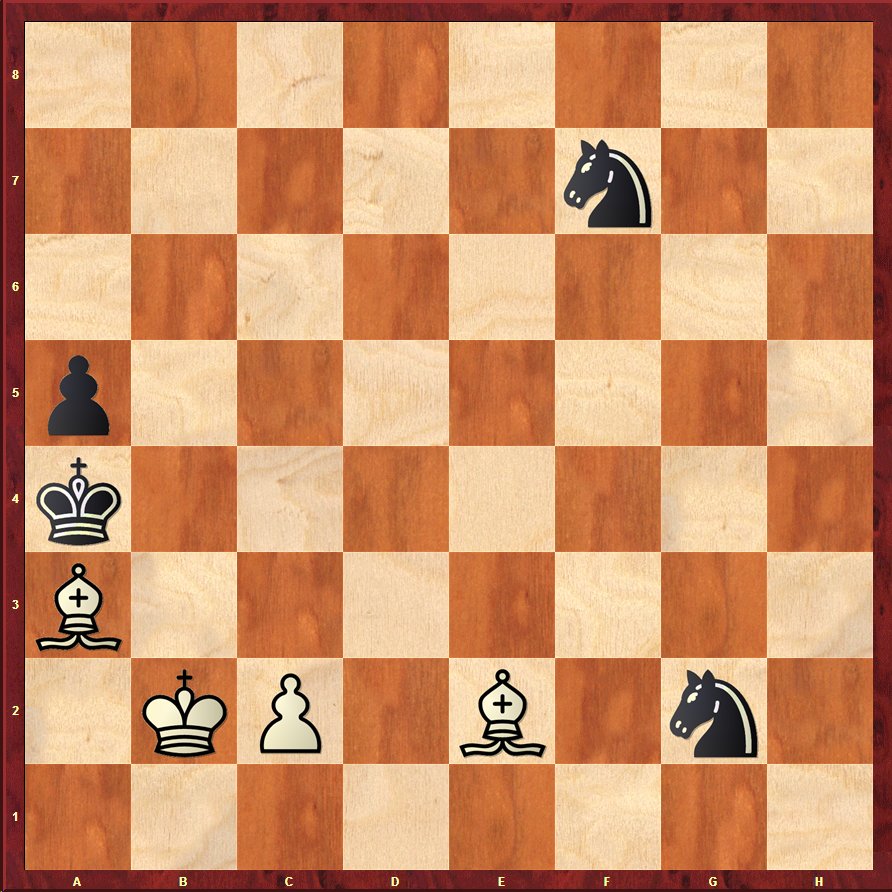
White to move. What is the best continuation for White?
8/5n2/8/p7/k7/B7/1KP1B1n1/8 w – – 0 1
Pogosiants, 1963

Chess Daily News from Susan Polgar

White to move. What is the best continuation for White?
8/5n2/8/p7/k7/B7/1KP1B1n1/8 w – – 0 1
Pogosiants, 1963
c4
If white could get a bishop on the a4/e8 diagonal before the king escapes through b5, he can mate black, so my first thought is to try to attack a knight right away; or, alternately, play c4 to threaten Bd1# while keeping the king hemmed in for a bit. Let’s look at the first idea:
1. Bf3 Ne5
I see no other move for black, though I am not 100% sure the resulting ending on other moves is actually winning, even with black is down a piece. With Ne5, black is covering c6 while threatening Nc4+ winning the piece back should white continue with Bxg2. So, I think this idea has come acropper.
Let’s now look at 1.Bh5 which is more promising right from the start, though I can certainly see a complicating factor already:
1. Bh5 Ne3
The black king can escape the hole right now, and maybe he does better, I will have to look at it eventually, but this is the best I can see right now. Continuing:
2. Bf7
I looked at other moves, but this seems the only way forward in this line. Continuing:
2. …..Nc4
3. Ka2
The complicating factor in this line is that white cannot capture at c4 without stalemating black, so the white king must go to a2 to try to get a winning endgame. Continuing:
3. …..Na3
This or try to play a piece down I think. I will come back to 3. …Kb5 later. Continuing:
4. c3
To win, white must maintain the pawn. I don’t see any other move that can do so- if white plays Be8 or Bb3 with check, Kb4 should hold since c3+ is no threat- black just captures the pawn. Black must now move the knight or lose it, but I can now see he loses it- Nb1, Nc2, or Nc4 allows Be8#, and Nb5 allows Bb3#, so to prevent mate black must play Kb5:
4. …..Kb5
5. Ka3 and this is clearly won. White will just play c4 leaving the pawn protected, and move in on the black pawn with the king and win it by forcing black’s king away.
So, I think the holes in this are at moves 3, 2, and possibly 1. Let’s work backwards. On move 3 in the line above, black could have refrained from capturing at a3:
3. …..Kb5
4. Bc4 Kc4
5. Bb2 and this is clearly won for white- he will just put the bishop on f6/g7/h8 and play c3 and then win the a-pawn with the king.
At move 2 in the main line, black didn’t have to check from c4. He could have tried to check from d1 instead:
2. …..Nd1 (Nc2 3.Be8# remember)
3. Kc1
The only move forward, I think-if 3.Ka2, and black just replies with Nc3+ and will win at a3 or get a repetition draw. Continuing:
3. …..Nc3
Here, Kxa3 4.Kd1 should be another winning endgame. Continuing:
4. Be7 and this should now be winning- it is only a matter of time before white forces the exchange of the knight for one of the bishops by attacking it.
Finally, back at move 1, I don’t think black really had anything else:
1. …..Nf4
2. Bf7 Kb5
3. Be7 and this is just like the other ending for the most part.
So, I think white wins with 1.Bh5.
I’m just waking up..so I saw this problem..my first impression is was not c4 and Bd1 mate cute or what? then I saw Ne3….but that mate patttern would not let me go..so I “Extended it a bit BA6 with the idea of C4 and Bb5 mate. Am I on the right track here? I’d conclude that black has to lose one of the nights to avoid this and white wins in a pedestrian way…but I must be missing a faster and better way….Hey! don’t judge too harshly..I’m just waking up.
Mike Magna
There is a second solution, but very contorted and not human at all, beginning with 1.c4 transposing quickly into the infamous 6 men endgame tablebase KBB vs KNp.
Of course, Pogosyants could not be aware of this variation because it requires god-like silicon based technique.
Many composers creations (Kasparian, Fritz, Rinck among others) were busted after Thompson, Nalimov and Konoval/Bourzutschky researches on perfect (ie computerized) way of playing the endgame.
Complete source:
Pogosyants, Schackbulletinen, 1963, 2nd prize ex aequo
bf3 is the move.. And the knight on g2 must be given up in order to save the checkmate on the next move(bc6+ will be checkmate so either move king to the b5 square or kf7 to ke5 to prevent bc6 in next move, which leaves knight on g2 in a very sad position!!).. From there on it should be simple win for white.
1.Bf3 threat is Bc6#
Black must lose a knight to stop the mate.
Bh5 attacking knight on f7 and if knight moves then Be8#
1.Bf3 N moves 2.Bc6#
1Bh5 Nc3
Only somewhat feasible defence. N at f7 can not be saved on account of 2 Be8#
2Bxf7 Nc4+
3Ka2
3Bxc4 stalemate.
3… Nxa3
What else?
4c3!! cute.
Now 4… Nb5 5Bb3#
4… Nb1 or Nc2 or Nc4 Be8#
1. Ba6 Ne5
stop king from moving out potential checkmate position.
2. c4
Now opposition has to give knight or face checkmate.
1. Ba6 Ne5
stop king from moving out potential checkmate position.
2. c4
Now opposition has to give knight or face checkmate.
1. Ba6 Ne5
stop king from moving out potential checkmate position.
2. c4
Now opposition has to give knight or face checkmate.