Bravo jean-michel!! Indeed what a fantastic ending. Did you find the solution yourself or have you seen this one before? Anyway, great analysis! Cheers to all
well this is way too long to include the moves but i think that 1. f7 re6+ 2.Kg5 Re5+ 3. Kg4 dont go to f-file due to re1-f1 idea 3.. re4 4. kg3 re1 5. kf2 Re4! threatening stalemate defense 6.f8=Q ?? Rf4+! 7. Qxf4 stalemate 6.f8=R!! the threat of rh8# is decisive for example 6…Rh4 7. kg3! threatening Rf1 mate and attacking the rook at the same time
the reason i said it was too long to include the moves is because this series is actually not the best defense! the best defense would be to force white to win with king and queen vs king and rook which is technically won but would definitely last long than 8 moves
the circumstance is very interesting i guess. do you play for the stalemate defense? or do you make white show his technique with K+Q vs K+R. its hard to say …personally i would make white show his technique with the material advantage.
If someone hasn’t seen this before, it is time for them to study endgames! If you try to play chess without knowing this kind of stuff, you are trying a major shortcut and most likely will not become a good chess player.
mr x even great players can mess this ending. its a stretch to say this end game is mandatory if you want to be good. its far from easy and one wrong move its stalemate.white has to tread carefuly to avoid this situation and squeeze a mate with the stubborn black rook. nothing is easy in this game. the simple isnt so simple.
As Susan titled: it is a Classic. I learned it from another chessplayer during the first week of going to my first chessclub, many years ago. But I learned it with the pieces on the queenside: White – Kb6, c6 and Black – Ka1, Rd5.
Much more later I´ve learned this position and study (on the queenside) was published by F. Saavedra at 1895.
Many years passed and I still can refresh my memories and feel the emotion when they first showed me this position and the solution. A classic and a beauty!
i dont think theres a definite win unless black makes a mistake with the rook. to say theres a solution is not correct in my opinion. the only solution is no solution. this is a draw as far as i can see regardless of what supposed beutiful end game solution exists. the under promotion doesnt work and shouldnt be considered.
I have a tendency to read the comments before getting deep into the problem.
There have been times when I was the first one to see the problem. When this happens and I solve the problem, I NEVER post the solution. It ruins the problem for those who come after. I will usually make some comment but never the solution or strong hints.
I get very disappointed when the first person to post gets it right. seems like such a waste. For me the whole idea is to have fun and learn from the problem not to bow down and worship someone else for getting it right. Too much ego gratification in posting the answer. Our journey here on earth is to let go of the ego not to strengthen it.
Now if Jean michel really worked it out then fine. Nice Job.
Anyway I will continue to not post the answer first. I prefer to allow everyone the joy of working it out.
I have never seen this problem or it was a very long time ago and I forgot it. I agree with Susan, this is a super problem. Having a winning game with the pawn against the rook.
I am not solving really that endgame,but I remember it.The answer is: 1.f7 Re6+ 2.Kg5 Re5+ 3.Kg4 Re4+ 4.Kg3 Re3+ 5.Kf2 Re4 6.f8=R Rh4 7.Kg3 and black is checkmated or is losing a rook right now. Maybe is it a type of Saavedra position?I am not really sure,but I believe my answer is good anyway
someone posting the answer is fine NN. This way Susan doesnt have to worry about wasting time posting it herself and in conclusion everyone will know what the answer is at the end. The ego problem comes on the end of the person who can’t stand seeing the answer posted! You should think about that. People do enjoy trying to solve chess puzzles because they love chess and dont always mean their have ego inflating problems pal. Anyone who would even complain about someone posting the answer is just showing they got problems. You can figure the puzzle out on your own before clicking the comments to see what the answer is, so I certainly disagree with your conclusion. Grow up, unless you are 8 years old. in that case, i apologize 🙂
jean-michel and jose delgado the rook wouldnt play e6. hed play e3 or e2 backing up and going for the check on the g file.im not trying rain on your victory parade but lets use good moves and see if theres a solution.
I have seen this from a book by a US GM. Anyone? It was a very well written beginners ‘learn to play chess’ book. The position in that was symmetrically on the left side of the board.
(1) Black is after a draw, hence wants to take whites (transformed) pawn with no care about loosing the rook.
(2) Black succeds by Re2, Rf2 unless white advanced the pawn twice and queens or rooks or whatever imediately.
(3) Hence, the first moves are forced (for white). 1. f7, Re2 2. f8=Q or what suits best,
(4) Now black changes plan to attack the white king. If the king moves to f file, blacks rook will give check and pin the converted pawn. Hence the white king moves between g and h file.
(5) BUT: it will approach the rook and when nearby, may escape over the f-file, as a check by the rook would the be punished by sacking the rook.
(6) At least black thus forces a K+R vs K+Q endgame, which I learned here is far from easy to play though a theoretical win for white.
blacks after a draw and doesnt concern himself with the white pawn. it would be foolish to try and stop its promotion because youd be wasting energy and would accomplish nothing. instead black backs up his rook and readys himself to try and stop the onslaught by the white queen. if white plays his best moves and black plays the precise moves the game is draw. the first few moves would go something like this
f7 e2 f8 promote Rg2+ Kh5 Kg1 Qa3
after these moves the the white queen cant get a direct attack on the black queen because the rook gets in the way and doesnt allow that to happen.
i just looked up this end game and apparently a queen versus rook endgame isnt an automatic win. this is what i suspected even though i wasnt aware of this. i just went on analysing it and found that black seemed to give white considerable difficulties. from what i read apparently most grandmasters would have a difficult time winning this endgame against precise play.if you are able to win the game it sure isnt the small amount of moves as suggested by others on here. it would take upwards of 50 moves.
fzjrjThis is actually a mirror of the Saavedra position. The original problem as published in 1895 had the pieces on the a,b,c files.
The accepted solution has been given (underpromote to rook). But that can be argued that that can’t be considered the best defense since a K+R would hold of checkmate for more than 11 moves.
K+Q vs K+R is a forced win for the K+Q in all typical positions. (ie: no captures or stalemate traps immediately available to the rook). But a skilled defender can hold out for 20 or 30 moves. In a recent example between 2 GMs the attacker walked into a stalemate.
If the black king was on g1 the game would be a draw. After Rf2 White would have to allow a draw by perpetual check since any White king move onto the f file would skewer the queen.
Here is a superior problem, published by one M.S. Liburkin in 1931, which includes the same famous ‘Saavedra’ position as one variation; but also includes much more.
Position: White: K on d1. N on a2. P on b5, c6. Black: K on a1. R on c5.
See if you can work that one out. (Hint: In the alternate variation that does NOT lead to Saavedra, the win ALSO requires an underpromotion!)
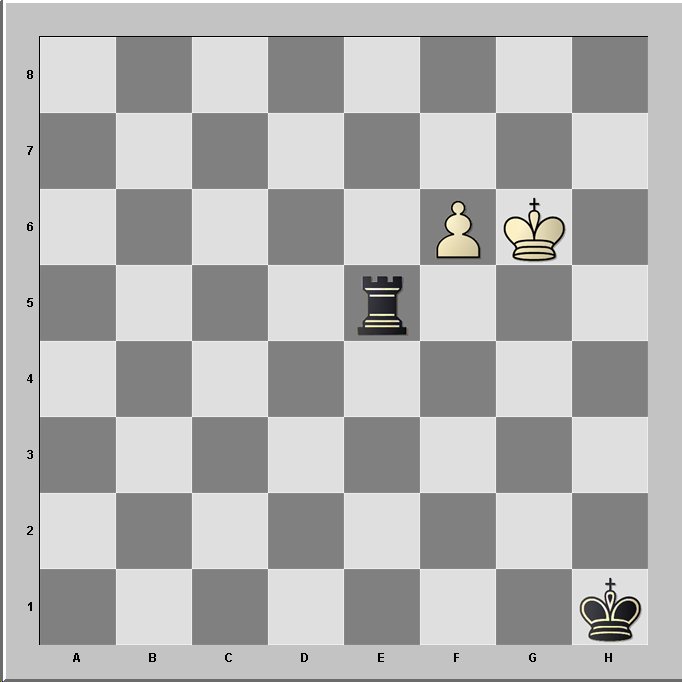


This one is beautiful if I have it right:
1. f7 otherwise …Rf5 gets the pawn.
How to stop it? Check with the rook, if the king goes to c-file to stop the checks, then go down to e1 with the skewer on f1 nabbing the new queen.
So:
1. f7 Re6+
2. Kg5 Re5+
3. Kg4 Re4+
4. Kg3 Re3+
5. Kf2
Now what for black? No more checks or skewer, but there is now a stalemate motif as the white king is now blocking two of black king’s three squares:
5 … Re4!
Now, if 6. f8 (Q), then … Rf4+ QXR is stalemate.
How to win?
Underpromotion to Rook!
6. f8 (R) threatens mate.
6. … Rh4 is only defense.
7. Kg3 threatens the rook and mate on f1.
1-0
If I have it right, this is really a nice endgame.
Bravo jean-michel!! Indeed what a fantastic ending. Did you find the solution yourself or have you seen this one before? Anyway, great analysis! Cheers to all
well this is way too long to include the moves but i think that 1. f7 re6+
2.Kg5 Re5+
3. Kg4 dont go to f-file due to re1-f1 idea 3.. re4
4. kg3 re1 5. kf2 Re4! threatening stalemate defense 6.f8=Q ?? Rf4+! 7. Qxf4 stalemate
6.f8=R!! the threat of rh8# is decisive for example 6…Rh4 7. kg3! threatening Rf1 mate and attacking the rook at the same time
i see jean-michel beat me to it 🙂 good job !
the reason i said it was too long to include the moves is because this series is actually not the best defense! the best defense would be to force white to win with king and queen vs king and rook which is technically won but would definitely last long than 8 moves
the circumstance is very interesting i guess. do you play for the stalemate defense? or do you make white show his technique with K+Q vs K+R. its hard to say …personally i would make white show his technique with the material advantage.
haha if black King was at g1 it would be a draw.
It’s a win for white, pawn to be promoted to a rook, not a queen, if queen then it’s a stalemate..
Melody
A shame that all those people who have seen it before ruin the fun for those who haven’t 🙂 This is the true classic of chess puzzles.
If someone hasn’t seen this before, it is time for them to study endgames! If you try to play chess without knowing this kind of stuff, you are trying a major shortcut and most likely will not become a good chess player.
f7 e2
f8 promote g2+
h5 g1
a3
mr x even great players can mess this ending. its a stretch to say this end game is mandatory if you want to be good. its far from easy and one wrong move its stalemate.white has to tread carefuly to avoid this situation and squeeze a mate with the stubborn black rook. nothing is easy in this game. the simple isnt so simple.
wolverine
lol savedra… isnt it a little too famous for a puzzle susan
As Susan titled: it is a Classic. I learned it from another chessplayer during the first week of going to my first chessclub, many years ago.
But I learned it with the pieces on the queenside: White – Kb6, c6 and Black – Ka1, Rd5.
Much more later I´ve learned this position and study (on the queenside) was published by F. Saavedra at 1895.
Many years passed and I still can refresh my memories and feel the emotion when they first showed me this position and the solution. A classic and a beauty!
A.
I got to the Kf2 part – but ignored the stalemate thingy. Nice endgame
i dont think theres a definite win unless black makes a mistake with the rook. to say theres a solution is not correct in my opinion. the only solution is no solution. this is a draw as far as i can see regardless of what supposed beutiful end game solution exists. the under promotion doesnt work and shouldnt be considered.
wolverine
In the time of online queriable endgame tablebases one shouldn’t throw such comments around without at least checking them:
http://www.k4it.de/index.php?topic=egtb&lang=en
Since I’m not good enough to actually really solve these puzzles myself the endgame tablebase is a fantastic ressource to see how these play out…
I have a tendency to read the comments before getting deep into the problem.
There have been times when I was the first one to see the problem. When this happens and I solve the problem, I NEVER post the solution. It ruins the problem for those who come after. I will usually make some comment but never the solution or strong hints.
I get very disappointed when the first person to post gets it right. seems like such a waste. For me the whole idea is to have fun and learn from the problem not to bow down and worship someone else for getting it right. Too much ego gratification in posting the answer. Our journey here on earth is to let go of the ego not to strengthen it.
Now if Jean michel really worked it out then fine. Nice Job.
Anyway I will continue to not post the answer first. I prefer to allow everyone the joy of working it out.
I have never seen this problem or it was a very long time ago and I forgot it. I agree with Susan, this is a super problem. Having a winning game with the pawn against the rook.
I am not solving really that endgame,but I remember it.The answer is:
1.f7 Re6+ 2.Kg5 Re5+ 3.Kg4 Re4+ 4.Kg3 Re3+ 5.Kf2 Re4 6.f8=R Rh4
7.Kg3 and black is checkmated or is losing a rook right now.
Maybe is it a type of Saavedra position?I am not really sure,but I believe my answer is good anyway
someone posting the answer is fine NN. This way Susan doesnt have to worry about wasting time posting it herself and in conclusion everyone will know what the answer is at the end. The ego problem comes on the end of the person who can’t stand seeing the answer posted! You should think about that. People do enjoy trying to solve chess puzzles because they love chess and dont always mean their have ego inflating problems pal. Anyone who would even complain about someone posting the answer is just showing they got problems. You can figure the puzzle out on your own before clicking the comments to see what the answer is, so I certainly disagree with your conclusion. Grow up, unless you are 8 years old. in that case, i apologize 🙂
jean-michel and jose delgado the rook wouldnt play e6. hed play e3 or e2 backing up and going for the check on the g file.im not trying rain on your victory parade but lets use good moves and see if theres a solution.
wolverine.
I don’t think that jean-michel is showing us the best black defense. I’d play 3… Kg2 .
I have seen this from a book by a US GM. Anyone? It was a very well written beginners ‘learn to play chess’ book. The position in that was symmetrically on the left side of the board.
– Vinay
@wolverine
Do I understand you right with the following.
(1) Black is after a draw, hence wants to take whites (transformed) pawn with no care about loosing the rook.
(2) Black succeds by Re2, Rf2 unless white advanced the pawn twice and queens or rooks or whatever imediately.
(3) Hence, the first moves are forced (for white).
1. f7, Re2
2. f8=Q or what suits best,
(4) Now black changes plan to attack the white king. If the king moves to f file, blacks rook will give check and pin the converted pawn. Hence the white king moves between g and h file.
(5) BUT: it will approach the rook and when nearby, may escape over the f-file, as a check by the rook would the be punished by sacking the rook.
(6) At least black thus forces a K+R vs K+Q endgame, which I learned here is far from easy to play though a theoretical win for white.
best
Jakob
blacks after a draw and doesnt concern himself with the white pawn. it would be foolish to try and stop its promotion because youd be wasting energy and would accomplish nothing. instead black backs up his rook and readys himself to try and stop the onslaught by the white queen. if white plays his best moves and black plays the precise moves the game is draw. the first few moves would go something like this
f7 e2
f8 promote Rg2+
Kh5 Kg1
Qa3
after these moves the the white queen cant get a direct attack on the black queen because the rook gets in the way and doesnt allow that to happen.
wolverine
@wolverine
.. but then you have a rook vs. queen endgame, which is a theoretical win for the queens side. Am I right?
I don’t claim to be able to convert the win in the position you created, but a theoretical winning position is not a draw.
best
Jakob
i just looked up this end game and apparently a queen versus rook endgame isnt an automatic win. this is what i suspected even though i wasnt aware of this. i just went on analysing it and found that black seemed to give white considerable difficulties. from what i read apparently most grandmasters would have a difficult time winning this endgame against precise play.if you are able to win the game it sure isnt the small amount of moves as suggested by others on here. it would take upwards of 50 moves.
wolverine
fzjrjThis is actually a mirror of the Saavedra position. The original problem as published in 1895 had the pieces on the a,b,c files.
The accepted solution has been given (underpromote to rook). But that can be argued that that can’t be considered the best defense since a K+R would hold of checkmate for more than 11 moves.
K+Q vs K+R is a forced win for the K+Q in all typical positions. (ie: no captures or stalemate traps immediately available to the rook). But a skilled defender can hold out for 20 or 30 moves. In a recent example between 2 GMs the attacker walked into a stalemate.
If the black king was on g1 the game would be a draw. After Rf2 White would have to allow a draw by perpetual check since any White king move onto the f file would skewer the queen.
I wonder why the answer to 1.f7 must be 1…, Re6+.
I see this variation:
1.f7, Re2
2.f8=Q, Rg2+
3.Kh7, Rh2+
4.Kg7, Rg2+
and I see no forced winning for white.
Am I right?
Here is a superior problem, published by one M.S. Liburkin in 1931, which includes the same famous ‘Saavedra’ position as one variation; but also includes much more.
Position: White: K on d1. N on a2. P on b5, c6.
Black: K on a1. R on c5.
See if you can work that one out. (Hint: In the alternate variation that does NOT lead to Saavedra, the win ALSO requires an underpromotion!)
No, Anon 9:37:00 AM, to make progress get the white king down the h-file:
3.Kh5 Rh2+
4.Kg4 Rg2+
Then:
5.Kf3