1.g5 fxg5 (if K or B moves, then 2.gxf6) 2.Kg4 (threatening 3.g3) B moves 3.Kxg5 and then Kf5, followed by the advance of the g and f pawns. Since the white bishop controls a8, black can never sacrifice the bishop on the two pawns.
Looking at this superficially, one thinks that it must be a draw. But then noticing the precarious placement of the Black bishop, one tries to make something of it. And yes, after
1. g5 fxg5
the only reasonable try for Black, he is already in Zugzwang.
2. Kg4!
The point. And a very pretty move.
2. .. Kg6
(2. .. Be1 {or Bf2} 3. Kxg5 {Being up 2 connected passed pawns, even with bishops of opposite colors, is an easy win.})
(2. .. gxf4 3. Kxh4 {Being up a bishop here is an easy win.})
(2. .. Kf6 {or Kh6} 3. g3 {trapping the bishop.})
3. Be4+ Kf6 {or Kh6} 4. g3
winning the bishop and the game. What a really cool endgame position to have occurred in a tournament game!!
i think 1. g5 is the best move for white … Black will definitely capture the pawn n I’ll just move my king to g4 threatening the bishop .. and it will leave me with two strong and free pawns
Not hard to find this line, but not so easy to see it wins either.
1. g5 fg5
This is forced since any other move has to be with the king or the bishop, and moving either one will allow white to win at f6 and the game. One of the key features is the lack of black control of f7 limiting the scope of black’s king to support f6. Continuing:
2. Kg4
By process of elimination this has to be the only winning move. If white doubles his pawns with 2.fg5, the black king will never move off of g7 again, and black will just move the bishop over to the g1/a7 diagonal and keep him there to support b6. Continuing:
2. …..Bf2
I don’t see how Be1 could be really different here. Continuing:
3. Kg5
So, white has accomplished the first part- has connected passers on the king side. Now he needs to bring in the win with the Bishops-of-Opposite-Color ending, but in this case it is pretty straightforward:
3. …..Be3
I don’t think black’s bishop maneuvers matter very much, but I am not 100% certain of it in this case. The idea for me here is to use the bishop on the c1/h6 diagonal to frustrate white’s attempts to play g4-g5-f6+ to force the black king out of the way. Continuing:
The defense of g7 can’t hold. White is going to play Kg4 followed by f5 and f6, and if black attempts to put his king on g6, white just checks from e4 with the bishop. So, black must fall back eventually to f8, but this also fails to hold:
7. Kg4
The effect of the black bishop keeps white from advancing the king immediately since he must still support whichever pawn he doesn’t move next:
7. …..Ke7 (Kg7 8.f5 anyway) 8. f5 Bb2
Black can try Kd6, but white can just ignore the attack on the bishop and play 9.f6 Kxd5 10.Kf5 and black will have to give up his bishop to stop just the g-pawn leaving white the f-pawn to win with. Continuing:
9. f6 Bf6 10.gf6 Kf6
And we now reach the point that KW Regan made in his comment- that white wins this ending because he has the right bishop for the a8 square to prevent black from drawing by stalemate. Let’s just play it out for practice:
11.Kf4 Ke7 12.Ke5 Kd7 13.Kd4 Kc7 14.Kc4
And we can see that b6 cannot be protected since the black king cannot sit on b7 and must shuffle between c7 or a7 and b8. Continuing:
14. ….Kb8 (Kd6 15.Kb5 wins, too) 15.Kb5 Ka7 16.Bc6 Kb8 17.Kb6 and the pawn will march to a8 to win the game.
This has nothing to do with Zugzwang at all also nothing with the square a8. The motif is the bad position of the black bishop which enables White to get two connected free pawns. 1.g5 fxg 2.Kg4! (threatens g3 to win the bishop) Bf2 3.Kxg and White wins.
“Chess Player” induced an interesting question for me- does it matter who has which bishop? While the advance of the a-pawn is not the main motif of the problem, I do think it important that white has the bishop that he does since I don’t think white can force a queen on the king-side.
If white is to prevent black sacrificing the bishop for the two pawns that remain after the initial exchange at g5, the white king must support the advance to f6, and he can only do this from e6 or e7 if the black bishop moves to a1/h8 diagonal at the proper moment (when white plays Ke5), but during this maneuver, black keeps the bishop targeted at g5, so the white king cannot leave that pawn unguarded. So, I think black will always be able to exchange the bishop for the g-f pawn combo at f6, and white must be able to win by queening at a8.
One might consider the starting position where every man on the board is translated one row towards the 8th rank- FEN is 6k1/1p3p2/3B1K2/P4PPb/8/6P1/8/8 w – – 0 1, and ask if white can win that position moving first?
You have brought up some interesting points, to which I would like to reply.
I don’t think it matters what color square the queening square is here, as long as White is left with B+P versus P. It does conceivably make a difference whether the White bishop is on the same color square as the White pawn, however. It is important that the bishop be able to protect the pawn if the Black king can get close to the White pawn.
I don’t think that White really has any trouble winning after spotting 2.Kg4!
Here is an example win from the original game position:
I disagree with “Chess Player” who asserts that this position is not an example of Zugzwang. After 2. Kg4 if Black moves either one of his pawns or moves his bishop, he loses material that he can’t afford to lose. It’s true that he can move move his king and not lose anything significant. So maybe this isn’t an example of 100% Zugzwang, only partial Zugzwang (and don’t ask me how I derived that term). (Partial derivative! Bad joke!!) But tell me, isn’t this position at least as much an example of Zugzwang than “The Immortal Zugzwang Game”, Saemisch-Nimzovich, Copenhagen, 1923? There is plenty of precident for using the term losely.
There are some days when, the rule book telling me it is my turn to move now, regardless of the nature of the position, I will feel that the compulsion to move is an overwhelming imposition on me, and that I’m in Zugzwang. Indeed, there are many days when I wake up and feel immediately like I’m in Zugzwang!
Your line from the original position is an important variation (and I definitely missed the continuation at move 9 for black), but I think it reinforces KW Regan’s point about the having the right bishop for the a8 square.
In the line you gave, black plays to having his king take a pawn at g5 instead of at f6 (as he does in the line I gave above), while allowing the white king to gain the tempii needed to cut the black king off from reaching a8 thus making the bishop color irrelevant. However, if white has to allow (and I am pretty sure black can force this) the black king to reach the corner first after liquidating the king-side pawns for the bishop, then white must have the white squared bishop to win. For example, the following position is a draw with proper play: 8/8/5k2/1p6/6K1/P7/3B4/8 w – – 0 1, which is an analogue of the position reached in my original line at move 10 (of course, I was forced to make alterations the queen side a bit for logical reasons). However, I think I proposed the wrong problem in my second comment- the following analogue where the queenside pawns are on b7 and a5, and white has the dark-squared bishop is a win for white because black can’t get to the corner without moving the pawn, and he can’t move the pawn without allowing white to capture with his. Damned hard to think of everything in endgame analysis and construction. Sheesh!
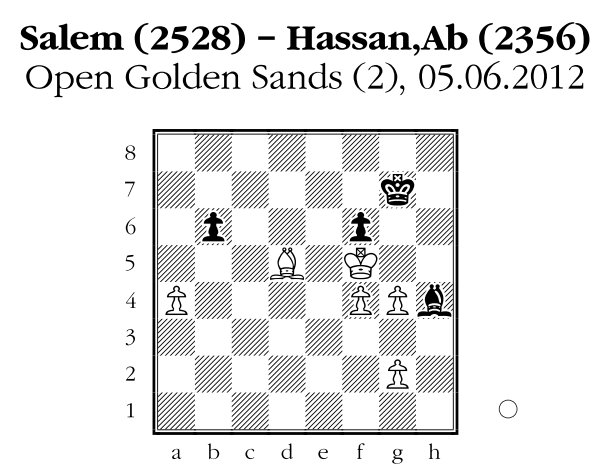


1g5 fxg5
2Kg4 (threat g3)
…. Bf2
3Kxg5 and White has two connected passers
1.g5 fxg5 (if K or B moves, then 2.gxf6) 2.Kg4 (threatening 3.g3) B moves 3.Kxg5 and then Kf5, followed by the advance of the g and f pawns. Since the white bishop controls a8, black can never sacrifice the bishop on the two pawns.
Looking at this superficially, one thinks that it must be a draw. But then noticing the precarious placement of the Black bishop, one tries to make something of it. And yes, after
1. g5 fxg5
the only reasonable try for Black, he is already in Zugzwang.
2. Kg4!
The point. And a very pretty move.
2. .. Kg6
(2. .. Be1 {or Bf2} 3. Kxg5 {Being up 2 connected passed pawns, even with bishops of opposite colors, is an easy win.})
(2. .. gxf4 3. Kxh4 {Being up
a bishop here is an easy win.})
(2. .. Kf6 {or Kh6} 3. g3 {trapping the
bishop.})
3. Be4+ Kf6 {or Kh6} 4. g3
winning the bishop and the game. What a really cool endgame position to have occurred in a tournament game!!
i think 1. g5 is the best move for white … Black will definitely capture the pawn n I’ll just move my king to g4 threatening the bishop .. and it will leave me with two strong and free pawns
1. g5 – fg
2. Kg4 – Be1 (otherwise g3)
3. Kxg5 +-
Very important here that a8 is a white square. Also nice that the first move is already Zugzwang.
Not hard to find this line, but not so easy to see it wins either.
1. g5 fg5
This is forced since any other move has to be with the king or the bishop, and moving either one will allow white to win at f6 and the game. One of the key features is the lack of black control of f7 limiting the scope of black’s king to support f6. Continuing:
2. Kg4
By process of elimination this has to be the only winning move. If white doubles his pawns with 2.fg5, the black king will never move off of g7 again, and black will just move the bishop over to the g1/a7 diagonal and keep him there to support b6. Continuing:
2. …..Bf2
I don’t see how Be1 could be really different here. Continuing:
3. Kg5
So, white has accomplished the first part- has connected passers on the king side. Now he needs to bring in the win with the Bishops-of-Opposite-Color ending, but in this case it is pretty straightforward:
3. …..Be3
I don’t think black’s bishop maneuvers matter very much, but I am not 100% certain of it in this case. The idea for me here is to use the bishop on the c1/h6 diagonal to frustrate white’s attempts to play g4-g5-f6+ to force the black king out of the way. Continuing:
4. Kf5 Bd2
5. g4 Bc1 (keeping on c1/h6 diag)
6. g5 Kf8
The defense of g7 can’t hold. White is going to play Kg4 followed by f5 and f6, and if black attempts to put his king on g6, white just checks from e4 with the bishop. So, black must fall back eventually to f8, but this also fails to hold:
7. Kg4
The effect of the black bishop keeps white from advancing the king immediately since he must still support whichever pawn he doesn’t move next:
7. …..Ke7 (Kg7 8.f5 anyway)
8. f5 Bb2
Black can try Kd6, but white can just ignore the attack on the bishop and play 9.f6 Kxd5 10.Kf5 and black will have to give up his bishop to stop just the g-pawn leaving white the f-pawn to win with. Continuing:
9. f6 Bf6
10.gf6 Kf6
And we now reach the point that KW Regan made in his comment- that white wins this ending because he has the right bishop for the a8 square to prevent black from drawing by stalemate. Let’s just play it out for practice:
11.Kf4 Ke7
12.Ke5 Kd7
13.Kd4 Kc7
14.Kc4
And we can see that b6 cannot be protected since the black king cannot sit on b7 and must shuffle between c7 or a7 and b8. Continuing:
14. ….Kb8 (Kd6 15.Kb5 wins, too)
15.Kb5 Ka7
16.Bc6 Kb8
17.Kb6 and the pawn will march to a8 to win the game.
g5. and when fxg. Kg4 with the threat of g3. After Kg4 black bishop moves then Kxg5 getting connected passed pawns.
I think I have the main idea but a clumsy subsequent play
1.g5 fxg5 (2.fxg5 doesn’t help)
2.Kg4 Bf2 (2…gxf4 3.Kxh4)
3.Kxg5 Be3
Now the two pawns on different files can march forward aided by the King and Bishop
4.Kf5 Kh6
5.g4 Bd4
6.g5+ Kh5
7.Bf7+ Kh4
8.Be6 Kh5
9.Bd5 Kh4
10.Bf3 Kg3
11.Bd1 Bc3
12.g6 Kh4
13.Ke6 Bh8
14.Kf7 Kg3
15.f5 Bd4
16.f6 Kf4
17.g7 Ke5
18.g8=Q
This has nothing to do with Zugzwang at all also nothing with the square a8.
The motif is the bad position of the black bishop which enables White to get two connected free pawns.
1.g5 fxg 2.Kg4! (threatens g3 to win the bishop) Bf2 3.Kxg and White wins.
1.g5 fxg 3.Kg4(threating 4.g3!)Bf2 4.Kxg! and -f and -g pawns will be decisive!
1.g5 fxg5 2.Kg4 Be1 3.Kxg5
1 g5 fxg5
2 Kg4 (threat g3)
2….. Bf2
3 Kxg5 and White wins because of two connected passers
1 g5 fxg5
2 Kg4 (threat g3)
2….. Bf2
3 Kxg5 and White wins with the two connected passers
g5 fg
kg4 be1 kg5 wins
g3? forcing the bishop to take… then Kg4?
“Chess Player” induced an interesting question for me- does it matter who has which bishop? While the advance of the a-pawn is not the main motif of the problem, I do think it important that white has the bishop that he does since I don’t think white can force a queen on the king-side.
If white is to prevent black sacrificing the bishop for the two pawns that remain after the initial exchange at g5, the white king must support the advance to f6, and he can only do this from e6 or e7 if the black bishop moves to a1/h8 diagonal at the proper moment (when white plays Ke5), but during this maneuver, black keeps the bishop targeted at g5, so the white king cannot leave that pawn unguarded. So, I think black will always be able to exchange the bishop for the g-f pawn combo at f6, and white must be able to win by queening at a8.
One might consider the starting position where every man on the board is translated one row towards the 8th rank- FEN is 6k1/1p3p2/3B1K2/P4PPb/8/6P1/8/8 w – – 0 1, and ask if white can win that position moving first?
Hi, Yancey.
You have brought up some interesting points, to which I would like to reply.
I don’t think it matters what color square the queening square is here, as long as White is left with B+P versus P. It does
conceivably make a difference whether the White bishop is on the same color square as the White pawn, however. It is important
that the bishop be able to protect the pawn if the Black king can get close to the White pawn.
I don’t think that White really has any trouble winning after spotting 2.Kg4!
Here is an example win from the original game position:
1. g5 fxg5 2. Kg4 Bf2 3. Kxg5 Be3 4. Kf5 Bd2 5. g4 Bc1 6. g5 Kf8 7. Kg4 Ke7 8. f5 Kd6 9. f6 Ke5 (9. .. Kxd5 10. f7 Ba3 11. Kf5 Bc5 12. g6 Bf8 13. Kf6) 10. f7 Ba3 11. Kh5 Kf5 12. Kh6 Bf8+ 13. Kh7 Kxg5 14. Kg8 Bh6 15. f8=Q Bxf8 16. Kxf8 Kf6 17. Bc4 Ke5 18. Ke7 Kd4 19. Bb5 Ke5 20. Kd7 Kd5 21. Kc7 Kc5 22. Kb7
And here is an amusing win from the alternate position you gave with everything shoved forward a rank:
1. g6 fxg6 2. Kg5 Bd1 3. Kxg6 Bc2 4. g4 Ba4 5. Kg5 Kf7 6. Kf4 Bd1 7. g5 Kg7 8. g6 Bc2 9. Kg5 Kg8 10. f6 Bb3 11. f7+ Bxf7 12. gxf7+ Kxf7 13. Kf5 Ke8 14. Ke6 Kd8 15. Be5 Ke8 16. Bc7 Kf8 17. Bd6+ Ke8 18. Be7 b5 19. a6 b4 20. a7 b3 21. a8=Q#
I disagree with “Chess Player” who asserts that this position is not an example of Zugzwang. After 2. Kg4 if Black moves
either one of his pawns or moves his bishop, he loses material that he can’t afford to lose. It’s true that he can move
move his king and not lose anything significant. So maybe this isn’t an example of 100% Zugzwang, only partial Zugzwang
(and don’t ask me how I derived that term). (Partial derivative! Bad joke!!) But tell me, isn’t this position at least as much
an example of Zugzwang than “The Immortal Zugzwang Game”, Saemisch-Nimzovich, Copenhagen, 1923? There is plenty of precident
for using the term losely.
There are some days when, the rule book telling me it is my turn to move now, regardless of the nature of the position,
I will feel that the compulsion to move is an overwhelming imposition on me, and that I’m in Zugzwang. Indeed,
there are many days when I wake up and feel immediately like I’m in Zugzwang!
Lucymarie,
Your line from the original position is an important variation (and I definitely missed the continuation at move 9 for black), but I think it reinforces KW Regan’s point about the
having the right bishop for the a8 square.
In the line you gave, black plays to having his king take a pawn at g5 instead of at f6 (as he does in the line I gave above), while allowing the white king to gain the tempii needed to cut the black king off from reaching a8 thus making the bishop color irrelevant. However, if white has to allow (and I am pretty sure black can force this) the black king to reach the corner first after liquidating the king-side pawns for the bishop, then white must have the white squared bishop to win. For example, the following position is a draw with proper play: 8/8/5k2/1p6/6K1/P7/3B4/8 w – – 0 1, which is an analogue of the position reached in my original line at move 10 (of course, I was forced to make alterations the queen side a bit for logical reasons). However, I think I proposed the wrong problem in my second comment- the following analogue where the queenside pawns are on b7 and a5, and white has the dark-squared bishop is a win for white because black can’t get to the corner without moving the pawn, and he can’t move the pawn without allowing white to capture with his. Damned hard to think of everything in endgame analysis and construction. Sheesh!
Oh, and Lucy, you wrote:
“So maybe this isn’t an example of 100% Zugzwang, only partial Zugzwang
(and don’t ask me how I derived that term).”
You derived that term because you were forced to do so! 🙂
Yes, Yancey. I was “forced to do so.” And now your pulling my leg! Very compelling.