1) By means of opposition and outflanking you will bring the king to the critical squares f6, e6, d6(d7-d8) then play g5 (see how white control the 6th rank now!)
2) Continuing with the usual opposition-outflanking technique… the f6 pawn is easily won…and it’s game over
Resume: Once we see the critical squares (here d6,e6,f6) our king just have to go there… Just one more thing: don’t play g5 BEFORE going to these squares because black’s king could then either go down the board and take your own pawns or keep an “eternal opposition”.
1.Kd3-Ke4? (Main Line) allowing 1…Kf6-Ke6! Seizing the opposition 2. Ke4-Kd4 (If 2.g4-g5 then 2…Ke6-Kd6! [not 2…Ke6-Kf7? Ke4-Kd5! wins] 3.Ke4-Kd4 Kd6-Ke6 [intending 4…Ke6-Kf5.] 4.Kd4-Ke4 Ke6-Kd6 and White cannot make progress as variations below will later prove) 2…Ke6-Kd6! Main line ctd (2…Ke6-Kf6? 3.Ke4- Kd5! Kf6-Kf7 4. Kd5-Ke5 Kf7-Ke7 g4-g5 is decisive) 3. Ke4-Kd4 (if 3.g4-g5!? Kd6-Ke6! eyeing f5 square 4.Ke4-Kf4!?[White now has the dangerous idea of Kf4-Kg4 followed by h5 as well as eyeing the critical e5 square] 4…Ke6- Kf7!! Only move, if [4…Ke6-Kd5? 5. Kf4-Kg4 Kd5-Ke6 6.h4-h5 wins] 5. Kf4-Ke5 [5.Kf4-Kg4 Kf7-Kg7 6. h5-h5 g6xgh+ followed by Kh7 draws] 5…Kf7-Ke7 6.Ke5-Kd5 Ke7-Kd7 7.Kd5-Kc5 would allow black play 7…Kd7- Ke6![ only not 7…Kd7-Kc7?? 8.h5 would be comical]
3…Kd6-Ke6! (Main line ctd) 4.Kd4-Ke4 and white cannot make progress because 4. g4-g5 allows 4…Ke6-Kf5 and 4.Kc4-Kc5 allows 4…Ke6-Ke5.
Henceforth a few points are now clear; 1.e5 square is critical. 2.White should delay the g pawn push as long as possible until White occupies the e5 square 3.white has the g pawn as a spare tempo to re-seize the opposition if necessary once the e5 square is occupied
So correct is
1.Kd3 –Kd4! Kf6-Ke6 2.Kd4-Ke4 Ke6- Kf6 (2…Ke6-Kd6 3. Ke4-Kf4 Kd6-Ke6 4. Kf4-Kg5 Ke6-Kf7 5. Kg5-Kh6 Kf7-Kf6 6. g4-g5+ and wins) 3.Kd4-Kd5 Kf6-Kf7 4.Kd5-Ke5 Kf7-Ke7 and only now e5 is occupied 5.g4-g5! with a trivial win.
Greetings again, One important point I forgot to add. The reason I gave the incorrect 1.Ke4 variation above is to indicate how easily black could still go wrong even after this inferior move.
frankly spoken: the given position is one of those pawn endgames, an average chess player should know by heart, even getting up at 3 o’clock in the morning, after 3 sixpacks of beer… 🙂
however, i’m interested in the answer of following question(s):
is – after 1.kd4!! (the diagonal opposition) 1…ke6 2.ke4! (the normal opposition) 2…kf6 3.kd5 called the knight’s opposition? i’m not quite sure – but maybe! LMAO
and what the heck should white play, if black does not like the “opposition allowing” move 2… kf6, and plays the sophisticated 2…g5!? instead?
Vohaul, I think very fast and I need two minutes to see a nine moves victory and to verify it later. Only a cheap player can play one absolutely won endgame thinking just ten seconds in it…because he can lose half point very easily.
And I do not know how many players can you defeat without sleep and with six packs of beer in your body, but I am not one of them!
And if you never read about “diagonal opposition” then buy a endgames book and stop speaking in your unpolite way.
whow, whow, slow down please jose… no offense meant!
what i simply wanted to say is, that after 1.kd4 ke6 2.ke4 a position arises, which is theoretically known as a win for white (if black is to move). you’ll find the entire position in nearly every endgame book and it is recommended to memorize it as a very important “endgame pattern”.
That’s the reason why it took me about 1 second to recognize it. of course i was a little amused by the stunning comments about how to win this.
greetings
PS: the new endgame puzzle is just the same thing…
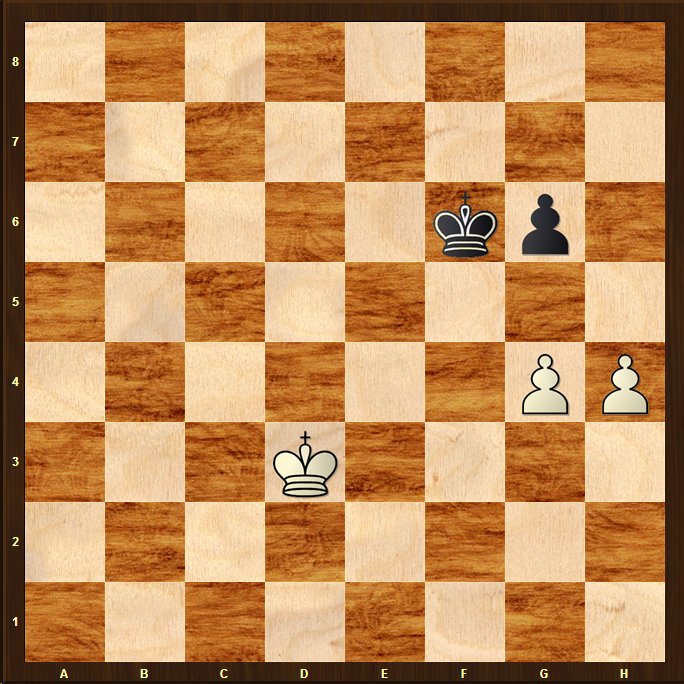


1. Kd4 Ke6
2. Ke4 Kf6
3. Kd5 Kf7
3. … Ke7
4. Ke5 Kf7
5. Kd6 Kf6
6. g5+ Kf5
7. Ke7 Kg4
8. Kf6 Kxh4
9. Kxg6 +-
4. Ke5 Ke7
5. g5 Kf7
6. Kd6 and White will win the g6 pawn.
Rainer
Good one Susan I learned from this one. These can be so subtle. I have to admit in a game I would have drawn.
My ideas are: Two steps:
1) By means of opposition and outflanking you will bring the king to the critical squares f6, e6, d6(d7-d8) then play g5 (see how white control the 6th rank now!)
2) Continuing with the usual opposition-outflanking technique… the f6 pawn is easily won…and it’s game over
Resume: Once we see the critical squares (here d6,e6,f6) our king just have to go there…
Just one more thing: don’t play g5 BEFORE going to these squares because black’s king could then either go down the board and take your own pawns or keep an “eternal opposition”.
Are my ideas right?
Have a nice day
As always in pawns endgames…king goes first.My moves:
1.Kd4!! (diagonal opposition)
1…g5 2.h5 winning
1…Ke6 2.Ke4(normal opposition)2…Kf6 3.Kd5 Kf7
4.Ke5 Ke7 5.g5(now white has the normal opposition again) Kf7 6.Kd6 Kg7 7.Ke7 Kh7 8.Kf7 Kh8 9.Kxg6 winning
http://www.youtube.com/watch?v=N003wIDsiCc
super good video with Magnus Carlsen on TV. Dont miss this one.
Susan I think this is good publicity. nicely done.
Greetings,
Erroneous would be
1.Kd3-Ke4? (Main Line) allowing 1…Kf6-Ke6! Seizing the opposition
2. Ke4-Kd4
(If 2.g4-g5 then 2…Ke6-Kd6! [not 2…Ke6-Kf7? Ke4-Kd5! wins]
3.Ke4-Kd4 Kd6-Ke6 [intending 4…Ke6-Kf5.] 4.Kd4-Ke4 Ke6-Kd6 and White cannot make progress as variations below will later prove)
2…Ke6-Kd6! Main line ctd (2…Ke6-Kf6? 3.Ke4- Kd5! Kf6-Kf7 4. Kd5-Ke5 Kf7-Ke7 g4-g5 is decisive)
3. Ke4-Kd4
(if 3.g4-g5!? Kd6-Ke6! eyeing f5 square 4.Ke4-Kf4!?[White now has the dangerous idea of Kf4-Kg4 followed by h5 as well as eyeing the critical e5 square] 4…Ke6- Kf7!! Only move, if [4…Ke6-Kd5? 5. Kf4-Kg4 Kd5-Ke6 6.h4-h5 wins] 5. Kf4-Ke5 [5.Kf4-Kg4 Kf7-Kg7 6. h5-h5 g6xgh+ followed by Kh7 draws] 5…Kf7-Ke7 6.Ke5-Kd5 Ke7-Kd7 7.Kd5-Kc5 would allow black play 7…Kd7- Ke6![ only not 7…Kd7-Kc7?? 8.h5 would be comical]
3…Kd6-Ke6! (Main line ctd)
4.Kd4-Ke4 and white cannot make progress because 4. g4-g5 allows 4…Ke6-Kf5 and 4.Kc4-Kc5 allows 4…Ke6-Ke5.
Henceforth a few points are now clear;
1.e5 square is critical.
2.White should delay the g pawn push as long as possible until White occupies the e5 square
3.white has the g pawn as a spare tempo to re-seize the opposition if necessary once the e5 square is occupied
So correct is
1.Kd3 –Kd4! Kf6-Ke6
2.Kd4-Ke4 Ke6- Kf6 (2…Ke6-Kd6 3. Ke4-Kf4 Kd6-Ke6 4. Kf4-Kg5 Ke6-Kf7 5. Kg5-Kh6 Kf7-Kf6 6. g4-g5+ and wins)
3.Kd4-Kd5 Kf6-Kf7
4.Kd5-Ke5 Kf7-Ke7
and only now e5 is occupied 5.g4-g5! with a trivial win.
Your’s Faithfully
King.
Greetings again,
One important point I forgot to add. The reason I gave the incorrect 1.Ke4 variation above is to indicate how easily black could still go wrong even after this inferior move.
Yours Faithfully,
King.
frankly spoken: the given position is one of those pawn endgames, an average chess player should know by heart, even getting up at 3 o’clock in the morning, after 3 sixpacks of beer… 🙂
however, i’m interested in the answer of following question(s):
is – after
1.kd4!! (the diagonal opposition) 1…ke6
2.ke4! (the normal opposition)
2…kf6
3.kd5 called the knight’s opposition? i’m not quite sure – but maybe! LMAO
and what the heck should white play, if black does not like the “opposition allowing” move 2… kf6, and plays the sophisticated
2…g5!? instead?
ROFL – and greetings
oh, btw. i needed less than 10 seconds to solve this puzzle… MUCH less…
greetings
Vohaul,
How much less?
…And just like it’s done in correspondence chess sometimes, I am including my next question (it should apply to any sensible answer):
What took you so long?
Michael Langer
Austin, Texas
Vohaul, I think very fast and I need two minutes to see a nine moves victory and to verify it later.
Only a cheap player can play one absolutely won endgame thinking just ten seconds in it…because he can lose half point very easily.
And I do not know how many players can you defeat without sleep and with six packs of beer in your body, but I am not one of them!
And if you never read about “diagonal opposition” then buy a endgames book and stop speaking in your unpolite way.
whow, whow, slow down please jose… no offense meant!
what i simply wanted to say is, that after 1.kd4 ke6 2.ke4 a position arises, which is theoretically known as a win for white (if black is to move). you’ll find the entire position in nearly every endgame book and it is recommended to memorize it as a very important “endgame pattern”.
That’s the reason why it took me about 1 second to recognize it. of course i was a little amused by the stunning comments about how to win this.
greetings
PS: the new endgame puzzle is just the same thing…