I think what I did with the Nf3+ that I thought was mate was I checked that all the dark squares were controlled and then just left it at that because I lost track of what I was thinking.
If 2) … Ke1, 3) Nf3 is not mate, since the d1 square is quite accessible. However, this is the familiar N + B mate, either:
1) Bd3 — if Kh2,
2) Kf2, Kh1
3) Bf1, Kh2
4) Nf3+, Kh1
5) Bg2+ OR
****
1) Bd2 — if Kh1
2) Kf2, Kh2
3) Bf1, Kh1
4) Bg2+, Kh2
5) Nf3#
I can fortunately play this ending from this position blindfolded. Of course, getting this position, where the king is corralled in the right corner, is still an ending I haven’t fully mastered so that I can easily win it against a solid player:
1. Bd3
Keeps the king in the corner by taking away the f1 square:
1. …………Kh2
If black plays Kh1, white rearranges what you see below to use the king to take away h2 rather than h3: [1. …Kh1 2.Kg3 Kg1 3.Nh3 Kh1 4.Be4#].
2. Kf2
Uses the king to take away g1- both kings moves in the lines clear the line to h1 for the bishop…..
2. …………..Kh1
From here, white has two options to finish this off in 5 moves total, I just prefer this one, as does Lenny it appears…..
3. Bf1
Replaces the knight’s guard on h3 so that he can move…..
3. …………..Kh2
4. Nf3 Kh1
5. Bg2#
Like I wrote, the really, really hard part about this ending is getting to the point in the diagrammed position.
A few years ago in Raleigh NC I escaped with a draw because I traded my Knights for his pawn(s). Amazingly I believe that same week he was teaching his students not worry about the B and N mate because it is so rare. (He told me)…and something like after I got his pawn that I was cruel. He just stared at the board…made a few moves and then agreed to a draw…wow…whew I escaped!
4k3/2R1P3/8/2P5/7p/8/2K3p1/8 w How should white proceed?
8/1p6/p3kpr1/P4R2/5PP1/1P6/1KP5/8 w How should white proceed?
Q7/8/2N5/1P6/4K1k1/8/8/1q6 w How should white proceed?
4k3/1R6/5K1p/p4P2/6P1/8/4r3/8 w How should white proceed?
8/4R3/2k5/8/1PK1N3/6p1/6B1/8 w Find the shortest mate.
The first time this was posted, the commenters found at least, I think, three 1st moves for white to win. 1.Rb5 is one of them that Lucymarie found. I favored 1.Rg5, and others favored 1.Re5, and I couldn’t really tell you which is most accurate, but they clearly gave white near decisive advantages.
Here is the solution for the third puzzle. The idea is to promote a white pawn.
V-1
1. Kd4 Qxb5
2. Ne5+ Kf5
3. Qf8+ Ke6
4. Qf7+ Kd6
5. Nc4+ Kc6
6. Qe8+ Kc7
7. Qxb5 Kc8
8. Qc6+ Kd8
9. Qb7 Ke8
10. Ne5 Kd8
11. Qd7#
There was a game in one of the Kasparov vs. Karpov matches (1990, I think) where Karpov, late in the match (sometime around game 20/21, think) needed a victory to even the match, and he pressed a Q+N vs Q ending for about 30 moves. If memory serves, Kasparov also had two unconnected pawns with his king and queen against Karpov’s queen, knight, and king. I remember thinking at the time that Karpov was just being stubborn in pressing the ending since I was convinced there was no way to even win the ending if Kasparov didn’t even have the two pawns. This little puzzle shows that Karpov wasn’t being stubborn for no reason- it can be won if player with just the queen is a bit careless.
Here is the solution for the first puzzle. I don’t know how to win. I only found out how to get a draw.
V-1
1. Rc8+ Kxe7
2. Rg8 h3
3. c6 h2
4. c7 g1=Q
5. Rxg1 hxg1=Q
6. c8=Q
It isn’t a strong line.
V-2
1. Rc8+ Kxe7
2. Rg8 h3
3. c6 Kd6
4. Rg6+ Kc7
5. Kb2 h2
6. Rxg2 h1=Q
7. Rc2
The white’s plan is to save a pawn to secure a draw.
Well done. Yes, the second line is the most challenging for white, but it is a technical draw. I was just checking to see if you understood that last line.
5R2/5p2/8/2K1k1p1/7p/5P2/8/8 b How should black proceed?
8/8/p7/1b6/1P6/8/1P6/4K1k1 b How should black proceed?
8/7p/pp6/k1pn2B1/P2P4/KP5p/5P2/8 w How should white proceed?
1r6/4R3/2k2p2/8/1P2K2P/5P2/8/8 b How should black proceed?
Consider this position that arises from the main line of the solution (I pulled this position directly from the Nalimov Tablebase, though I have an analogous line in my own solution from 5 years ago).
8/8/p7/8/1P4b1/1P6/2K5/4k3 b
In reviewing my comment, it was a bit unclear to me even then if black has to force white to move the b5 to allow black to convert the black a-pawn into a b pawn. Is that the case or not?
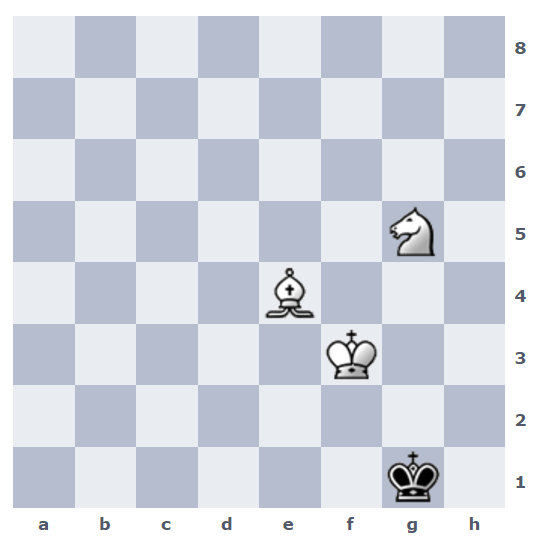


1. Kg3 Kf1 2. Bd3+ Kg1 ( 2. … Ke1 3. Nf3# ) 3 Nh3+ Kh1 4. Be4#
I think what I did with the Nf3+ that I thought was mate was I checked that all the dark squares were controlled and then just left it at that because I lost track of what I was thinking.
If 2) … Ke1, 3) Nf3 is not mate, since the d1 square is quite accessible. However, this is the familiar N + B mate, either:
1) Bd3 — if Kh2,
2) Kf2, Kh1
3) Bf1, Kh2
4) Nf3+, Kh1
5) Bg2+ OR
****
1) Bd2 — if Kh1
2) Kf2, Kh2
3) Bf1, Kh1
4) Bg2+, Kh2
5) Nf3#
Lenny you lost one move in the second variation.
1. Bd3 Kh1
2. Kg3 Kg1
3. Nh3+ Kh1
4. Be4#
Correct! Mate in 4 is better than mate in 5! Nice catch, Alena.
I can fortunately play this ending from this position blindfolded. Of course, getting this position, where the king is corralled in the right corner, is still an ending I haven’t fully mastered so that I can easily win it against a solid player:
1. Bd3
Keeps the king in the corner by taking away the f1 square:
1. …………Kh2
If black plays Kh1, white rearranges what you see below to use the king to take away h2 rather than h3: [1. …Kh1 2.Kg3 Kg1 3.Nh3 Kh1 4.Be4#].
2. Kf2
Uses the king to take away g1- both kings moves in the lines clear the line to h1 for the bishop…..
2. …………..Kh1
From here, white has two options to finish this off in 5 moves total, I just prefer this one, as does Lenny it appears…..
3. Bf1
Replaces the knight’s guard on h3 so that he can move…..
3. …………..Kh2
4. Nf3 Kh1
5. Bg2#
Like I wrote, the really, really hard part about this ending is getting to the point in the diagrammed position.
Bd3 Kh2, Kf2 Kh1, Kg3 Kg1, Nh3+ Kh1, Nf3 #
A few years ago in Raleigh NC I escaped with a draw because I traded my Knights for his pawn(s). Amazingly I believe that same week he was teaching his students not worry about the B and N mate because it is so rare. (He told me)…and something like after I got his pawn that I was cruel. He just stared at the board…made a few moves and then agreed to a draw…wow…whew I escaped!
Puzzles for Alena or any who wish to try them:
4k3/2R1P3/8/2P5/7p/8/2K3p1/8 w How should white proceed?
8/1p6/p3kpr1/P4R2/5PP1/1P6/1KP5/8 w How should white proceed?
Q7/8/2N5/1P6/4K1k1/8/8/1q6 w How should white proceed?
4k3/1R6/5K1p/p4P2/6P1/8/4r3/8 w How should white proceed?
8/4R3/2k5/8/1PK1N3/6p1/6B1/8 w Find the shortest mate.
Here is the solution for the second puzzle.
1. Rb5 Rg7
2. f5+ Kd6
3. Rb6+ Kc5
4. Rxf6+ Rxg4
5. Rf7 b6
6. axb6 Kxb6
7. Rf6+ Kb7
8. Rf8 Rf4
9. f6 Kc6
10. f7 Kd7
11. Ra8 Rxf7
12. Ra7+ Ke6
13. Rxf7 Kxf7
14. Ka3 Ke6
15. Ka4 Kd5
16. Ka5 Kd4
17. Kxa6 Kc5
It’s a winning position for white.
The first time this was posted, the commenters found at least, I think, three 1st moves for white to win. 1.Rb5 is one of them that Lucymarie found. I favored 1.Rg5, and others favored 1.Re5, and I couldn’t really tell you which is most accurate, but they clearly gave white near decisive advantages.
Link
Wow!
Here is the solution for the third puzzle. The idea is to promote a white pawn.
V-1
1. Kd4 Qxb5
2. Ne5+ Kf5
3. Qf8+ Ke6
4. Qf7+ Kd6
5. Nc4+ Kc6
6. Qe8+ Kc7
7. Qxb5 Kc8
8. Qc6+ Kd8
9. Qb7 Ke8
10. Ne5 Kd8
11. Qd7#
V-2
1. Kd4 Qb2+
2. Kc5 Qc3+
3. Kb6 Qf6
4. Qg8+ Kh3
5. Ka7 Qf3
6. Qe6+ Kg3
7. Qd6+ Kg2
8. b6 Qf7+
9. b7 Kf2
10. Kb6 Qf3
11. b8=Q
It’s a win.
Well done!
There was a game in one of the Kasparov vs. Karpov matches (1990, I think) where Karpov, late in the match (sometime around game 20/21, think) needed a victory to even the match, and he pressed a Q+N vs Q ending for about 30 moves. If memory serves, Kasparov also had two unconnected pawns with his king and queen against Karpov’s queen, knight, and king. I remember thinking at the time that Karpov was just being stubborn in pressing the ending since I was convinced there was no way to even win the ending if Kasparov didn’t even have the two pawns. This little puzzle shows that Karpov wasn’t being stubborn for no reason- it can be won if player with just the queen is a bit careless.
Here is the solution for the fourth puzzle.
V-1
1. g5! h5
2. g6 h4
3. Rb8+ Kd7
4. g7 Rg2
5. g8=Q Rxg8
6. Rxg8 Kc6
7. Rh8 Kb5
8. Rxh4 a4
9. Ke6 a3
10. f6 a2
11. Rh1 a1=Q
12. Rxa1
V-2
1. g5 h5
2. g6 Kd8
3. g7 Rg2
4. Kf7 Kc8
5. Re7 Kd8
6. Ra7 Kc8
7. g8=Q+ Rxg8
8. Kxg8 Kb8
9. Rxa5 Kb7
10. Ra4 Kc6
11. Rh4 Kd7
12. Rxh5
It’s a winning position for white.
Looks good.
Link
Here is the solution for the fifth puzzle. It’s a beautiful puzzle. There are a few ways to checkmate.
V-1
1. b5+ Kb6
2. Nd2 Ka5
3. Nb3+ Ka4
4. Ra7#
V-2
1. Nd2+ Kb6
2. Nb3 Ka6
3. Nc5+ Kb6
4. Rb7#
V-3
1. Nxg3+ Kd6
2. Kd4 Ke6
3. Bd5+ Kd6
4. Ne4#
The first puzzle is very very difficult. I will try to crack it.
Mate in 4 is not the shortest!
Alena, after you solve this one, there are more puzzles below these comments.
Here is the solution for the first puzzle. I don’t know how to win. I only found out how to get a draw.
V-1
1. Rc8+ Kxe7
2. Rg8 h3
3. c6 h2
4. c7 g1=Q
5. Rxg1 hxg1=Q
6. c8=Q
It isn’t a strong line.
V-2
1. Rc8+ Kxe7
2. Rg8 h3
3. c6 Kd6
4. Rg6+ Kc7
5. Kb2 h2
6. Rxg2 h1=Q
7. Rc2
The white’s plan is to save a pawn to secure a draw.
Well done. Yes, the second line is the most challenging for white, but it is a technical draw. I was just checking to see if you understood that last line.
At last I have found the shortest mate.
1. Kc3! Kb5
2. Nc5 Kb6
3. Rb7#
You got it.
1. Bd3 Kh1 2. Kf2 Kh2 3. Bf1 Kh1 4. Bg2+ Kh2
5. Nf3#
or
1. Bd3 Kh2 2. Kf2 Kh1 3. Bf1 Kh2 4. Nf3+ Kh1
5. Bg2#
Puzzles for Alena or whoever wishes to try them:
5R2/5p2/8/2K1k1p1/7p/5P2/8/8 b How should black proceed?
8/8/p7/1b6/1P6/8/1P6/4K1k1 b How should black proceed?
8/7p/pp6/k1pn2B1/P2P4/KP5p/5P2/8 w How should white proceed?
1r6/4R3/2k2p2/8/1P2K2P/5P2/8/8 b How should black proceed?
Lol, problem solving fiesta!…I work two jobs so I do not have time lol!
Here is the solution for the first puzzle.
V-1
1…Kf4
2. Rxf7+ Kg3
3. Rh7 Kxf3
4. Kc4 Kg3
5. Rh5 g4
6. Kd5 h3
7. Ke5 h2
8. Kf5 Kg2
9. Kxg4 h1=Q
10. Rxh1 Kxh1
V-2
1…Kf4
2. Rxf7+ Kg3
3. f4 gxf4
4. Rxg7+ Kf3
5. Rh7 Kg3
6. Rg7+ Kf3
7. Rh7 Kg3
8. Kd4 h3
9. Ke4 h2
10. Rg7+ Kf2
11. Rh7 Kg3
12. Rg7+ Kf2
13. Rh7 Kg3
14. Rh5 Kg2
15. Rg5+ Kf2
16. Rh5 Kg2
17. Kxf4 h1=Q
18. Rxh1 Kxh1
V-2
1…Kf4
2. Rxf7+ Kg3
3. Rh7 Kxf3
4. Kc4 Kg3
5. Rh5 g4
6. Kd5 h3
7. Ke5 h2
8. Kf5 Kg2
9. Kxg4 h1=Q
10. Rxh1 Kxh1
It’s a draw.
Link
Here is the solution for the second puzzle.
1… Ba4
2. Kd2 Kf2
3. Kc3 Bb5
4. Kb3 Ke1
5. Kc3 Kd1
6. Kb3 Kc1
7. Kc3 Kb1
8. Kb3 Ka1
9. Kc3 Ka2
10. Kc2 Bc4
11. Kc3 Bb3
12. Kd3 Kxb2
13. Kd4 Kc2
14. Ke3 Kc3
15. Ke2 Kxb4
16. Kd2 Ka3
17. Kc1 Ka2
18. Kd2 a5
19. Kc3 a4
20. Kd3 a3
21. Kc3 Kb1
22. Kxb3 a2
23. Kc4 a1=Q
It’s a winning position for black.
Consider this position that arises from the main line of the solution (I pulled this position directly from the Nalimov Tablebase, though I have an analogous line in my own solution from 5 years ago).
8/8/p7/8/1P4b1/1P6/2K5/4k3 b
In reviewing my comment, it was a bit unclear to me even then if black has to force white to move the b5 to allow black to convert the black a-pawn into a b pawn. Is that the case or not?
In my opinion it’s inevitable.
Here is the solution for the third puzzle.
1. Bd8! c4
2. Bg5 Nb4
3. Bd2 b5
4. Bxb4+ Kb6
5. Bd6 Kc6
6. Be5 Kd5
7. axb5 axb5
8. Kb4 cxb3
9. Kxb3 h2
10. Bxh2 Kxd4
11. Kb4 Ke4
12. Kxb5 Kf3
13. Bg3 Kg4
14. Kc4 Kf5
15. Kd3 Kg4
16. Ke3 h5
17. Bb8 h4
18. Ke4 Kh5
19. Bh2 Kg5
20. Kf3 Kf5
21. Bf4 h3
22. Bg3 Kg5
23. Ke4 Kf6
24. f3 Ke6
25. Kf4 Kf7
26. Kf5 Kg7
27. f4 Kf7
28. Kg5 Ke6
29. Kg6 Kd5
30. f5 Kc6
31. f6 Kd5
It’s a winning position for white.
Well done!
Link