It’s a loss for white. Black’s two rooks can be put in 8th rank to stop white’s pawn promotion . White can promote only one pawn and will lose another . Eventually black will win.
I will post the full analysis in the morning, however, I will offer a clue- white can’t win or draw by putting only the g and h pawns on the 7th rank immediately- he will need to advance the f-pawn more quickly than it seems. If white tries 1.g7 2.h7, or vice versa, black can defend the 8th rank and, this is important, can actively attack the pawns from that rank with the rooks.
With that in mind, you have to choose the order in which the three pawns advance, and it does matter which one you choose to move first, and after that, which one you choose to move second- it basically boils down to which formation of three connected pawns is strongest.
Even though Black can attacks in the 8th Rank with double rook, White has advantage of checking the black king while Queening the h pawn… hence white wins the game.
1) h7 Rb1 2) h8+ (Q) Kb7 there by game of Queen vs 2 Rooks … but pawns play an advantage role
1. f5 loses to 1…Rbb1 2. g7 Rg1+ 3. Kf3 Rb8 4. f6 Rg6 5. h7 R:f6+ 6. Ke4 (or 6. Kg4 Rg6+ which is even easier) Rff8! followed by Rh8 and the exchange of the R for the two advanced pawns.
1. h7 forces a R to the 8th rank, say 1…Rb8 2. f5 Rh8 3. f6 R:h7 4. gh Rc8 5. f7 and the black pawn decides the game since neither pawn can promote without the support of the white K and black’s pawn promotes before the white K can get to g7.
So 1. g7 must be right if there is a win. 1…Rb8 2. f5 Rg8 3. f6 and now the R cannot sacrifice itself since the pawns will remain connected. So 3…Rcc8 but now 4. h7 Rh8 5. f7 R:h7 6. g8Q and white wins.
This is a tricky problem! Like Karthik, I had thought either pawn push would be ok, however there is a difference I didn’t appreciate until I had puzzled over the fact that it was still lost for white in the line I had in mind, and I don’t know what Karthik had in mind with the 2nd move of black, but lets just get to it:
1. g7!
Of course, the idea is to tie the rooks down on the 8th rank with g7 and h7, but one offers a different and winning line at a key juncture that the other doesn’t:
1. ………….Rb8 (or Rc8 to guard the 8th rank)
2. h7?? Rcc8 (double guarding the 8th rank now)
And it looks like white should be able to now advance the f-pawn to win or draw, but this does overlook a key aspect of this kind of ending- black doesn’t have to sit passively with the rooks tied down waiting for white to advance the f-pawn:
3. f5 Rh8!!
It is easy to miss this offensive move for black, but think about it- what can white do? If white doesn’t take the rook, the rook captures at h7, and if white plays g8Q, black sacrifices a rook for the new queen and the h-pawn. The remaining rook is enough to win the game considering that black still has the passed a-pawn. So, white must take at h8, but that is no better:
4. gh8Q Rh8 and this is clearly won for black.
So, white needs to advance the f-pawn before playing h7:
1. g7! Rb8
2. f5!
Now black has a problem. Attacking the f or h pawn laterally won’t help- white will just play h7 in either case:
2. …………Rc5
3. h7
Here, even 3.f6 will win. Continuing:
3. ………..Rcc8 (I will return to this move below for a wrap up)
4. f6!
And now Rh8 won’t help…..
4. ………..Rh8
5. f7!
And with a pawn in hand, the resulting Q vs R ending is easy enough to manage for white.
So, the final issue to deal with is why did it have to be 1. g7 and not 1.h7……..
1. h7?? Rb8
2. f5
As before, 2.g7 allows Rcc8 and Rh8 to win for black, so white must try to get the f-pawn into the game more quickly, however with arrangement of pawns, black has a resource that wasn’t available in the previous line, and maybe this is what Karthik had in mind with the erroneous suggestion for black’s second move:
2. …………Rc7 (though now that I think about it, Rh8 wins here, too)
This move prevents g7. Because of the a-pawn, white doesn’t have time to advance his king or even the forward f-pawn now:
3. f6 Rh7!!
4. gh7 a5
And black will queen long before white’s king can aid either one of the advanced pawns. The important point to take away here is that the sacrifice at h7 disconnected the remaining pawns and they were impotent against the rook. So, let’s go back to the line that starts with 1.g7 and see what happens if black tries this same defense:
1. g7! Rb8
2. f5 Rc7
The analogous line, and the loose end I mentioned when I first discussed 1.g7/2.f5. This move again prevents white from immediately putting two pawns on the seventh rank, however it is different now because….
3. f6!
Before, black could sacrifice for the pawn on the 7th rank, in that case, it was the h-pawn, which after the recapture left white with two advanced, but disconnected pawns on f6 and h7, neither of which could guard the other while queening- this led to white losing. However, when the advanced pawn is the g-pawn, 3.f6 doubles the guard on the 7th rank pawn. Black would have to sacrifice both rooks and still only win two of the three pawns. For example:
3. ……….Rg7
4. fg7 Rg8 (trying a swindle on 5.h7??)
5. Kf3! and h7 can’t be prevented, and white will get at least a Q vs R ending still having a pawn on board.
Finally, in the line above, black can’t blockade successfully either at move 3:
3. ………..Rf7
4. h7! Rff8 (another swindle try)
5. f7! and again white will end up with at least Q vs R with a pawn still alive.
1. g7 Rb8 2. f5 Rc6 3. h7 and black has no better than 3…Rcc8 which, as we have seen, loses to 4. f6!. The point is that if the pawns get to g7 and h7 before black has gotten both rooks to his home rank, then attacking either pawn from the side or behind loses to the promotion of the other one.
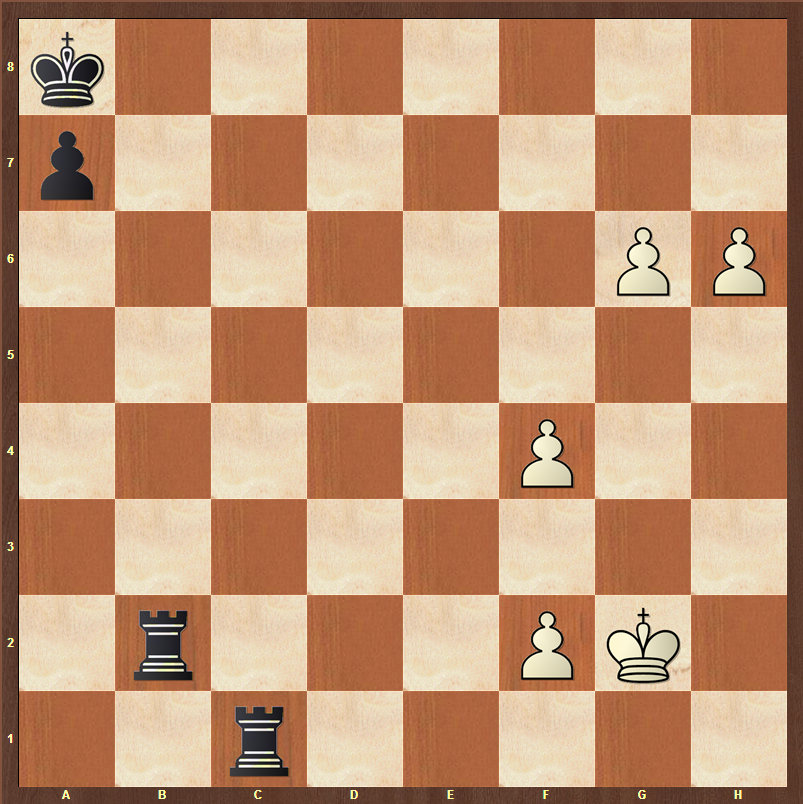


Seems like g7 or h7 both work?
1. g7 Rb8/c8 2. h7 Rc7/b7 3. g8Q
2. h7 Rb8/c8 2. g7 Rb7/c7 3. g8Q
It’s win for White.
1) h7 Rc2 2) h8+ (Q) Kb7 3) Qxb2 Rxb2 4) g7 another Queen to come
It’s a loss for white. Black’s two rooks can be put in 8th rank to stop white’s pawn promotion . White can promote only one pawn and will lose another . Eventually black will win.
I also overlooked 2.f5
I will post the full analysis in the morning, however, I will offer a clue- white can’t win or draw by putting only the g and h pawns on the 7th rank immediately- he will need to advance the f-pawn more quickly than it seems. If white tries 1.g7 2.h7, or vice versa, black can defend the 8th rank and, this is important, can actively attack the pawns from that rank with the rooks.
With that in mind, you have to choose the order in which the three pawns advance, and it does matter which one you choose to move first, and after that, which one you choose to move second- it basically boils down to which formation of three connected pawns is strongest.
Oh, and white will win this. At worst, white ends up with Q+P vs R+P ending.
Even though Black can attacks in the 8th Rank with double rook, White has advantage of checking the black king while Queening the h pawn… hence white wins the game.
1) h7 Rb1 2) h8+ (Q) Kb7 there by game of Queen vs 2 Rooks … but pawns play an advantage role
Wrong 8th rank, 1.h7 Rc8 2.g7 Rb8 3.f5 Rh8 attacking from in front.
1. f5 loses to 1…Rbb1 2. g7 Rg1+ 3. Kf3 Rb8 4. f6 Rg6 5. h7 R:f6+ 6. Ke4 (or 6. Kg4 Rg6+ which is even easier) Rff8! followed by Rh8 and the exchange of the R for the two advanced pawns.
1. h7 forces a R to the 8th rank, say 1…Rb8 2. f5 Rh8 3. f6 R:h7 4. gh Rc8 5. f7 and the black pawn decides the game since neither pawn can promote without the support of the white K and black’s pawn promotes before the white K can get to g7.
So 1. g7 must be right if there is a win. 1…Rb8 2. f5 Rg8 3. f6 and now the R cannot sacrifice itself since the pawns will remain connected. So 3…Rcc8 but now 4. h7 Rh8 5. f7 R:h7 6. g8Q and white wins.
Very interesting problem!
This is a tricky problem! Like Karthik, I had thought either pawn push would be ok, however there is a difference I didn’t appreciate until I had puzzled over the fact that it was still lost for white in the line I had in mind, and I don’t know what Karthik had in mind with the 2nd move of black, but lets just get to it:
1. g7!
Of course, the idea is to tie the rooks down on the 8th rank with g7 and h7, but one offers a different and winning line at a key juncture that the other doesn’t:
1. ………….Rb8 (or Rc8 to guard the 8th rank)
2. h7?? Rcc8 (double guarding the 8th rank now)
And it looks like white should be able to now advance the f-pawn to win or draw, but this does overlook a key aspect of this kind of ending- black doesn’t have to sit passively with the rooks tied down waiting for white to advance the f-pawn:
3. f5 Rh8!!
It is easy to miss this offensive move for black, but think about it- what can white do? If white doesn’t take the rook, the rook captures at h7, and if white plays g8Q, black sacrifices a rook for the new queen and the h-pawn. The remaining rook is enough to win the game considering that black still has the passed a-pawn. So, white must take at h8, but that is no better:
4. gh8Q Rh8 and this is clearly won for black.
So, white needs to advance the f-pawn before playing h7:
1. g7! Rb8
2. f5!
Now black has a problem. Attacking the f or h pawn laterally won’t help- white will just play h7 in either case:
2. …………Rc5
3. h7
Here, even 3.f6 will win. Continuing:
3. ………..Rcc8 (I will return to this move below for a wrap up)
4. f6!
And now Rh8 won’t help…..
4. ………..Rh8
5. f7!
And with a pawn in hand, the resulting Q vs R ending is easy enough to manage for white.
So, the final issue to deal with is why did it have to be 1. g7 and not 1.h7……..
1. h7?? Rb8
2. f5
As before, 2.g7 allows Rcc8 and Rh8 to win for black, so white must try to get the f-pawn into the game more quickly, however with arrangement of pawns, black has a resource that wasn’t available in the previous line, and maybe this is what Karthik had in mind with the erroneous suggestion for black’s second move:
2. …………Rc7 (though now that I think about it, Rh8 wins here, too)
This move prevents g7. Because of the a-pawn, white doesn’t have time to advance his king or even the forward f-pawn now:
3. f6 Rh7!!
4. gh7 a5
And black will queen long before white’s king can aid either one of the advanced pawns. The important point to take away here is that the sacrifice at h7 disconnected the remaining pawns and they were impotent against the rook. So, let’s go back to the line that starts with 1.g7 and see what happens if black tries this same defense:
1. g7! Rb8
2. f5 Rc7
The analogous line, and the loose end I mentioned when I first discussed 1.g7/2.f5. This move again prevents white from immediately putting two pawns on the seventh rank, however it is different now because….
3. f6!
Before, black could sacrifice for the pawn on the 7th rank, in that case, it was the h-pawn, which after the recapture left white with two advanced, but disconnected pawns on f6 and h7, neither of which could guard the other while queening- this led to white losing. However, when the advanced pawn is the g-pawn, 3.f6 doubles the guard on the 7th rank pawn. Black would have to sacrifice both rooks and still only win two of the three pawns. For example:
3. ……….Rg7
4. fg7 Rg8 (trying a swindle on 5.h7??)
5. Kf3! and h7 can’t be prevented, and white will get at least a Q vs R ending still having a pawn on board.
Finally, in the line above, black can’t blockade successfully either at move 3:
3. ………..Rf7
4. h7! Rff8 (another swindle try)
5. f7! and again white will end up with at least Q vs R with a pawn still alive.
What about this line:
1. g7!, Rb8
2. f5, Rc6!
Very Interesting
1. g7 Rb8 2. f5 Rc6 3. h7 and black has no better than 3…Rcc8 which, as we have seen, loses to 4. f6!. The point is that if the pawns get to g7 and h7 before black has gotten both rooks to his home rank, then attacking either pawn from the side or behind loses to the promotion of the other one.