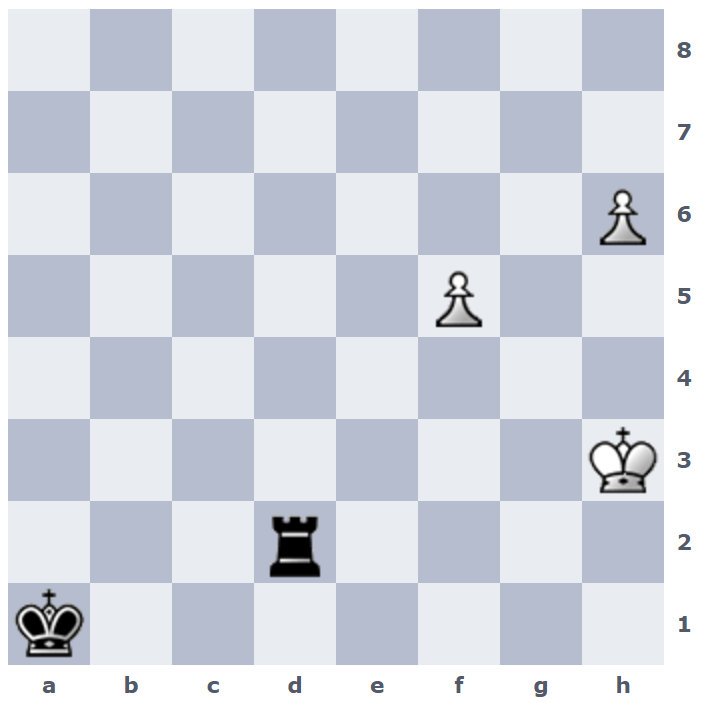
Black is threatening Rd6 which after Kg4 Rxh6 Kg5 looks like a draw,
1.h7 Rd1 2.Kg2 Rd2+ 3.Kg3 Rd3+ 4.Kg4 so the pawn must be stopped from in front
1.h7 Rd8 2.f6 Rh8 3.f7 Rxh7+ so h7 isn’t good.
1.f6 Rf2 2.h7 wins
1.f6 Rd7 2.Kg4 and Rd1 looks the best move
so
1.f6 Rd1 2.f7 wins and so the BK has to try to help
1.f6 Rd7 2.Kg4 Kb2 3.Kg5 Kc3 4.Kg6 Kd4 and Black can delay better with Rd8
1.f6 Rd8 2.Kg4 Kb2 3.Kg5 Kc3 4.Kg6 Kd4 5.Kg7 Ke5 6.f7 Ke6 7.f8=Q Rxf8 8.Kxf8 wins so try 6…Kf5 7.h7 also wins
Therefore White has a win with 1.f6
There are two moves here that can fool a player- 1.h7 and 1.Kg4/h4. James above points out the futility of 1.h7- the capture on h7 by the black rook after 1. …Rd8 occurs with check unless white then plays 2.Kg4, but after the h-pawn falls, black can sacrifice for the remaining pawn to draw. And Karthik points out the flaw in 1.Kg4/h4- white can’t protect the two pawns simultaneously on the g-file- and if he puts the king on f6, black attacks the unprotected h-pawn, and if white puts the king on h7, black attacks the unprotected f-pawn. White just doesn’t have time to protect and push at the same time. There is just one issue to discuss with 1.f6 that James missed- white’s win is more difficult than it seems:
1. f6! Rd7
2. Kg4 Kb2
3. Kg5 Kc3
4. Kg6 Rd1!
Bringing the king to d4 at move 4 is futile and shortens white’s win as James demonstrates after 5.Kg7. However, with 4. ….Rd1, black can at least win one of the pawns without having to concede the rook:
5. h7
Not sure which is shortest, but it doesn’t matter, 5.f7 will lead to similar structure:
5. ………Rg1!
Unlike the lines after 1.Kg4/h4, the advanced h-pawn kills black since these checks can now be stopped by the typical walk down on the checking rook- white need only keep off the h-file while doing so:
6. Kf5 Rf1 (if Rh1 7.f7 will eventually win similarly)
7. Kg4 Rg1 (of course, Rxf6 loses quickly to 8.h8Q pinning and winning the rook)
8. Kf3 Rh1 (again, not Rf1 followed by Rxf6)
9. f7!
And, here, I can’t really tell which is most resistant- Rxh7 or Kc4 for black- however, in neither one can white quickly win the rook with a double attack, however Kc4 at least lays a sneaky little trap if white is careless…..
9. ……….Kc4!?
10.Kg3!
As good is Kf2/g2/e3/e4/e2.g4. The point, of course, is that 10.f8Q allows the skewer from f1, though white has just enough time to recover to protect the remaining pawn long enough to force black to sacrifice for it for draw. After 10.Kg3, white will get his queen, though not an easy task to finish:
10. ………..Rh7 (this or lose much more quickly now)
11.f8Q Rh5!
Or Ra7, I think is as good relative to the other moves available to black here. Rh5, though is easy to spot- the rook is prepared to block the checks from c8 and g8 to connect up the black king with his last defender. The only other checks are from f4 and f1, but neither allows white to double attack the black men successfully:
12.Qf4 Kc5
And I have played this type of ending ad nauseum online over the years from both sides- there is no forced double attack here as long as black is careful- especially, most of the time, keeping the rook and king on opposite colored squares until he can get them together. The only time being separated on opposite colored squares is a problem is when white can check the king along a rank or file and attack the rook on diagonal- that and skewers along the ranks and files. Eventually, white will have to concede a move by bringing the king closer to the black king, and black can use that move to bring his pieces into each other’s protection. The win from move 12 above is at least 25 moves out with most accurate play. This is an excellent ending to play against any chess program. I finally mastered it by playing it over and over against an online Shredder program a few years ago.


Draw
1. Kh4 Rh2+ 2. Kg5 Rg2+ 3. Kf6 Rh1 4. Kg7 Rg1+ 5. Kf7 Rh2 6. Kg7
Black is threatening Rd6 which after Kg4 Rxh6 Kg5 looks like a draw,
1.h7 Rd1 2.Kg2 Rd2+ 3.Kg3 Rd3+ 4.Kg4 so the pawn must be stopped from in front
1.h7 Rd8 2.f6 Rh8 3.f7 Rxh7+ so h7 isn’t good.
1.f6 Rf2 2.h7 wins
1.f6 Rd7 2.Kg4 and Rd1 looks the best move
so
1.f6 Rd1 2.f7 wins and so the BK has to try to help
1.f6 Rd7 2.Kg4 Kb2 3.Kg5 Kc3 4.Kg6 Kd4 and Black can delay better with Rd8
1.f6 Rd8 2.Kg4 Kb2 3.Kg5 Kc3 4.Kg6 Kd4 5.Kg7 Ke5 6.f7 Ke6 7.f8=Q Rxf8 8.Kxf8 wins so try 6…Kf5 7.h7 also wins
Therefore White has a win with 1.f6
There are two moves here that can fool a player- 1.h7 and 1.Kg4/h4. James above points out the futility of 1.h7- the capture on h7 by the black rook after 1. …Rd8 occurs with check unless white then plays 2.Kg4, but after the h-pawn falls, black can sacrifice for the remaining pawn to draw. And Karthik points out the flaw in 1.Kg4/h4- white can’t protect the two pawns simultaneously on the g-file- and if he puts the king on f6, black attacks the unprotected h-pawn, and if white puts the king on h7, black attacks the unprotected f-pawn. White just doesn’t have time to protect and push at the same time. There is just one issue to discuss with 1.f6 that James missed- white’s win is more difficult than it seems:
1. f6! Rd7
2. Kg4 Kb2
3. Kg5 Kc3
4. Kg6 Rd1!
Bringing the king to d4 at move 4 is futile and shortens white’s win as James demonstrates after 5.Kg7. However, with 4. ….Rd1, black can at least win one of the pawns without having to concede the rook:
5. h7
Not sure which is shortest, but it doesn’t matter, 5.f7 will lead to similar structure:
5. ………Rg1!
Unlike the lines after 1.Kg4/h4, the advanced h-pawn kills black since these checks can now be stopped by the typical walk down on the checking rook- white need only keep off the h-file while doing so:
6. Kf5 Rf1 (if Rh1 7.f7 will eventually win similarly)
7. Kg4 Rg1 (of course, Rxf6 loses quickly to 8.h8Q pinning and winning the rook)
8. Kf3 Rh1 (again, not Rf1 followed by Rxf6)
9. f7!
And, here, I can’t really tell which is most resistant- Rxh7 or Kc4 for black- however, in neither one can white quickly win the rook with a double attack, however Kc4 at least lays a sneaky little trap if white is careless…..
9. ……….Kc4!?
10.Kg3!
As good is Kf2/g2/e3/e4/e2.g4. The point, of course, is that 10.f8Q allows the skewer from f1, though white has just enough time to recover to protect the remaining pawn long enough to force black to sacrifice for it for draw. After 10.Kg3, white will get his queen, though not an easy task to finish:
10. ………..Rh7 (this or lose much more quickly now)
11.f8Q Rh5!
Or Ra7, I think is as good relative to the other moves available to black here. Rh5, though is easy to spot- the rook is prepared to block the checks from c8 and g8 to connect up the black king with his last defender. The only other checks are from f4 and f1, but neither allows white to double attack the black men successfully:
12.Qf4 Kc5
And I have played this type of ending ad nauseum online over the years from both sides- there is no forced double attack here as long as black is careful- especially, most of the time, keeping the rook and king on opposite colored squares until he can get them together. The only time being separated on opposite colored squares is a problem is when white can check the king along a rank or file and attack the rook on diagonal- that and skewers along the ranks and files. Eventually, white will have to concede a move by bringing the king closer to the black king, and black can use that move to bring his pieces into each other’s protection. The win from move 12 above is at least 25 moves out with most accurate play. This is an excellent ending to play against any chess program. I finally mastered it by playing it over and over against an online Shredder program a few years ago.
Thanks very much 🙂