Menu   ≡ ╳
  • News
    • Major Tournaments
    • General News
    • USA Chess
  • Puzzles
  • Improvement
  • Event
  • College
  • Scholastic
  • Women
  • Search

        More results...

        Or you can try to:
        Search in Shop
        Exact matches only
        Search in title
        Search in content
        Search in comments
        Search in excerpt
        Search for News
        Search in pages
        Search in groups
        Search in users
        Search in forums
        Filter by Categories

        Try these: Sicilian Defense, Empire Chess, USA Chess

    • SPICE
    • Videos
    • Susan’s Blog
    • About Us
    • Contact Us
    • SPICE
    • Videos
    • Susan’s Blog
    • About Us
    • Contact Us
    Menu   ≡ ╳
    • News
      • Major Tournaments
      • General News
      • USA Chess
    • Puzzles
    • Improvement
    • Event
    • College
    • Scholastic
    • Women
    • Search

          More results...

          Or you can try to:
          Search in Shop
          Exact matches only
          Search in title
          Search in content
          Search in comments
          Search in excerpt
          Search for News
          Search in pages
          Search in groups
          Search in users
          Search in forums
          Filter by Categories

          Try these: Sicilian Defense, Empire Chess, USA Chess

      Home  >  Daily News  >  DaVinci chess mystery

      DaVinci chess mystery

      Chess mystery, Leonardo da Vinci


      March 10, 2008
      Renaissance chess master and the Da Vinci decode mystery

      Raymond Keene
      Chess Correspondent

      A masterpiece from the early literature of chess has recently resurfaced after being thought lost for five centuries.

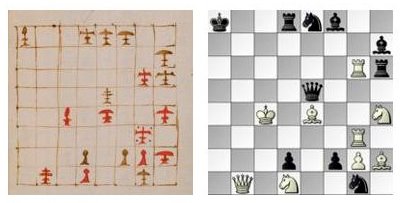
      The rediscovery of this book is of much more than scholarly or antiquarian interest, for it has been suggested that its chess puzzle diagrams were not only designed by Leonardo da Vinci, but also drawn by him and, the most tantalising prospect of all, perhaps even composed by him.

      The book, De ludo schacorum (about the game of chess), was written by the Renaissance mathematician Luca Pacioli who lived from the mid-15th century to early in the 16th. The so-called new chess, which considerably enhanced the powers of the pieces, was introduced around the 1470s. Pacioli’s long-lost book was said to be a series of educational positions and chess puzzles featuring both the old and new styles of chess — the latter known as a la rabiosa (with the mad or angry queen), because of the vastly extended powers of this new piece.

      The puzzles showing the new chess were rumoured to have been composed to demonstrate how the fresh powers of queen, bishop and pawn truly functioned on the open board. However, Pacioli’s book was lost and doubts were raised that it had been written at all. Now the book has resurfaced from the 22,000-volume library of Count Guglielmo Coronini, and facsimiles have been published with strange and rather beautiful diagrams in red and black showing the pieces in action.

      Recently The Guardian published a puzzle from the book with a commentary by its chess correspondent who conceded that he “did not have the foggiest idea” what the puzzle meant or whether it was taken from the old or new style of chess.

      Having had time to examine the puzzle more closely, I have established that it is definitely the new rabiosa form of chess which we still play now. I have also worked out that there is a fiendishly difficult forced checkmate from the puzzle position.

      This is amazing, since the new chess had been in existence for only a few years when the book was written. Given its relative novelty, the person who composed this puzzle was evidently a chess genius.

      As well as being highly advanced for its time, the solution also succeeds brilliantly in its didactic purpose of showcasing the sweeping new powers of queen and bishop as well as the potentially devastating weapon of a humble pawn now being able to promote to a mighty queen. Normally this would end the contest in the promoter’s favour. However, in this puzzle the losing side even manages to promote to a queen with check, yet still succumbs.

      What about Leonardo da Vinci’s involvement, as suggested by the owners of the book, the Fondazione Coronini Cronberg?

      Click here to read the full article.

      Posted by Picasa
      Chess Daily News from Susan Polgar
      Previous Article Monday chess tactic
      Next Article Breaking News – NY Governor Spitzer resigned (according to NY Senator D’Amato)

      About Author

      Susan Polgar

      Related Posts

      • Leonardo da Vinci chess player?

        September 16, 2016
      • The 6 Evils of Chess – Words of a 17th century monk

        July 12, 2011
      • 41 year old chess mystery

        November 21, 2010

      6 Comments

      1. Anonymous Reply
        March 10, 2008 at 5:58 pm

        A yes… another stale, 2 week old story brought to you courtesy of Google News Alerts.

      2. grundy Reply
        March 10, 2008 at 7:30 pm

        “Anonymous said…
        A yes… another stale, 2 week old story brought to you courtesy of Google News Alerts.”

        Then why don’t go bother Google and leave us alone? Then you can flame some guy at Google because you don’t like the Google logo art.
        Pissant Schmeg-master.

      3. Anonymous Reply
        March 10, 2008 at 8:32 pm

        Are we sure these diagrams are not fake ones?

      4. cfdincle Reply
        March 10, 2008 at 8:34 pm

        The only thing I don’t get is according to the diagram it appears that a white pawn is supposed to be on d1 (not a white Knight). Any thoughts on this? Perhaps the mystery is not so much related to the actual position and the legal moves as it is to the position of the various pieces…hmmm

      5. James O'Fee Reply
        March 11, 2008 at 11:07 am

        The TIMES didn’t include the solution to the puzzle in the on-line version. It is –

        1 … Qxe4+
        2 Qxe4+ Ka7
        3 Ra3+ Bxa3
        4 Qe3+ Rd4+
        5 Qxd4+ Kb7
        6 Qd7+ Ka8
        7 Qxe8+ Kb7

        See

        http://www.impalapublications.com/blog/index.php?/archives/2518-The-Da-Vinci-decode-mystery,-by-James-OFee.html
        8 Qb8 checkmate

        or

        1 … Rd5
        2 Ra3+ Bxa3
        3 Bxe5 f1Q+
        4 Kxd5 Nd6
        5 Ke6+ Ka7
        6 Bd4+ Bc5
        7 Bxc5+ Ka6
        8 Qb6 checkmate

      6. Anonymous Reply
        December 8, 2010 at 4:04 am

        I am also confused about D1. it doesn’t appear to be a knight.

      Leave a Reply to cfdincle Cancel reply

      Improvement

      • Important Scholastic Coaching Tips
      • My Chess Quotes Over The Years
      • My kids know chess rules. What’s next?
      • Chess Parenting

      Events

      • My Top 10 Most Memorable Moments in Chess (Part 3) May 13, 2021
      • My Top 10 Most Memorable Moments in Chess (Part 2) May 12, 2021
      • My Top 10 Most Memorable Moments in Chess (Part 1) May 10, 2021
      • About Susan Polgar April 9, 2021
      • About Us
      • Contact Us
      • Daily News
      • My Account
      • Terms & Conditions
      • Privacy Policy

      Anand Armenia Breaking News Chess Club and Scholastic Center of St Louis Chess interview Chess Olympiad Chess tactic Chess tournament chess trivia China FIDE Grand Prix Holland India Khanty-Mansiysk LIVE games Lubbock Magnus Carlsen Moscow National Championship Norway OnlineChessLessons Philippines Puzzle Solving Russia Scholastic chess Spain SPF SPICE SPICE Cup St Louis Susan Polgar Tata Steel Chess Texas Tech Tromsø TTU Turkey Webster University Wesley So Wijk aan Zee Women's Chess Women's Grand Prix Women's World Championship World Championship World Cup

      April 2026
      M T W T F S S
       12345
      6789101112
      13141516171819
      20212223242526
      27282930  
      « Sep