Menu   ≡ ╳
  • News
    • Major Tournaments
    • General News
    • USA Chess
  • Puzzles
  • Improvement
  • Event
  • College
  • Scholastic
  • Women
  • Search

        More results...

        Or you can try to:
        Search in Shop
        Exact matches only
        Search in title
        Search in content
        Search in comments
        Search in excerpt
        Search for News
        Search in pages
        Search in groups
        Search in users
        Search in forums
        Filter by Categories

        Try these: Sicilian Defense, Empire Chess, USA Chess

    • SPICE
    • Videos
    • Susan’s Blog
    • About Us
    • Contact Us
    • SPICE
    • Videos
    • Susan’s Blog
    • About Us
    • Contact Us
    Menu   ≡ ╳
    • News
      • Major Tournaments
      • General News
      • USA Chess
    • Puzzles
    • Improvement
    • Event
    • College
    • Scholastic
    • Women
    • Search

          More results...

          Or you can try to:
          Search in Shop
          Exact matches only
          Search in title
          Search in content
          Search in comments
          Search in excerpt
          Search for News
          Search in pages
          Search in groups
          Search in users
          Search in forums
          Filter by Categories

          Try these: Sicilian Defense, Empire Chess, USA Chess

      Home  >  Chess Improvement • Chess Puzzles  >  Early morning chess tactic

      Early morning chess tactic

      Chess tactic, Puzzle Solving


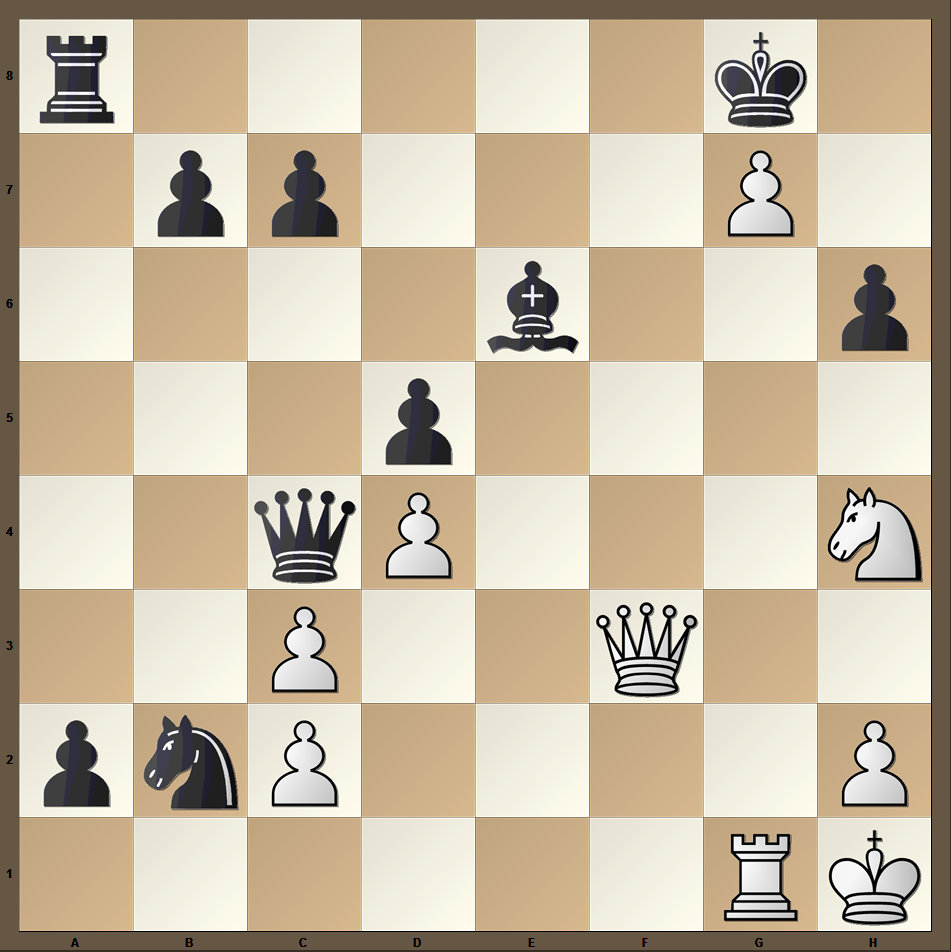
      White to move. How should white proceed?

      r5k1/1pp3P1/4b2p/3p4/2qP3N/2P2Q2/pnP4P/6RK w – – 0 1

      Chess Daily News from Susan Polgar
      Previous Article Khenkin leads German Championship after 6
      Next Article Large group of VIPs at the Fischer Premiere

      About Author

      Susan Polgar

      Related Posts

      • More Special Endgame!

        January 3, 2021
      • Precision Chess Tactic

        December 27, 2020
      • Daily dose of tactic!

        December 21, 2020

      20 Comments

      1. Trevor John Reply
        June 1, 2011 at 6:50 am

        Ng6
        Threatening Qf8+, RxQ
        pxR=Q+, Kh7
        Qh8#
        Any black move to prevent Qf8 just simply delays the inevitable by a couple of moves.

      2. Anonymous Reply
        June 1, 2011 at 7:40 am

        let´s include the knight into the attack with Ng6.
        1. Ng6 Kxg7
        2. Ne7+ Kh7/h8
        3. Qf6 and, i think, Qg7# is unstoppable.
        if 2…. Bg4, then
        3. Qxg4+ Kf6 (Kh7/h8, 4. Qg7#)
        4. Qg7+ Ke6
        5. Rg6#
        3. … Kf8
        4. Qg8+ Kxe7
        5. Qh7+ Kd8/e8/f8 (Kd6/e6, 6. Rg6#)
        6. Rg8#
        5. … Kf6
        6. Rg6+ Kf5
        7. Qf7+ Ke4
        8. Re6#
        3. … Kf7
        4. Qg6+ Kxe7
        5. Qh7+ Kd8/e8/f8 (Kd6/e6, 6. Rg6#)
        6. Rg8#
        5. … Kf6
        6. Rg6+ Kf5
        7. Qf7+ Ke4
        8. Re6#
        4. … Kf8
        5. Qg8+ Kxe7
        6. Qh7+ Kd8/e8/f8 (Kd6/e6, 7. Rg6#)
        7. Rg8#
        6. … Kf6
        7. Rg6+ Kf5
        8. Qf7+ Ke4
        9. Re6#
        if 1. … a1Q, then
        2. Qf8+ Rxf8
        3. gxf8Q+ Kh7
        4. Qh8#
        2. … Kh7
        3. Qh8+ Rxh8
        4. gxh8Q#
        1. … Re8
        2. Ne7 Rxe7
        3. Qf8+ Kh7
        4. Qh8#
        1. … Kh7
        2. Qf8 Rxf8
        3. gxf8Q Bg8 (else, 4. Qh8#)
        4. Qe7+ Bf7
        5. Qxf7#
        2. … Bg8
        3. Ne7 Rxf8
        4. gxf8Q any
        5. Qg7#
        3. … Ra6/Qc6
        4. Qf5+ R/Qg6
        5. Qxg6#
        well, i think, black is doomed. there seems to be no way out.
        greets, jan

      3. Stefan Reply
        June 1, 2011 at 8:43 am

        Df6 threats to take the bishop on e6 and the pawn on h6

      4. Anonymous Reply
        June 1, 2011 at 9:25 am

        Qf8

      5. Anonymous Reply
        June 1, 2011 at 9:42 am

        Ng6 A1=Q
        Qf8

      6. pht Reply
        June 1, 2011 at 10:57 am

        I immediately see that f8 is a weak field for black, a field he can not strengthen.
        Therefore I very much like:

        1. Ng6

        a)
        1. … Kxg7
        2. Nf8+! Kh8 (Bg4 delays by one)
        3. Qf6#

        b)
        1. … a1=Q
        2. Qf8+ Rxf8
        3. gxf8=Q+ Kh7
        4. Qh8#

        bII)
        2. … Kh7
        3. g8=Q+ Bxg8
        4. Qg7#/Rg7#

        c)
        1. … Bg4
        2. Qf8+ Rxf8 (Kk7 g8=Q#)
        3. gxf8=Q+ Kh7
        4. Qf7#

      7. Shalom Avitan Reply
        June 1, 2011 at 11:29 am

        1. Ng6
        if 1. .. Kxg7
        2. Nf8+
        if 1. .. Bf7
        2. Ne7+ Kh7
        3. Qf5+
        if 1. .. Kh7
        2. Nf8+ Kg8
        3. Nxe6
        any other move
        2. Qf8+

      8. Anonymous Reply
        June 1, 2011 at 2:12 pm

        Rf1 then Qf8 mate to follow

      9. Yancey Ward Reply
        June 1, 2011 at 2:22 pm

        The first move is quiet, but actually wasn’t hard to find since the only two checks possible-Qf7 and Qf8 were both clearly bad. 1.Ng6 both threatens Qf8 and Ne7 in the critical lines:

        1. Ng6

        Now, black has no checks on the white king, all three squares that the black queen can move to to cover f8 are attacked safely by white pawns and the queen, and only the bishop can interpose on the f-file and doing so at f5 is met by Qxf5 with the same threats, or is met by 2.Ne7 if black interposes at f7. Taking the various options in order:

        1. …..a1(Q)
        2. Qf8 Rf8 (Kh7 3.Qh8 Rh8 4.gh8Q#)
        3. gf8Q Kh7
        4. Qh8#

        Or

        1. …..Qb4 (Qc5 essentially same)
        2. cb4 and the line will follow the previous variation, or the variations that follow.

        Or

        1. …..Qf1
        2. Qf1 and will follow the first variation or the ones that follow.

        Or

        1. …..Bf5
        2. Qf5 and will follow the first variation or the ones that follow.

        Or

        1. …..Bf7 (other important line)
        2. Ne7 Kh7
        3. Qf7 Bg6
        4. Qg6#

      10. Haridaran Reply
        June 1, 2011 at 2:25 pm

        1. Ng6! should win.

      11. Anonymous Reply
        June 1, 2011 at 2:55 pm

        1. Ng6 and 2. Qf8 is inevitable.

        Best regards
        Stef

      12. Anonymous Reply
        June 1, 2011 at 3:40 pm

        rf1 won’t work if only because of qf1 followed by a1=q. Maybe qf6 is good for white?

      13. Venky [ India - Chennai ] Reply
        June 1, 2011 at 4:02 pm

        Hi Susan Polgar,

        Well,simple but interesting puzzle.

        White wins the game.

        Example One
        ===========
        1.Ng6 a1(Q)
        2.Qf8+ R*Qf8
        3.g*Rf8(Q)+ Kh7
        4.Qh8++ Mate

        Example Two
        ===========
        1.Ng6 K*g7
        2.Nf8+ Kh8
        3.Qf6++ Mate

        Example Three
        =============
        1.Ng6 Bf7
        2.Ne7+ Kh7
        3.Qf5+ Bg6
        4.Q*Bg6++ Mate

        White wins the game.

        By
        Venky [ India – Chennai ]

      14. henryk Reply
        June 1, 2011 at 4:31 pm

        I spent some time calculating 1.Rf1 but then I realized that black simply plays 1…QxR and black wins, so that is out of the question.

        That left me with:

        1.Ng6 (theating Nf8 mate) and black is busted. Actually, looking the position more closely, any move that black makes white respond with 2.Nf8+ followed by mate.

      15. henryk Reply
        June 1, 2011 at 4:36 pm

        Well, with the exception of 2…Kh7

        But white simply plays 3.g8(Q)+ RxQ 4.Nf8+ RxN 5.QxR and white mates next move.

      16. Anup Reply
        June 1, 2011 at 4:43 pm

        1. Ng6

        Option 1:
        1. … Kxg7
        2. Nf8+ Kh8
        3. Qf6++

        Option 2:
        1. … Bf7
        2. Ne7+ Kh7
        3. Qf5+ Bg6
        4. Qxg6++

        Option 3:
        1. … Kh7
        2. Nf8+ Rxf8
        3. gxf8(N)+ Kh8
        4. Qf6++

        Option 4:
        1. … a1(Q) or any other move
        2. Qf8+ Rxf8
        3. gxf8(Q)+ Kh7
        4. Qh8++

      17. Lucymarie Reply
        June 1, 2011 at 5:33 pm

        Pretty nifty puzzle! Got one of your own advanced passed pawns in your way? Sacrifice it!

        1. Ng6!

        Threat is:2. Qf8+ Rxf8 [2. … Kh7 3. Qh8+ Kxh8 4. gxh8=Q#]
        3. gxf8=Q+ Kh7
        4. Qh8#

        If Black captures the g-pawn:

        1. … Kxg7
        2. Nf8+ [the point: knight keeps king from h7 square, and rook now controls g-file]

        2. … Bg4
        3. Rxg4+ Kh8
        4. Qf6#

        If Black king moves to h7 on 1st move:

        1. … Kh7
        2. Nf8+ Kg8 [2. … Rxf8 3. gxf8=N+ Kh8 4. Qf6#]
        3. Nxe6 [and there is no defence to Qf8+ next move]
        3. … a1=Q
        4. Qf8+ Rxf8 [4. … Kh7 5. g8=Q#]
        5. gxf8=Q+ Kh7
        6. Qg7#

        Does Black have any other defences on his first move? I see only one: the attempted hornswoggle 1. … Qf1.

        1. … Qf1?! [Who knows? Maybe he will fall for it!]

        2. Qxf1 [Taking with the rook would be a mistake. Taking with the queen preserves all the aforementioned mating lines without risks to White.]

      18. Anonymous Reply
        June 1, 2011 at 5:53 pm

        Once again there is the mysterious black pawn on a2 !! White should summon the arbiter and claim a victory.

      19. Nikonoel Reply
        June 1, 2011 at 5:58 pm

        Dear anonymous (comment number 1),

        Please allow me to disagree with Rf1, for the good reason that Qxf1 Qxf1 a1=Q and white is dead 🙂
        I think Ng6 is winning, but haven’t backed up my proposal with serious analysis… Let’s see what the others think of it!

      20. pht Reply
        June 2, 2011 at 9:53 am

        I think a couple of variations should be better discussed:

        1. Ng6 Kh7
        2. Qf8! a1=Q
        3. Qh8+! Rxh8 (finally forced to take that queen)
        4. fxh8=Q#
        Here the two first moves may be interchanged. It’s two of the main variations I should say, I didn’t find the correct answer here in any of the posts (including my own first post:-).

        1. Ng6 Qf1 (only practical swindle attempt, hoping for Rxf1 leaving knight unprotected)
        2. Qxf1 (only correct move, maintaining the plan of playing queen to f8 and then to h8 as mentioned above)

        The rook must under no circumstance be mooved, the knight must allways remain protected.

      Leave a Reply to Stefan Cancel reply

      Improvement

      • Important Scholastic Coaching Tips
      • My Chess Quotes Over The Years
      • My kids know chess rules. What’s next?
      • Chess Parenting

      Events

      • My Top 10 Most Memorable Moments in Chess (Part 3) May 13, 2021
      • My Top 10 Most Memorable Moments in Chess (Part 2) May 12, 2021
      • My Top 10 Most Memorable Moments in Chess (Part 1) May 10, 2021
      • About Susan Polgar April 9, 2021
      • About Us
      • Contact Us
      • Daily News
      • My Account
      • Terms & Conditions
      • Privacy Policy

      Anand Armenia Breaking News Chess Club and Scholastic Center of St Louis Chess interview Chess Olympiad Chess tactic Chess tournament chess trivia China FIDE Grand Prix Holland India Khanty-Mansiysk LIVE games Lubbock Magnus Carlsen Moscow National Championship Norway OnlineChessLessons Philippines Puzzle Solving Russia Scholastic chess Spain SPF SPICE SPICE Cup St Louis Susan Polgar Tata Steel Chess Texas Tech Tromsø TTU Turkey Webster University Wesley So Wijk aan Zee Women's Chess Women's Grand Prix Women's World Championship World Championship World Cup

      April 2026
      M T W T F S S
       12345
      6789101112
      13141516171819
      20212223242526
      27282930  
      « Sep