
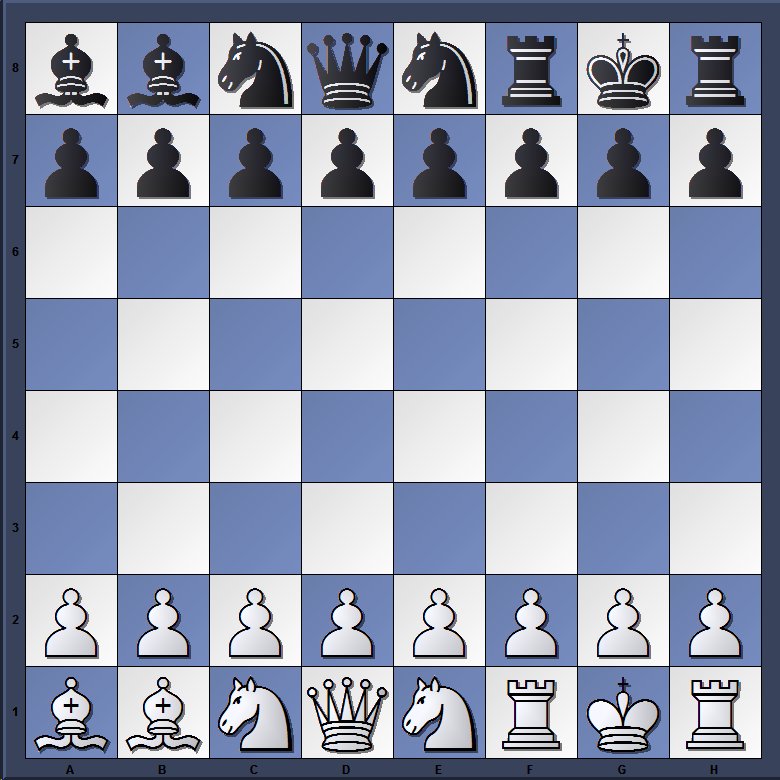
I was discussing Chess960 – Fischer Random yesterday. Today, Ken Tait sent me a passage from Edward Lasker in the book Chess Secrets:
Edward Laskers comments on Capablanca’s Chess Reform idea.
After fifty years of tournament experience, I can not help looking at these recurrent contests with a certain detachment. A game won or lost somehow no longer appears to be of such vital importance, and I don’t think as harshly as I used to of an opponent after losing a game to him which-if there were any justice up above– I should have won.
Today, winning a tournament game against a master active in serious chess, or even against any one of the numerous aspirants to mastership, is infinitely more difficult than it was a generation ago. Almost every young tournament player is equipped with a thorough knowledge of analyzed openings. Against an adversary less familiar with current analyses, this is frequently sufficient to secure a positional advantage which highly developed modern technique can turn into victory no matter how well the adversary defends himself.
Rebelling against this trend toward mechanization, Capablanca suggested as long ago as twenty years ago rendering all present-day opening knowledge obsolete by reforming chess once more, thus throwing each player on his own resources and giving the game another 500 years of vitality, just as the first reform had done which was initiated in the 15th century.
The change proposed by Capablanca was not an entirely arbitrary one. He argued–rather forcefully, it seemed to me–that in addition to the Queen, which combines the move of Rook and Bishop, it would be logical to place a piece on the board which combined the moves of Rook and Knight, and another which combined the moves of Bishop and Knight.
We Played quite a number of games with such pieces added. The Rook-Knight, which we called the Chancellor, we placed between the Bishop and Knight on the Kings wing, and the Bishop-Knight or Archbishop on the corresponding square on the Queen’s wing. In front of each we added a Pawn, of course. After experimenting with a 10 x 10 and a 10 x 8 board, we decided in favour of the latter, because it speeded up the game considerably, just as the original chess has been speeded up by the change of Queen and Bishop moves in the Middle Ages. The new pieces proved so powerful that violent attacks always occurred at an early stage. Usually it took no more than twenty of thirty moves to finish a game.
As was to be expected, the average player did not take kindly to the proposed change. Chess seemed complex enough to him as it was, and it was not his concern whether a few chess masters began to be bored by it.
Thus a fine idea was buried which, in slightly different form, had already been voiced by the English master H.E. Bird fifty years earlier. Now that Capablanca is gone, I should like to see his proposal resurrected in his honor–if only by occasional try on the part of those who happen to see these lines and who are open-minded enough to concede that when a World Champion suggests a change, it probably has its merits.
Edward Lasker. Chess Secrets, 1952
Thanks Ken for sharing it with us.

This excerpt shows that clever observations hold true over time. Even in that era (long before computers, Informants, databases, Internet) there was a feeling that too much was now rote-memory and home analysis and too little was actual over the board play.
I think the following statement is as relevant now as it was when Edward Lasker said it:
“As was to be expected, the average player did not take kindly to the proposed change. Chess seemed complex enough to him as it was, and it was not his concern whether a few chess masters began to be bored by it.”
Don’t get me wrong, these chess variants (Chess960 and Gothic Chess) are great but I don’t see them ever replacing Classic Chess. No matter how advanced in opening theory we become it won’t matter much to the general chess playing population.
Personally, I do like the new tournament rules that inhibit and even prohibit short non-fighting draws.
Disconnect.
Edward Lasker cited memorized OPENING THEORY as Capablanca’s motivation for adding the chancellor and archbiship (similar to Gothic Chess).
But Capa’s reason was to make chess sufficiently complex that the DRAW RATE would be reduced.
The effects of adding new powerful pieces, and extra squares, are huge. Regular knights become marginalized. Skills at cramping the opponent become almost irrelevant on such a big board.
These effects detract from the magic of chess. This Capa or Gothic Chess crosses the line into not being chess anymore.
Chess960 (FRC) does not need the extra pieces (nor the expanded 10×8 board) to eliminate today’s form of memorized opening variations.
When players cannot rely on home memorized opening variations, the draw rate in chess960 might be lower than in traditional chess1.
By slightly re-engineering the castling rule to motivate more OPPOSITE WING CASTLING, the draw rate could be further reduced in chess960 (and presumably in chess1 too, where same wing castling dominates to an oppressive suffocating 84% of games where both players castle).
Chess960 is just chess.
Chess960 Yesterday
GeneM
I agree with Capablanca’s critics. The proposal to add new pieces will complicate the game abit too much. I prefer Chess960 as the method to free chess from the drudgery of rote.
i think that these new pieces seem like weapons of mass destruction – they should never be aloud on the board unless they have a stripe and stars flag on them.
Rastamann.
I guess I can’t see any reason why “classical” chess cannot co-exist peacefully with variants of the game. Those who want to stick with it can do so, and those who wish to explore other forms can indulge themselves as well. Personally, I cannot foresee myself ever reaching the point where memory and home analysis renders chess boring or frustrating – one of the benefits of being a club player…
The popularity of a sport perishes when only one Country dominates, which has been the case with chess. Russians over history as far as I am concerned have been theoreticians.
Ever since Botvinnik, Openings and schemes of play have been analyzed to death; The rest of THE WORLD SADLY HAD TO COPY TO STRUGGLE TO KEEP UP; Computers helped narrow the gap but only killed the game further.
I’ll give it to the Russians they are profound opening experts; perhaps it’s something that comes from their culture (Being thorough in anything they do… I don’t Know), nevertheless something to be envied; but sadly the game is suffering because of it.
FRC 960 gives the chance for the CREATIVE process to begin at move 1. And thoroughly resurrects the true meaning of the word CREATIVE.
I TOTALLY believe CREATIVE players will rise from different parts of the GLOBE, something chess desperately needs so every nation can have a role model to look forward to.
To this end FIDE will no longer be a MONOPOLY.
Chess will be very rich for it.
King.
chess960 will never make it. people are unwilling to throw out all their opening studies.
too many people make too much money on openings to go with chess960.
try to get a fischer random game on icc and see how long you sit and wait for a match.
i hope i’m wrong.
Fischer-Random Chess is the only hope we have of popularizing the game of chess amongst the mass population. I would like to compare this with the resurgent popularity of SuDoKu. Why has SuDoKu become popular?: because almost everybody can play it, it is easier to understand.
The chess960 version of chess is “less intellectual”, in the sense, beginner level players do not have to sit and wade through thousands of opening before having any chance of beating an expert level player. Here, they are at an intellectual “equal” from the very starting… something I think might attract the general populace to take up chess. For the expert level player: it is a chance and challenges to be creative from move 1 onwards. Just my two cents worth.
“beginner level players do not have to sit and wade through thousands of opening before having any chance of beating an expert level player”
this is simply no argument. why would a beginner even expect to beat an expert? thats why he IS a beginner and that one IS an expert. you can sit at a board beginner vs beginner and have a close and tough match without even knowing there exists such a thing as “opening theory”.
and for the record, a beginner will stand no chance to beat an expert if they first sit down to a game of chess960.
The new pieces sound ugly. I think there is a danger of unbalancing the game, with some pieces becoming too dominant and others largely redundant, a sort of inflation which looks good at first sight but doesn’t address the issue. Even experts have daft ideas – it’s all the more dangerous when they do, as they are the ones who get quoted as gospel.
FRC is close enough to classic chess to be interesting to most chess players. Ones acquired skills, at whatever level, are still relevant. If you stray from that too far, you enter the endless world of chess variants.
Check out this site for details:
chessvariants.org/index/mainquery.php?type=Any&orderby=LinkText&displayauthor=1&displayinventor=1&showimages=1&showtextnotes=1&listrecognizedonly=1&primarylinksonly=1&usethisheading=Recognized+Chess+Variants
Here’s an idea I had for a more random Fischer random: the 2 sides can each have any combination of pieces for which the conventional point count total is the same.
I think it would be a good thing for Chess as it is to be accompanied by a new form of the game, but for it to ever happen, there would have to be a gradual build-up of the number of people who play that new form.
The depth of opening theory has been present for a long time, but it has not caused the world’s Grandmasters to decide that Chess needs to switch to, for example, Chess960, as urgently as Checkers needed to adopt the two-move restriction. What would cause that to change?