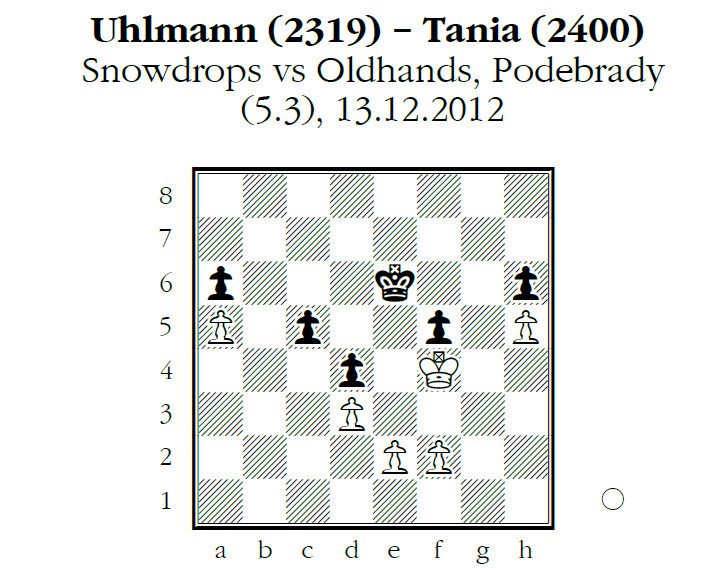
White to move. Is it a win, draw, or loss for white? How should white proceed?
Source: ChessToday.net
Chess Daily News from Susan Polgar


White to move. Is it a win, draw, or loss for white? How should white proceed?
Source: ChessToday.net
Just a cursory glance suggests to me the first move has to be e3 or e4. Just on first principles, I would not want to play Kg3 or Kf3 which seems to concede ground to the black king. The other pawn move, f3, is trickier, but I still think white can draw in that line, though I am really unsure of this:
1. f3?! Kf6
2. Kg3
Or [2.e3 c4! 3.dc4 d3-+]; or [2.e4 de3 3.Ke3 Ke5 4.f4 Kd5 5.Ke2 Kd4 6.Kd2 c4 7.dc4 Kc4 8.Ke3 Kc3-+]. Continuing:
2. …..Kg5
3. Kf2 Kh5
4. Kg3 Kg6
The major fork in the road in this line. I think with Kg5, white just plays f4 with a pretty standard draw, but black might try f4 himself here giving white the passing f-pawn, but by my count, white puts his king on e5 and queens the half move ahead of black since he will pick up one tempo at least in the f-pawn’s advance as it checks the black king on the g-file. Both players get a queen, but white gets the initiative and captures at c5 before black can mobilize his. Continuing:
5. f4! h5
6. Kh4 Kh6 (or lose)
7. Kg3 and neither player can make progress from here.
Since I need some time to puzzle over the other pawn moves, I will stop here for the moment.
Alright, I didn’t need to puzzle over one of two pawn pushes too long. Let’s look at e3 first since it is clearly the wrong one, too, since I had already covered variations of this in my last comment:
1. e3 c4!
2. ed4
If 2.dc4, black pushes d3, and if 2.e4, black pushes c3 to win. Continuing:
2. …..c3
3. Ke3 f4!
4. Ke2 Kd5-+
So, to win, e4 it must be, and while complicated, is fairly easy to understand. The rook pawns on the wings play a big role, and the fact that white’s are two further squares advanced is a big key to position, as we will see several times:
1. e4 de3 (alternatives below)
2. fe3! Kf6
3. e4! fe4
4. de4!
The 4.Ke4 line: [4.Ke4 Ke6 5.d4 cd4 6.Kd4 Kd6=] is a dead draw as black can always keep the opposition, but keep this position in mind since we will see variations on it later where white has both diagonal and direct opposition. Continuing:
4. …..Ke6
The alternatives also look losing to me: [4. …c4 5.e5! Ke6 6.Ke4 c3 (or 6. …Ke7 7.Kd4 Ke6 8.Kc4 Ke5 9.Kc5 Ke6 10.Kb6 Kd6 11.Ka6 Kc6 (Kc7 12.Kb5+-) 12.Ka7 Kc7 13.a6 Kc8 14.Kb6 Kb8 15.Kc5 Ka7 16.Kd5 Ka6 17.Ke6 Kb6 18.Kf6 Kc6 19.Kg6 Kd6 20.Kh6 Ke6 21.Kg7+-) 7.Kd3 Ke5 (or 7. …c2 8.Kc2 Ke5 9.Kc3 Kf5 10.Kc4 Kg5 11.Kc5 Kh5 12.Kb6 Kg5 13.Ka6 h5 14.Kb6 h4 15.a6 h3 16.a7 h2 17.a8Q h1Q 18.Qh1+-) 8.Kc3 Ke6 (or 8. …Kd6 9.Kd4 Kc6 10.Ke5+- and white queens his h-pawn in 7 moves while it takes black 8 moves) 9.Kc4 Kd6 10.Kd4! Kc6 11.Ke5 and again, white queens first and covers black’s queen square]; or [4. …Ke7 5.Ke5 c4 6.Kd4+-]. Continuing from 4. …Ke6 above:
5. e5! Kd5
The notes above cover all the alternatives to Kd5. Continuing:
6. Kf5! c4
7. e6 c3 (Kd6 8.Kf6 c3 9.e7+-)
8. e7 c2
9. e8(Q)c1(Q)
10.Qd8 and black loses his queen on the next move.
So, lets go back to move 1 for black’s alternatives:
1. e4 fe4
2. Ke4 Kd6
Or, [2. …Kf6 3.Kd5 Kg5 4.Kc5! Kh5 5.Kb6 Kg4 6.Ka6 h5 7.Kb6 and black’s pawn queens after white’s and is captured at h1]. Continuing:
3. f4 Ke6
4. f5 Kf6 (what else better?)
5. Kd5 c4 (alternatives above)
6. Kc4 Kf5
7. Kd4 Kg5
8. Kc5 Kh5
9. d4 Kg4
10.d5 h5
11.d6 h4
12.d7 h3
13.d8Q h2
14.Qd1 wins.
Finally:
1. e4 c4
2. dc4 fe4
3. Ke4 wins with ease.
Black wins.
e4
Very tough.
I got as far as 1 e3 c4 and Black wins
I think white’s fighting for a draw here and I don’t think he’s going to make it, because black has wonderful penetration squares on g5 and b5.
Further, if white covers the g5 square by playing f4 at some point, then he has no kingside penetration possibilities either and black can walk over to b5 for the win.
So white has to maintain threats against the black f-pawn in order to tie down the black king.
So I suggest 1 Kf3.
If 1 … Ke5; 2 Kg3 Kf6; 3 Kg4 … or if 1 … Kf6; 2 Kf4.
Until a pawn moves, white must answer … Kf6 with Kf4 and triangulate accordingly.
Something white certainly should avoid is e3? c4! dxc4 d3 Kf3 etc.
Better is:
1. e4! c4
2. dxc4 d3
3. exf5+ Kf6
4. Ke3 Kxf5
5. Kxd3
is up with 2 pawns and wins.
1. … fxe4
2. Kxe4 Kd6 (otherwise Kd5 wins)
3. f4
will be up with one pawn and win, I think.
My bad – I missed 1 e4.
In Yancey Ward’s line, after
1 e4 fe
2 Ke4 Kd6
3 f4 Ke6
4 f5 Kf6
5 Kd5
I like:
5 … K:f5
6 K:c5 Kg5
7 K:d4 K:h4
8 Ke5 Kg4
9 d4 h5
10 d5 h4
11 d6 h3
12 d7 h2
13 d8(Q) h1(Q)
While White can win the pawn at a6, I think the Q ending is drawn
Or:
1 e4 fe
2 Ke4 Kd6
3 f4 Ke6
4 f5 Kf6
If:
5 Kf4 c4
6 dc d3
7 Ke3 K:f5
8 c5 Ke5
9 K:d3 Kd5
10 c6 K:c6
11 Kc4 Kd6
12 Kd4 Kc6
and draws
James,
At move 7 in your first line in the last comment, white goes for the a-pawn rather than the d-pawn and queens ahead of black.
At move 7 in your first line in the last comment, white goes for the a-pawn rather than the d-pawn and queens ahead of black.
Whoopsy! Thank you.