White needs to make black decide between the options of protecting the c-pawn and stopping the e-pawn.
Now, how should white do this? To me, the answer is pretty obvious- white wants to keep black from blockading the e-pawn by putting the bishop on e7, thereby also allowing black to protect the c-pawn by pushing it to c5. So, white must play Ke6 here threatening Kd6 winning the c-pawn for a draw. However, to study this thoroughly, let’s see why white loses with any other first move so that we understand the problem better:
1. e6?? Be7
I don’t really know the shortest win here, but this is obvious move to me. Black should also win with just about any move that doesn’t immediately lose the bishop or takes the bishop off of the h4/d8 diagonal. If there is a shorter route, it is probably the king moves up the board- especially Kd2/c2 since they have to be played in this line as well, but it isn’t critical that black blockade the pawn on move 1. Continuing from 1. …Be7 above:
2. Ke5
White can, of course, go around through g6 to attack the bishop from f7, but black just pushes the c-pawn and then can retreat the bishop to g5/h4 since the c-pawn will now be safe from the king. 2.Ke5 is the only plausible attempt now. Continuing:
2. …..c5
Again, there are plethora of winning moves, but this move and Kc2/d2/b2 are the obvious ones to shorten the game. Continuing:
3. Kd5 Kc2 4. Kc4 Bf8 (zugzwang) 5. Kd5 Kd3
And now c4 can’t be prevented winning the game for black. So, let’s look briefly at the other obvious, but losing move for white at move 1:
1. Ke4?? Be7 (shortest? or not?) 2. Kd4 Kc2
And it should be obvious that black wins this. Even if white takes the opposition with 3.Kc4, black just plays waiting moves until the white king is forced to move out of the way. In my next comment, I will discuss the correct drawing move of 1.Ke6.
White just holds Ke6 attacking blacks pawn, and the bishop is chased off from critical squares. If bishop takes pawn, white will remove the remaining pawn. Alternatively, both pawns run and queen simultaneously resulting in queens and kings draw.
In my previous comment, I discussed how white loses if he allows black to play Be7 safely. Let’s now discuss 1.Ke6 that draws by taking away the critical e7 square:
1. Ke6! Bf2
Preparing to push c5 when white attacks with 2.Kd6. I will cover the alternative moves later. Continuing:
2. Kd6! c5 3. e6
Here, 3.Kd5 should also draw, but e6 must be played in that line, too. Now black can either guard the e7 square, or he can protect the pawn- he can’t do both. If he doesn’t guard e7, white will get a queen. The safest line for black is to play Bh4 on move 3 after which white just captures at c5 to draw. Counting moves, I can see that black can probably push c4 on the third move and still draw this since the queening square is a dark one protected by the bishop, plus it is c-pawn that also gives possible stalemate themes (with the king on a1 when white captures the pawn at c2) even if black loses the bishop at some point.
Now, at move 1, black could push the c-pawn immediately:
1. Ke6 c5 2. Kd5! Be7 (Bf2 3.e6=) 3. Ke6! Bf8
Of course, if black plays Bd8, Bg5/h4, white returns the king to d5. Black can queen his c-pawn in 5 more moves by pushing c4 here (4 pawn moves and 1 king move), but white will queen his in 5 moves too (3 pawn moves and 2 king moves) to obtain the draw still. Also, the possible king moves for black don’t really change things other than who queens just before the other player (for example, 3. …Kc2 allows white to queen the half move ahead, but still drawn). Continuing from 3. …Bf8 above:
4. Kf7!
Threatening the capture at f8 followed by advance of the e-pawn to draw. Black has only one plausible retreat:
4. …..Bh6 (Bd6 draws too!!) 5. Kg6! Bf4
Here, if black plays Bf8, white returns the king f7, and if black plays Be3, white pushes the e-pawn since black’s bishop can’t guard e7 from either g5 or c5 (black’s pawn is in the way. Continuing:
6. Kf5!
The only draw once again is to attack the bishop. If white pushes e6 now, the black bishop gets to d6 to stop the e-pawn, and black’s c-pawn is decisive. If white plays Kf6 here, black will push c4 followed by Bd6 to win. Continuing:
6. …..Bg3 (planning to play Bh4) 7. Ke4!
Now that white is out of attacks on the bishop, he returns to threaten the c-pawn again. 7.Ke4 is the only drawing move:
7. …..Bh4
Black cannot capture at e5 and save the c-pawn at the same time, nor can he advance the king fast enough to protect once it reaches c4, and he can’t play c4 now without losing the pawn to 8.Kd4. The only plausible attempt is Bh4:
8. Kd5! Be7 9. Ke6 and we have again reached the position that arose at move 3 above. This is clearly a drawn ending, and a very pretty problem overall. Much more complicated than I had thought at the beginning.
Ke6 might save the game intending to chase black’ s pawn. If black defends with c5 and Bf2 white will queen. If Be7 then white just takes and will queen.. Unless there is anything better this looks drawn
A) 1.Ke4 Kc2 2.Kd4 Be7 3.Kc4 (3.e6 Kb3 black promotes his pawn) … Kd2 putting white in a zugzuang. 4.e6 Kc2 5.Kd4 Kb3 and black promotes his pawn. White cannot promote his pawn ’cause when reach d7-square, black just move his bishop to h4-square avoiding the promotion e-pawn. Seems that white is not able to make opposition against black king and the bishop contributes for that. Thereby white need use his e-pawn, but bishop keep e7 square. The diagonal d8-h4 has 5 squares and is impossible treats the bishop making one square per move. Try opposition against black king fails. Let’s try get the c-pawn
B) 1.Ke6 c5 (the unique good move which keep the pawn on the board!) 2.Kd5 Be7 3.Ke6
B.1) 3. …Bf8 4.Kf7 Be6 5.Kg6 Bf4 6.Kf5!! (if bishop takes the pawn then white can reach and get the black pawn) …. Bg3 7.Ke4 Bh4 8.Kd5 back to same position!
B.2) 3. …Bd8 4.Kd5 Bb6 5.Kc6 Bd8 (…Ba7 6.Kb7 win the bishop) 6.Kd5 back to same position!
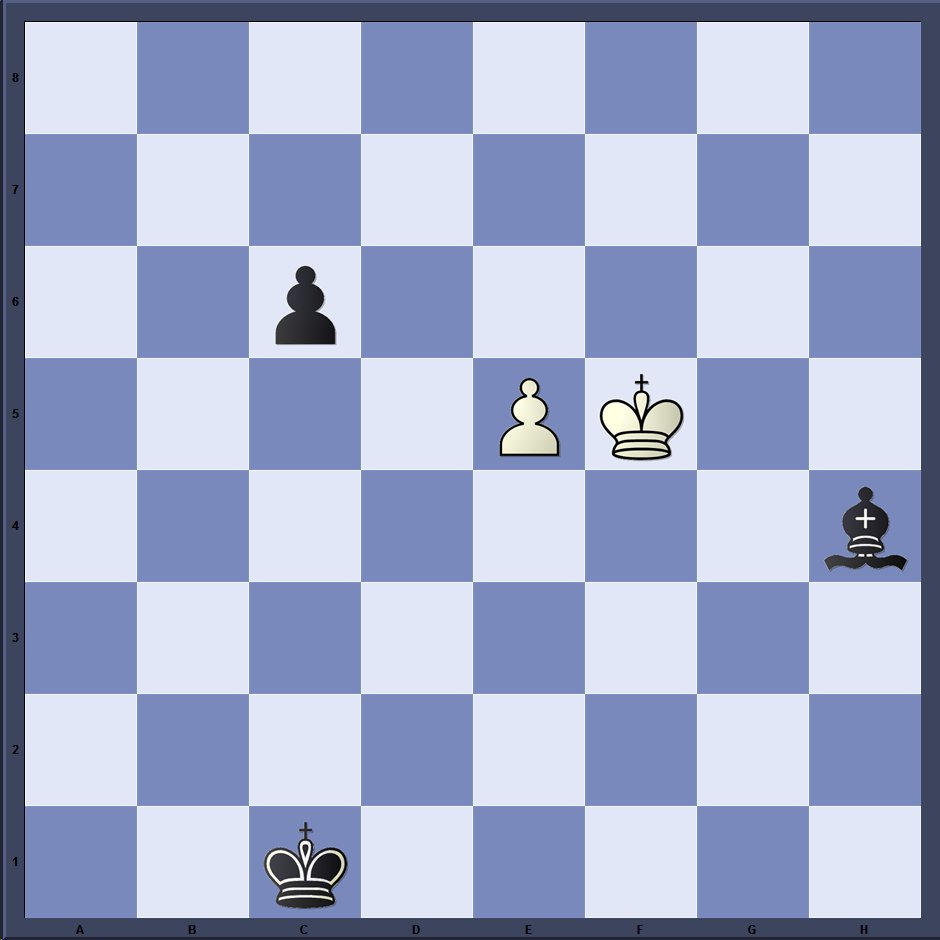


Yes he can: Ke6
which direction is the board going? some labeling would help
Pls post the answer. I see a loss for white
White needs to make black decide between the options of protecting the c-pawn and stopping the e-pawn.
Now, how should white do this? To me, the answer is pretty obvious- white wants to keep black from blockading the e-pawn by putting the bishop on e7, thereby also allowing black to protect the c-pawn by pushing it to c5. So, white must play Ke6 here threatening Kd6 winning the c-pawn for a draw. However, to study this thoroughly, let’s see why white loses with any other first move so that we understand the problem better:
1. e6?? Be7
I don’t really know the shortest win here, but this is obvious move to me. Black should also win with just about any move that doesn’t immediately lose the bishop or takes the bishop off of the h4/d8 diagonal. If there is a shorter route, it is probably the king moves up the board- especially Kd2/c2 since they have to be played in this line as well, but it isn’t critical that black blockade the pawn on move 1. Continuing from 1. …Be7 above:
2. Ke5
White can, of course, go around through g6 to attack the bishop from f7, but black just pushes the c-pawn and then can retreat the bishop to g5/h4 since the c-pawn will now be safe from the king. 2.Ke5 is the only plausible attempt now. Continuing:
2. …..c5
Again, there are plethora of winning moves, but this move and Kc2/d2/b2 are the obvious ones to shorten the game. Continuing:
3. Kd5 Kc2
4. Kc4 Bf8 (zugzwang)
5. Kd5 Kd3
And now c4 can’t be prevented winning the game for black. So, let’s look briefly at the other obvious, but losing move for white at move 1:
1. Ke4?? Be7 (shortest? or not?)
2. Kd4 Kc2
And it should be obvious that black wins this. Even if white takes the opposition with 3.Kc4, black just plays waiting moves until the white king is forced to move out of the way. In my next comment, I will discuss the correct drawing move of 1.Ke6.
White just holds Ke6 attacking blacks pawn, and the bishop is chased off from critical squares. If bishop takes pawn, white will remove the remaining pawn. Alternatively, both pawns run and queen simultaneously resulting in queens and kings draw.
Very cool illustration of Domination theme in mainline:
1. Ke6 c5 2. Kd5 Be7 3. Ke6 Bf8 4. Kf7 Bh6 5. Kg6 Bf4 6. Kf5 Bg3 7. Ke4 Bh4 8. Kd5 Bf2 9. e6
In my previous comment, I discussed how white loses if he allows black to play Be7 safely. Let’s now discuss 1.Ke6 that draws by taking away the critical e7 square:
1. Ke6! Bf2
Preparing to push c5 when white attacks with 2.Kd6. I will cover the alternative moves later. Continuing:
2. Kd6! c5
3. e6
Here, 3.Kd5 should also draw, but e6 must be played in that line, too. Now black can either guard the e7 square, or he can protect the pawn- he can’t do both. If he doesn’t guard e7, white will get a queen. The safest line for black is to play Bh4 on move 3 after which white just captures at c5 to draw. Counting moves, I can see that black can probably push c4 on the third move and still draw this since the queening square is a dark one protected by the bishop, plus it is c-pawn that also gives possible stalemate themes (with the king on a1 when white captures the pawn at c2) even if black loses the bishop at some point.
Now, at move 1, black could push the c-pawn immediately:
1. Ke6 c5
2. Kd5! Be7 (Bf2 3.e6=)
3. Ke6! Bf8
Of course, if black plays Bd8, Bg5/h4, white returns the king to d5. Black can queen his c-pawn in 5 more moves by pushing c4 here (4 pawn moves and 1 king move), but white will queen his in 5 moves too (3 pawn moves and 2 king moves) to obtain the draw still. Also, the possible king moves for black don’t really change things other than who queens just before the other player (for example, 3. …Kc2 allows white to queen the half move ahead, but still drawn). Continuing from 3. …Bf8 above:
4. Kf7!
Threatening the capture at f8 followed by advance of the e-pawn to draw. Black has only one plausible retreat:
4. …..Bh6 (Bd6 draws too!!)
5. Kg6! Bf4
Here, if black plays Bf8, white returns the king f7, and if black plays Be3, white pushes the e-pawn since black’s bishop can’t guard e7 from either g5 or c5 (black’s pawn is in the way. Continuing:
6. Kf5!
The only draw once again is to attack the bishop. If white pushes e6 now, the black bishop gets to d6 to stop the e-pawn, and black’s c-pawn is decisive. If white plays Kf6 here, black will push c4 followed by Bd6 to win. Continuing:
6. …..Bg3 (planning to play Bh4)
7. Ke4!
Now that white is out of attacks on the bishop, he returns to threaten the c-pawn again. 7.Ke4 is the only drawing move:
7. …..Bh4
Black cannot capture at e5 and save the c-pawn at the same time, nor can he advance the king fast enough to protect once it reaches c4, and he can’t play c4 now without losing the pawn to 8.Kd4. The only plausible attempt is Bh4:
8. Kd5! Be7
9. Ke6 and we have again reached the position that arose at move 3 above. This is clearly a drawn ending, and a very pretty problem overall. Much more complicated than I had thought at the beginning.
“Ke6” is the only move which can lead White to a draw.
Ke6 might save the game intending to chase black’ s pawn. If black defends with c5 and Bf2 white will queen. If Be7 then white just takes and will queen.. Unless there is anything better this looks drawn
según el FEN la posición es blancas abajo.. coronan arriba..
//ratz
I think White can save it. 1.Ke6 c5 2. Kd5 Bf2 then after 3.e6 Black has to stop the pawn with his bishop.
A)
1.Ke4 Kc2
2.Kd4 Be7
3.Kc4 (3.e6 Kb3 black promotes his pawn)
… Kd2 putting white in a zugzuang.
4.e6 Kc2
5.Kd4 Kb3 and black promotes his pawn. White cannot promote his pawn ’cause when reach d7-square, black just move his bishop to h4-square avoiding the promotion e-pawn.
Seems that white is not able to make opposition against black king and the bishop contributes for that. Thereby white need use his e-pawn, but bishop keep e7 square. The diagonal d8-h4 has 5 squares and is impossible treats the bishop making one square per move. Try opposition against black king fails. Let’s try get the c-pawn
B)
1.Ke6 c5 (the unique good move which keep the pawn on the board!)
2.Kd5 Be7
3.Ke6
B.1)
3. …Bf8
4.Kf7 Be6
5.Kg6 Bf4
6.Kf5!! (if bishop takes the pawn then white can reach and get the black pawn)
…. Bg3
7.Ke4 Bh4
8.Kd5 back to same position!
B.2)
3. …Bd8
4.Kd5 Bb6
5.Kc6 Bd8 (…Ba7 6.Kb7 win the bishop)
6.Kd5 back to same position!
White can save this position!
Thank you
Based on an idea first exposed by Selesniev
Selesniev, Tidskrift för Schack, 1920
4B3/5K2/5P1b/2p5/2p5/1k6/8/8 w – – 0 1
Draw