Observations: This looks very drawish at first sight, since with the bishops of opposite colors, it looks like there is no way for Black to do anything with the passed a-pawn. BUT….. Black can get rid of the White bishop by sacrificing the exchange, and can trap the White rook:
1…. Rxa2 2. Rxa2 Bb2 and Black is winning, I think.
Now White doesn’t have time to bring his King over to the queenside, to trade the Black bishop and a-pawn for the White rook, because the Black f-pawn is always a threat.
The White king won’t be able to occupy e4, because the Black f-pawn can go to f5, and the White king can’t go to e4 because of the Black bishop. The Black king will be able to waltz up to d6, and then capture the White d-pawn.
How about the old rook trap maneuver? I have played this sort of maneuver many times over the years online- usually with the pawn on the seventh rank. One reason I would look at this first is that these types of endings with bishops of opposite colors are tough, even with the rooks on the board, and the other reason I would do it is that, with the kingside majority, black can create a passed pawn when needed, and white’s passed d-pawn isn’t going to get past the black king- white’s will be tied to it’s defense. Let’s see if it works:
1. …..Ra2 2. Ra2 Bb2
And, now, the rook is immobilized. White has king moves and pawn moves- of course, d6 is going to lose the d-pawn immediately, so I can’t imagine much better for white here than Ke3 or Kf3 to bring the king forward:
3. Ke3 Kf7 4. Ke4
I am, for now, going to ignore moving the kingside pawns. First, the potential numbers of variations are tedious, and I don’t think they really matter that much anyway. I would choose Ke4 instead of a move like Kd3 for the simple reason that I would want to keep the king near the king side in order to, maybe, sacrifice the d-pawn at some point for the ability to liquidate the king side pawns altogether- at that point, white could sacrifice the rook for the a-pawn and obtain a draw of insufficient material.
4. …..f5
I am not sure what is best for black here. As black, I want to prevent g4, I think, and drive the white king back, so f5 looks good enough for now. Continuing:
5. Kf4
I think this might be the only plausibly holding move now. On playing the king to e3 or f3, black can play Kf6, and I don’t see how white can hold since the black king will penetrate through e5. On Kd3 (to reach c4 to protect d5), black has to be careful to not let the white king support the advance of the d-pawn by reaching c6- white will then either queen first or force black to bring the bishop back to stop the d-pawn; so, after 5.Kd3, black must make the approach to d6 from e7: [5.Kd3 Ke7! 6.g4 (6.Kc4 Kd6 7.g4 f4 8.g5 Ke5 9.d6 Kd6 10.Kd3 Ke5 wins easily) Kd6 7.gf5 gf5 8.Ke3 Kd5 and black wins with the passed f-pawn]. Continuing:
5. …..Kf6 6. g4
I really can’t make anything work for white now. On d6, black first drives the white king back with g5+, and the wall consisting of the bishop cover of e5 along with the g and f pawns coverage of the squares e4-h4 keep the white king out while the black king rounds up the d-pawn and then comes back to create a passed pawn on the king side to win the game. On h4, black simply plays h6 to again threaten g5+. Continuing:
6. …..g5+ 7. Ke3 f4 8. Ke4
Here, h4 is met by h6. Cont.:
8. …..Ke7 9. Kd3
On Kf3, Kd6 obviously wins. Cont.:
9. …..Kd6 10.Ke4 Kc5 11.Kf5 f3 12.Kg5
There is no future, either, in Ke6 as the f-pawn queen 2 moves before white’s d-pawn in the race. Cont.:
12. …..f2 13. Kh6 f1(Q) and black will also have his bishop in addition to his queen.
So, on a first analysis, I think black wins quite directly by sacrificing the exchange at move 1.
If I am up to it, I will post other possible white defenses later, but I don’t really think there is anything white can actually do to overcome black’s advantage once the rook is locked up.
In my previous comment, I showed the line that starts:
1. …..Ra2 2. Ra2 Bb2
Imprisoning the rook and reducing the game to a kings + pawns endgame in which black has the kingside majority and a bishop controlling key squares at d4 and e5. I had also shown, I think, that white will lose quite quickly when he advances the king to attempt to hold the d-pawn- black always creates zugzwang to win the d-pawn, and then uses the majority to create a winning passed pawn. One last thing I want to look at tonight is to see if white can advance the kingside pawns in such a way as to create holes and/or chances to liquidate four of the pawns and then use the d-pawn advance to win the last black pawn on the kingside. I don’t think this can possibly work, but I want to be thorough. Continuing from the line above starting with move 3:
3. g4
To try to prevent f5 and the wall that black created on d4 and e4 that greatly inhibited white’s king in my last comment. Continuing:
3. …..Kf7 (going for the d-pawn) 4. h4
On Ke3: [4.Ke3 Ke7 5.Ke4 (5.h4 Kd6 6.Ke4 Kc5 7.h5 {7.g5 f5 wins}Kd6! 8.hg6 hg6 9.g5 f5 wins) Kd6 will win, too, the same way]. Continuing:
4. …..Ke7 5. Ke3
What else here is different than what we have seen before? Continuing:
5. …..Kd6 6. Ke4 Kc5 7. h5
I know, we saw this in the variations I outlined after white’s fourth move- they are all lost for white.
I don’t see any defense for white whatsoever after black plays 1. ….Ra2. Looks like a clean winning move to me.
I began by looking at all possible checks and captures, per Fred Horowitz.
The first move I considered, …Rxa2, happened to yield an idea (sacrificing the exchange in order to permanently trap white’s rook):
…Rxa2 Rxa2 Bb2!
From here, I considered two plans for white. The first plan was to get the white king to c2 so that white may play
Rxb2 axb2 Kxb2
but this fails to black’s …Kg8-f7-e7-d6-xd5, and then using his kingside pawn majority to queen and win.
The second plan I considered was to ignore the trapped rook, and to simply use the white king to support the passed d-pawn into queenhood. But this also fails, as in the following sample line:
…Rxa2 Rxa2 Bb2! Ke3 Kf7 Kd3 Ke7 Kc4 Kd6, and white is in zugzwang, and must lose the d-pawn.
1.Rxa2 Rxa2 2.Bb2 and the white king will have to march all the way to the Q side, allowing the black king to collect the d pawn and help his pawns on the K side If white will try to hold on to the d pawn, a K side pawn mass advance is in place to force the black king to the K side allowing the black king to collect the D pawn, and take the trapped rook
The exchange sacrifice Rxa2 should be enough to win the game. After Rxa2 white’s rook is out of play for the game after Bb2 Black’s king near enough to stop whites isolated d- pawn and white’ s king cannot get an active position as the d4 square maintaines guarded by the black bishop. after the fall of the d pawn (any protecting Ke4 can be answered by f5) white’S practically lost. If black does not manage to win the 3vs 2 ending there is also our little rook on the a2 square which can be target for blacks king, which will result in a fast queen
The favorable pawn ending with the possibility of the capture of the rook if all the pawns are exchanged since the white King will be too far to avoid it, makes it a win for black.
i see nothing special black can do here except trap the white rook: 1. … Rxa2 2. Rxa2 Bb2 and unfortunately i’m not very good at endgames. i would try to exploit the fact, that the bishop is covering some central squares and the king can’t effectively protect the passed pawn. so maybe we can win the d-pawn with the king. i’m just not really sure, who’s going to be in zugzwang first, but i think, it might work out. ok, it’s always more convincing to give an example: 3. Kf3 Kf7 4. g4 Ke7 5. Ke4 Kd6 6. h4 h6 7. g5 hxg5 8. hxg5 f5+ 9. Kf4 Kxd5 greets, jan
This time i started with a fantacy about playing bishop to d2, killing Ba2. But all my attemts to get bishop to d2 failed to black’s Kf2-e3-d3 or Kf2-e1-d1.
So I had to instead find this (rather obvious) solution:
1. Rxa2 Rxa2 2. Bb2! and black’s rook is out of play!
White king goes for d5.
Black king can go for protecting d5, or for c2 ending up on b1 after exchanging, or stay on kingside to take a pawn battle.
Neither helps, white’s kingside pawn majority should win the endgame in some way.
1. Rxa2 Rxa2 2. Bb2 The black rook won’t move any more. 2. … Kf8 wants to go to d6 3. Ke3 Ke7 4. Ke4 Kd6 White will sooner or later run into zugzwang and lose pawn d5. After that, the black King will go after the rook, and, if white tries to defend it, push his pawns on the King’s side. One possible sequence: 5. g3 f5 6. h4 h6 7. Ke3 Kxd5 8. Kd3 Kc5 9. Kc2 Kd4 10. Rxb2 axb2 11. Kxb2 Ke3 and wins easily
1…. R:a2 2. R:a2 Bb2 and use the K to get in front of the d-pawn. White can only free his R by running his K over to recapture the pawn. If instead he leaves the B on the board, it restricts him from defending the d-pawn and black will effectively be playing an easily won pawn endgame on the f, g, and h files. The only trap to avoid is getting stuck in an ending with only an h-pawn, since there is the idea of Ra1 at a time when the K is stalemated.
Just one additional note on this type of situation- a couple of commenters wrote that the trapped rook could serve as a target if necessary in this endgame. This is only true if black can be assured of retaining either the f or g pawn. Retaining the h-pawn is no good since the queening square is the opposite color of the bishop. If, in going for the rook, black allows white to liquidate the f and g pawns, then the rook sacrifices itself for the a-pawn instead of the bishop leading to a theoretical drawn position.
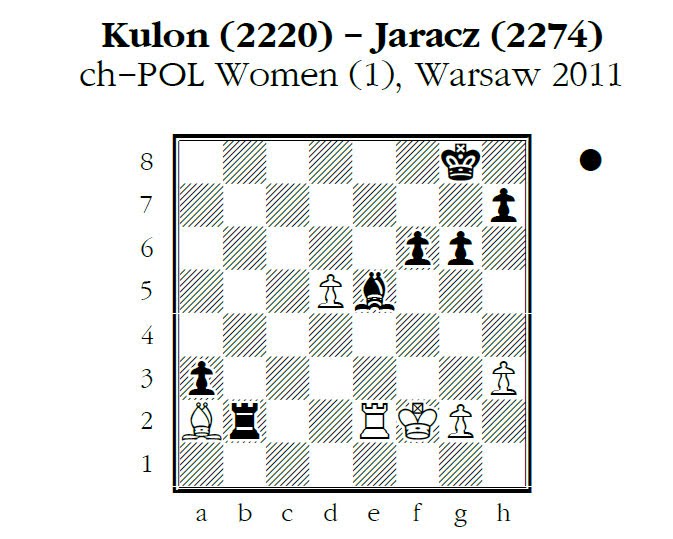


1… RxB 2.RxR Bb2 and the R is trapped.
Observations: This looks very drawish at first sight, since with the bishops of opposite colors, it looks like there is no way for Black to do anything with the passed a-pawn. BUT…..
Black can get rid of the White bishop by sacrificing the exchange, and can trap the White rook:
1…. Rxa2
2. Rxa2 Bb2 and Black is winning, I think.
Now White doesn’t have time to bring his King over to the queenside, to trade the Black bishop and a-pawn for the White rook, because the Black f-pawn is always a threat.
The White king won’t be able to occupy e4, because the Black f-pawn can go to f5, and the White king can’t go to e4 because of the Black bishop. The Black king will be able
to waltz up to d6, and then capture the White d-pawn.
Lucymarie
How about the old rook trap maneuver? I have played this sort of maneuver many times over the years online- usually with the pawn on the seventh rank. One reason I would look at this first is that these types of endings with bishops of opposite colors are tough, even with the rooks on the board, and the other reason I would do it is that, with the kingside majority, black can create a passed pawn when needed, and white’s passed d-pawn isn’t going to get past the black king- white’s will be tied to it’s defense. Let’s see if it works:
1. …..Ra2
2. Ra2 Bb2
And, now, the rook is immobilized. White has king moves and pawn moves- of course, d6 is going to lose the d-pawn immediately, so I can’t imagine much better for white here than Ke3 or Kf3 to bring the king forward:
3. Ke3 Kf7
4. Ke4
I am, for now, going to ignore moving the kingside pawns. First, the potential numbers of variations are tedious, and I don’t think they really matter that much anyway. I would choose Ke4 instead of a move like Kd3 for the simple reason that I would want to keep the king near the king side in order to, maybe, sacrifice the d-pawn at some point for the ability to liquidate the king side pawns altogether- at that point, white could sacrifice the rook for the a-pawn and obtain a draw of insufficient material.
4. …..f5
I am not sure what is best for black here. As black, I want to prevent g4, I think, and drive the white king back, so f5 looks good enough for now. Continuing:
5. Kf4
I think this might be the only plausibly holding move now. On playing the king to e3 or f3, black can play Kf6, and I don’t see how white can hold since the black king will penetrate through e5. On Kd3 (to reach c4 to protect d5), black has to be careful to not let the white king support the advance of the d-pawn by reaching c6- white will then either queen first or force black to bring the bishop back to stop the d-pawn; so, after 5.Kd3, black must make the approach to d6 from e7: [5.Kd3 Ke7! 6.g4 (6.Kc4 Kd6 7.g4 f4 8.g5 Ke5 9.d6 Kd6 10.Kd3 Ke5 wins easily) Kd6 7.gf5 gf5 8.Ke3 Kd5 and black wins with the passed f-pawn]. Continuing:
5. …..Kf6
6. g4
I really can’t make anything work for white now. On d6, black first drives the white king back with g5+, and the wall consisting of the bishop cover of e5 along with the g and f pawns coverage of the squares e4-h4 keep the white king out while the black king rounds up the d-pawn and then comes back to create a passed pawn on the king side to win the game. On h4, black simply plays h6 to again threaten g5+. Continuing:
6. …..g5+
7. Ke3 f4
8. Ke4
Here, h4 is met by h6. Cont.:
8. …..Ke7
9. Kd3
On Kf3, Kd6 obviously wins. Cont.:
9. …..Kd6
10.Ke4 Kc5
11.Kf5 f3
12.Kg5
There is no future, either, in Ke6 as the f-pawn queen 2 moves before white’s d-pawn in the race. Cont.:
12. …..f2
13. Kh6 f1(Q) and black will also have his bishop in addition to his queen.
So, on a first analysis, I think black wins quite directly by sacrificing the exchange at move 1.
If I am up to it, I will post other possible white defenses later, but I don’t really think there is anything white can actually do to overcome black’s advantage once the rook is locked up.
In my previous comment, I showed the line that starts:
1. …..Ra2
2. Ra2 Bb2
Imprisoning the rook and reducing the game to a kings + pawns endgame in which black has the kingside majority and a bishop controlling key squares at d4 and e5. I had also shown, I think, that white will lose quite quickly when he advances the king to attempt to hold the d-pawn- black always creates zugzwang to win the d-pawn, and then uses the majority to create a winning passed pawn. One last thing I want to look at tonight is to see if white can advance the kingside pawns in such a way as to create holes and/or chances to liquidate four of the pawns and then use the d-pawn advance to win the last black pawn on the kingside. I don’t think this can possibly work, but I want to be thorough. Continuing from the line above starting with move 3:
3. g4
To try to prevent f5 and the wall that black created on d4 and e4 that greatly inhibited white’s king in my last comment. Continuing:
3. …..Kf7 (going for the d-pawn)
4. h4
On Ke3: [4.Ke3 Ke7 5.Ke4 (5.h4 Kd6 6.Ke4 Kc5 7.h5 {7.g5 f5 wins}Kd6! 8.hg6 hg6 9.g5 f5 wins) Kd6 will win, too, the same way]. Continuing:
4. …..Ke7
5. Ke3
What else here is different than what we have seen before? Continuing:
5. …..Kd6
6. Ke4 Kc5
7. h5
I know, we saw this in the variations I outlined after white’s fourth move- they are all lost for white.
I don’t see any defense for white whatsoever after black plays 1. ….Ra2. Looks like a clean winning move to me.
I began by looking at all possible checks and captures, per Fred Horowitz.
The first move I considered, …Rxa2, happened to yield an idea (sacrificing the exchange in order to permanently trap white’s rook):
…Rxa2
Rxa2 Bb2!
From here, I considered two plans for white. The first plan was to get the white king to c2 so that white may play
Rxb2 axb2
Kxb2
but this fails to black’s …Kg8-f7-e7-d6-xd5, and then using his kingside pawn majority to queen and win.
The second plan I considered was to ignore the trapped rook, and to simply use the white king to support the passed d-pawn into queenhood. But this also fails, as in the following sample line:
…Rxa2
Rxa2 Bb2!
Ke3 Kf7
Kd3 Ke7
Kc4 Kd6, and white is in zugzwang, and must lose the d-pawn.
Tim LOOOOVES Tiffanie!!!
1…Rxe2 2.Kxe2 f5 seems like a winning endgame since Black will create a second passed pawn on the kingside.
1.Rxa2 Rxa2
2.Bb2
and the white king will have to march all the way to the Q side, allowing the black king to collect the d pawn and help his pawns on the K side
If white will try to hold on to the d pawn, a K side pawn mass advance is in place to force the black king to the K side allowing the black king to collect the D pawn, and take the trapped rook
The exchange sacrifice Rxa2 should be enough to win the game.
After Rxa2 white’s rook is out of play for the game after Bb2
Black’s king near enough to stop whites isolated d- pawn
and white’ s king cannot get an active position as the d4 square maintaines guarded by the black bishop.
after the fall of the d pawn (any protecting Ke4 can be answered by f5) white’S practically lost.
If black does not manage to win the 3vs 2 ending there is also our little rook on the a2 square which can be target for blacks king, which will result in a fast queen
1..Rxa2 2.Rxa2 Bb2 locking the white rook.
RxB RxR
Bb2
The favorable pawn ending with the possibility of the capture of the rook if all the pawns are exchanged since the white King will be too far to avoid it, makes it a win for black.
i see nothing special black can do here except trap the white rook:
1. … Rxa2
2. Rxa2 Bb2
and unfortunately i’m not very good at endgames. i would try to exploit the fact, that the bishop is covering some central squares and the king can’t effectively protect the passed pawn. so maybe we can win the d-pawn with the king. i’m just not really sure, who’s going to be in zugzwang first, but i think, it might work out. ok, it’s always more convincing to give an example:
3. Kf3 Kf7
4. g4 Ke7
5. Ke4 Kd6
6. h4 h6
7. g5 hxg5
8. hxg5 f5+
9. Kf4 Kxd5
greets, jan
This time i started with a fantacy about playing bishop to d2, killing Ba2.
But all my attemts to get bishop to d2 failed to black’s Kf2-e3-d3 or Kf2-e1-d1.
So I had to instead find this (rather obvious) solution:
1. Rxa2 Rxa2
2. Bb2!
and black’s rook is out of play!
White king goes for d5.
Black king can go for protecting d5, or for c2 ending up on b1 after exchanging, or stay on kingside to take a pawn battle.
Neither helps, white’s kingside pawn majority should win the endgame in some way.
Rxa2!! nice one
1. Rxa2 Rxa2
2. Bb2
The black rook won’t move any more.
2. … Kf8 wants to go to d6
3. Ke3 Ke7
4. Ke4 Kd6
White will sooner or later run into zugzwang and lose pawn d5. After that, the black King will go after the rook, and, if white tries to defend it, push his pawns on the King’s side. One possible sequence:
5. g3 f5
6. h4 h6
7. Ke3 Kxd5
8. Kd3 Kc5
9. Kc2 Kd4
10. Rxb2 axb2
11. Kxb2 Ke3 and wins easily
1…. R:a2 2. R:a2 Bb2 and use the K to get in front of the d-pawn. White can only free his R by running his K over to recapture the pawn. If instead he leaves the B on the board, it restricts him from defending the d-pawn and black will effectively be playing an easily won pawn endgame on the f, g, and h files. The only trap to avoid is getting stuck in an ending with only an h-pawn, since there is the idea of Ra1 at a time when the K is stalemated.
Just one additional note on this type of situation- a couple of commenters wrote that the trapped rook could serve as a target if necessary in this endgame. This is only true if black can be assured of retaining either the f or g pawn. Retaining the h-pawn is no good since the queening square is the opposite color of the bishop. If, in going for the rook, black allows white to liquidate the f and g pawns, then the rook sacrifices itself for the a-pawn instead of the bishop leading to a theoretical drawn position.
Nice, I haven’t run into this before. Now that I see it it makes a lot of sense