Almost without thinking about it, I would be interested in Rg5. The idea is to clear, with force, the f5 square for the white pawn to fork the king and rook:
1. Rg5 Rg5
Here, fg5 won’t hold: [1. …fg5 2.f5 Kf6 3.fg6 Kg6 4.Kc3 Kf6 5.Kd4 with a clearly won K+4P vs K+3P ending]. Neither can black hold with Rh6: [1. …Rh6 2.Rh5! Rh5 3.gh5 Kf7 4.Kc3 with another won K+P ending]. Finally, Kf7 loses to 2.Rg6. Continuing:
2. fg5 fg5 3. c4
Here, white should be ok with b4 as well. Continuing:
3. …..Ke5
The only way to hold this can be to create a passer on the king side, but this is going to be too slow. Continuing:
4. b4 Kf4 (alternatives below) 5. b5
Here, c5 is ok, too. Continuing:
5. …..Kg4 (ab5 6.cb5 Kg4 7.a6+-) 6. c5!
The last hurdle cleared. It is tempting to just play 6.ba6 here and push the c-pawn, but black has already captured at g4 giving the passing g-pawn, and his king is still in range to stop c8Q- that ending looks potentially lost for white to me. 6.c5 keeps the tempo for white- now the black king is out of range from the queening squares of b8 and c8. Continuing:
6. …..ab5 (Kf5 7.c6 bc6 8.ba6+-) 7. a6 ba6 8. c6 Kf3 9. c7 g4 10.c8Q g3 11.Qa6 g2 12.Qa7 and the white queen will occupy g1 while her king mops up the black b-pawn.
Back at move 4 in this line, black still loses if he keeps the king guarding the queen side:
4. …..Kd4 5. Kb3!
Almost surely the only winning move. If white plays 5.c5, black replies with Kc4 and white will make no further progress. Continuing:
5. …..Ke5 (Kd3 6.b5 Kd4 7.Kb4+-) 6. Kc3 Kd6 7. Kd4 and this is clearly lost for black.
The initial posted comments suggest Re5+ (or Rd4+ typo). I hadn’t really considered this line, but it might well win, too:
1. Re5 fe5 (Kf7 possible I suppose) 2. f5 Kf6 3. fg6 Kg6 4. Kc3 Kg5 5. Kd3 Kf4
The tough question is right here. White can push g5, but black doesn’t have to cooperate by playing Kxg5- he has time to play Kf3 followed by tempo gain of e4+:
Or 8.Kd2 Kf2! gains the tempo again by threatening e3 with check again. Continuing:
8. …..e3 9. g7 e2 10.g1Q e1Q
And white will struggle to win this queen ending.
So, back at move 6, I think white will do better with a move like Ke2 to keep the e file passer under control:
6. Ke2 Kg4 7. Ke3 Kf5 8. b4
Here, c4 looks weak to me after black pushes e4: [8.c4? e4! 9.b4 Ke5 and the black king can now clear up the pawns on the queen side since the white king must now give ground, or he must further weaken the queen side pawns by pushing either b5 or c5. Continuing:
We have the same position as before in the note immediately above, but now black must move. Continuing:
10. ….Kf5 (or lose the e-pawn) 11.b5
I think c5 ok here, too.
11. ….Ke5 12.c5!
Here, 12.b6 is probably ok, though I am not quite 100% sure of it, but 12.ba6 is a likely draw: [12.ba6? ab6 13.c5 Kd5 14.c6 Kc6 15.Ke4=]. 12.c5 leads to a fairly common motif in endings, and is one I have seen from both sides of the board more than once while playing online, and I think has even been the subject of a puzzle on this site before. Continuing:
12. ….Kd5
Or [12. …ab5 13.c6! bc6 14.a6+-]. Continuing:
13.c6 Kd6
Or [13. …bc6 14.ba6+-]; or [13. …ab5 14.cb7+-]. Continuing:
14.cb7 Kc7 15.ba6+-
This line wins, I think, but seems just a bit more complicated than the 1.Rg5 line;.
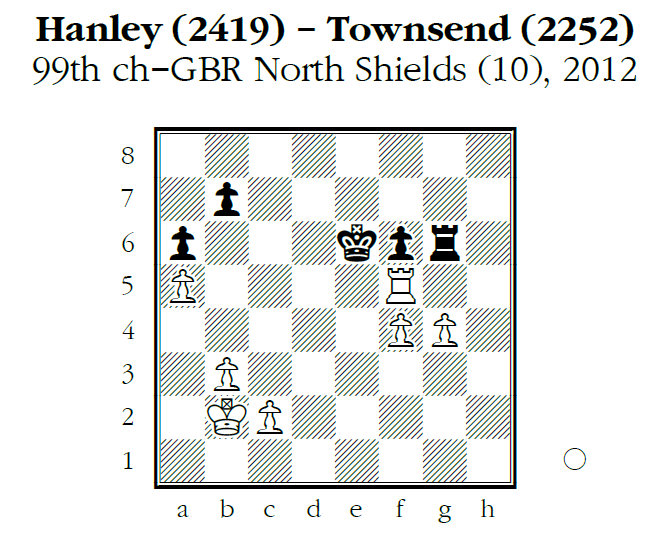


1. Rg5 fxg5
(1… Rh6 2. Rh5 wins)
2. f5+ Kf6
3. fxg6 Kxg6
4. Kc3 Kf6
5. Kd5
and the king/pawn endgame is won for white
1. Re5+, fxe5
2. f5+
and next move takes the rook
difficult then for king to manage pawn progress on both sides.
This comment has been removed by the author.
Almost without thinking about it, I would be interested in Rg5. The idea is to clear, with force, the f5 square for the white pawn to fork the king and rook:
1. Rg5 Rg5
Here, fg5 won’t hold: [1. …fg5 2.f5 Kf6 3.fg6 Kg6 4.Kc3 Kf6 5.Kd4 with a clearly won K+4P vs K+3P ending]. Neither can black hold with Rh6: [1. …Rh6 2.Rh5! Rh5 3.gh5 Kf7 4.Kc3 with another won K+P ending]. Finally, Kf7 loses to 2.Rg6. Continuing:
2. fg5 fg5
3. c4
Here, white should be ok with b4 as well. Continuing:
3. …..Ke5
The only way to hold this can be to create a passer on the king side, but this is going to be too slow. Continuing:
4. b4 Kf4 (alternatives below)
5. b5
Here, c5 is ok, too. Continuing:
5. …..Kg4 (ab5 6.cb5 Kg4 7.a6+-)
6. c5!
The last hurdle cleared. It is tempting to just play 6.ba6 here and push the c-pawn, but black has already captured at g4 giving the passing g-pawn, and his king is still in range to stop c8Q- that ending looks potentially lost for white to me. 6.c5 keeps the tempo for white- now the black king is out of range from the queening squares of b8 and c8. Continuing:
6. …..ab5 (Kf5 7.c6 bc6 8.ba6+-)
7. a6 ba6
8. c6 Kf3
9. c7 g4
10.c8Q g3
11.Qa6 g2
12.Qa7 and the white queen will occupy g1 while her king mops up the black b-pawn.
Back at move 4 in this line, black still loses if he keeps the king guarding the queen side:
4. …..Kd4
5. Kb3!
Almost surely the only winning move. If white plays 5.c5, black replies with Kc4 and white will make no further progress. Continuing:
5. …..Ke5 (Kd3 6.b5 Kd4 7.Kb4+-)
6. Kc3 Kd6
7. Kd4 and this is clearly lost for black.
1. Rd4+!; fxRd4
(1. … K moves 2. f5 etc.)
2. f5+; Kf6
3. fxRg6; Kxg6
4. ç4 should win
for instance: … Kg5
5. b4; Kxg4
6. b5; d5
7. ç5; d5
8. ç4; d6
9. ç6; bxç6
10. bxç6; d2
11. ç7; d1=D
12: ç8=D+ followed by Dxa6
This comment has been removed by the author.
This comment has been removed by the author.
This comment has been removed by the author.
This comment has been removed by the author.
1. Rb5 Black is a dead duck after this move.
The main line goes something like this:
1. .. axb5 2. f5+ Kf7 3. fxg6+ Kxg6 4. c4 bxc4 5. b4 (5. bxc4 also wins, but not as quickly.)5. .. Kg5 6. b5 Kf4 7. a6 bxa6 8. bxa6 Ke4 9. Kc3 with obvious win for White.
An example of the mess the Black king can get into is:
1. .. Rg7 2. Rb6+ Kd5 (2. .. Kf7 3. Rxb7+) 3. Kc3 f5 4. Kd3 fxg4 5. c4+ Kc5 6. b4#
Also possible is:
1. .. Rg7 2. Rb6+ Kd5 3. Kc3 Rxg4 (3. .. Ke4 4. Rxf6 Rxg4 5. Rf7) 4. Rxb7 Rxf4 5. Rb6 Rf1 6. Rxa6 f5 7. Rb6 f4 (7. .. Rh1 8. a6 Rh8 9. Rb5+ Ke4 10. a7 Ra8 11. Rb7 f4 12. Re7+ Kd5 13. Kd3) 8. a6 Ra1 9. Kb2 Ra5 10. c4+ Kd4 (10. .. Kc5 11. Rb5+ Rxb5 12. cxb5 Kb6 13. Kc3 f3 14. Kd3 f2
15. Ke2) 11. b4 Ra4 12. Kb3
1. .. Rxg4 2. f5+ Kd6 3. Rxb7 Ke5 4. Rb6 Kxf5 5. Rxa6
Lucymarie Ruth
The initial posted comments suggest Re5+ (or Rd4+ typo). I hadn’t really considered this line, but it might well win, too:
1. Re5 fe5 (Kf7 possible I suppose)
2. f5 Kf6
3. fg6 Kg6
4. Kc3 Kg5
5. Kd3 Kf4
The tough question is right here. White can push g5, but black doesn’t have to cooperate by playing Kxg5- he has time to play Kf3 followed by tempo gain of e4+:
6. g5 Kf3! (Kg5 7.Ke4 Kf6 8.c4+-?)
7. g6 e4!
8. Kc4
Or 8.Kd2 Kf2! gains the tempo again by threatening e3 with check again. Continuing:
8. …..e3
9. g7 e2
10.g1Q e1Q
And white will struggle to win this queen ending.
So, back at move 6, I think white will do better with a move like Ke2 to keep the e file passer under control:
6. Ke2 Kg4
7. Ke3 Kf5
8. b4
Here, c4 looks weak to me after black pushes e4: [8.c4? e4! 9.b4 Ke5 and the black king can now clear up the pawns on the queen side since the white king must now give ground, or he must further weaken the queen side pawns by pushing either b5 or c5. Continuing:
8. …..e4 (anything better?)
9. c3! Ke5 (or lose the e-pawn)
10.c4
We have the same position as before in the note immediately above, but now black must move. Continuing:
10. ….Kf5 (or lose the e-pawn)
11.b5
I think c5 ok here, too.
11. ….Ke5
12.c5!
Here, 12.b6 is probably ok, though I am not quite 100% sure of it, but 12.ba6 is a likely draw: [12.ba6? ab6 13.c5 Kd5 14.c6 Kc6 15.Ke4=]. 12.c5 leads to a fairly common motif in endings, and is one I have seen from both sides of the board more than once while playing online, and I think has even been the subject of a puzzle on this site before. Continuing:
12. ….Kd5
Or [12. …ab5 13.c6! bc6 14.a6+-]. Continuing:
13.c6 Kd6
Or [13. …bc6 14.ba6+-]; or [13. …ab5 14.cb7+-]. Continuing:
14.cb7 Kc7
15.ba6+-
This line wins, I think, but seems just a bit more complicated than the 1.Rg5 line;.
1. Rg5 is the direction to go.