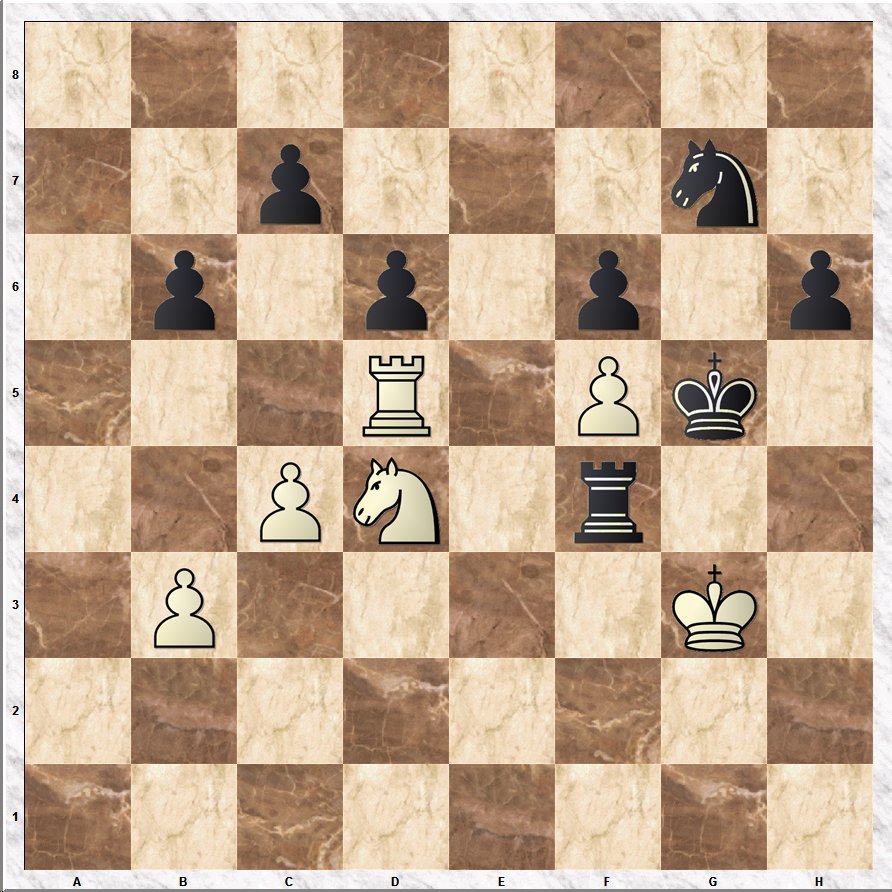
White to move. Is this a win, draw, or loss for White? How should White proceed?
8/2p3n1/1p1p1p1p/3R1Pk1/2PN1r2/1P4K1/8/8 w – – 0 1
Chess Daily News from Susan Polgar


White to move. Is this a win, draw, or loss for White? How should White proceed?
8/2p3n1/1p1p1p1p/3R1Pk1/2PN1r2/1P4K1/8/8 w – – 0 1
Very easy!
1.Ne6+!
A>1….Kh5.2.Nxg7+!.Kg5.3.Ne6+!.Kh5.4.Nxf4+!.Kg5. 5.Ne6+!.Kh5.6.Rd1!!.~any.7.Rh1#!
B>1….Nxe6.2.fxe6+!.
B1>2..Rf5.3.Rxf5+!.Kxf5.4.e7! Queens next move and wins easily!
B2>2…Kg6.3.Kxf4! And wins easily!
B3>2…f5!.3.Re5!!! And the e pawn cannot be stopped from queening.
pht
I have the habit of digging past.I have placed comment justifying your move which you were regretting.Click the link
attacking-chess-tactic_27 Jan
I can’t see anything better than
1. Ne6+ Nxe6
1. … Kh5? 2. Nxf4+ Kg5 3. Ne6+ of course.
2. fxe6+ f5
2. … Kg6? 3. Kxf4 or 2. … Rf5? 3. Rxf5+ Kxf5 4. e7 of course.
3. Re5 Rg4+
Last try. 3. … Re4 4. Rxe4 fxe4 5. e7 loses badly, while 3. … Kf6 4. e7 dxe5 6. e8=Q allows Black to resist but White still should win. I think. Very similar to the main line.
4. Kf2
4. Kh3 should be OK too, but White would lose if 4. Kf3?? Re4 5. Rxe4 fxe4 with check, so that 5. Kxe4 Kf6 stops the e pawn.
4. … dxe5
4. … Rf4+ 5. Ke3 doesn’t help Black appreciably.
5. e7
White will have Queen for Rook and 3 passed pawns. In the absence of the Queenside pawns, this would be a difficult endgame for White. But with the Queenside pawns, I suspect White will be able to create a passed pawn to win the Rook. It won’t be easy, but White should be able to win. I think – would take a lot more analysis to be sure. But there certainly doesn’t seem to be anything better than this for White.
But this seems much less clear-cut than one would expect for these puzzles. So once the answers are posted, I imagine I’ll see that I missed something basic. *sigh*
1.Ne6+ Nxe6
2.fxe6+ f5
3.Re5!
(An ingenious move.R behind passed P.If the R is captured black R can not have a go at the P)
4…. Rg4+
4.Kf2
(A prank played by black.If white plays 4.Kf3 Re4 since 5.Rxe4 fxe4+ because it is a check black gets time to stop the pawn.)
4…dxe5
5.e7 Rf4+
6.Ke2
This endgame is beyond my capacity. White must be satisfied with draw.
White wins! The knight gives a check !
1. Nf6+ NxN
2. f5xN+ Kg6
3. KxR
White gains material and has a passed pawn. Win follows.
1. Ne6+ N:e6
2. fe+ and the e-pawn promotes after either 2…Rf5 3. R:f5+ or the critical line
2. …. f5
3. Re5!!
A pretty (although pretty easy) study.
It looks simple on the surface, but is more complex than first appearances:
1. Ne6! Ne6
2. fe6
With discovered check. The black king can’t retreat to g6 since his rook would then be hanging. So he must block the check with either Rf5 or f5:
2. ……f5 (Rf5?? 3.Rf5 Kf5 4.e7+-)
3. Re5!
The hardest of the moves to spot, I imagine, but a common theme. White is now threatening to push the e-pawn to the queening square, and the black rook can’t get behind it, even if black now takes the rook since his own pawn will block up the e-file. Let’s look at the two main lines:
3. ……de5 (Kf6 4.e7)
4. e7 Rg4 (e4 below!)
5. Kf2 Rf4
6. Ke2 Re4
7. Kd3 and black will run out of checks after Rd4. With the b and c pawns, white’s edge should be decisive.
More testing however at move 4…
4. ……e4 (to win the b-pawn)
5. e8(Q) Rf3
6. Kg2 Rb3
7. Qe7 Kg4 (any better?)
8. Qg7 Kf4
9. Qh6 Ke5
10.Qg7
Is less clearly won to my eye. I would have to put some more thought into this ending to be sure. I think maybe I have overlooked better lines for white in the above, but I am not sure where. Black can continue from here with Kd6 protecting c7, but then white plays Qf6 followed by Qxf5. If black then takes the white pawn…
10. …..Kd6
11.Qf6 Kc5
12.Qf5 Kc4
13.Qe4 and this ending is drawn as I verified with a Nalimov tablebase. This line is key, and I don’t have an answer at the moment. I need to look more deeply at white’s various options after black has played 4. …e4.
I think this is drawn with best play. I think black can even let the c-pawn go in the line I discussed above and simply maintain the f/e-pawn combo as a shield for his king. I can’t see any way for white to make progress.
Maybe, instead of 1. Ne6+, it would be better to play simply
1. Nf3+ Rxf3+
2. Kxf3 h5
Not 2. … Nxf5?? 3. Ke4
And, for example
3. Ke4 h4
4. Rd1 Nh5
with the idea of 5. Rg1+ Ng3+.
The Knight seems very awkward in this position, but White has to guard against the h pawn promoting while also infiltrating the Queenside. I’m not sure whether that would be easier than the endgame with Queen versus Rook plus 3 pawns. But the choice between those two endings is more a case of “endgame evaluation” than of “endgame chess tactic.” So there’s probably still something I’m missing here.
Ne6+ Nxe6
fxe6+ f5
Re5 and you either loose the rook or the e6 pawn queens.
Seems too easy. (Not bragging, just usually have a harder time with these puzzles).
Ne6+ Nxe6, fxe6+ Rf5, Rxf5+ Kxf5, e7
Why the link I have sent is not working? Any idea?