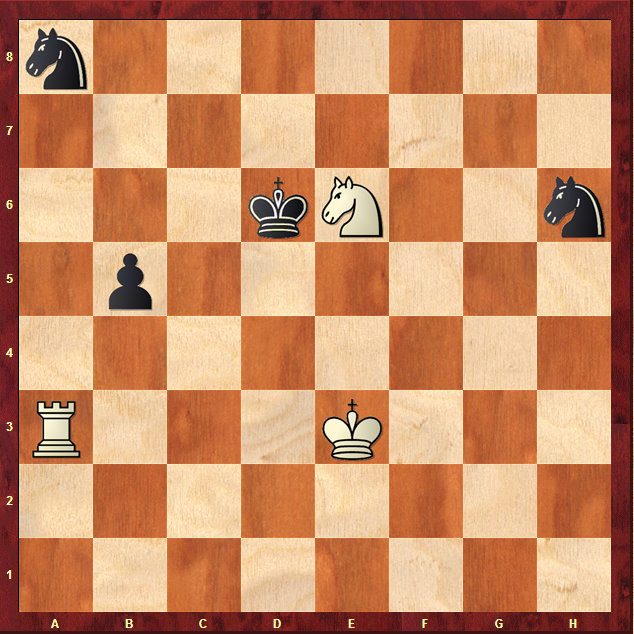
White to move. How should White proceed?
n7/8/3kN2n/1p6/8/R3K3/8/8 w – – 0 1
Abramenko, 1996

Chess Daily News from Susan Polgar

White to move. How should White proceed?
n7/8/3kN2n/1p6/8/R3K3/8/8 w – – 0 1
Abramenko, 1996
I guess the most “obvious” move would be Ra8. The reason this seems “obvious” to me is that I can see that if black replies by taking at e6, then Ra6 wins the knight at h6, too, and the game since the white king is well placed to stop the remaining black pawn. Of course, this wouldn’t be a chess problem if this idea were really going to win for white. So, let’s see why this isn’t going to work, and hopefully figure out the winning play:
1. Ra8
Now, to be able to win at e6, black needs to do one of two things- move his knight out of the way with check to a square where his king can protect it after taking at e6 and being checked by the rook, or to check with the knight (at g4) and lure the white king away from the black pawn so that black can obtain the draw that way. I can readily see (and for an obvious reason) that Ng4+, to lure the white king away from b5, isn’t going to work:
1. …..Ng4
2. Kf4 Ke6
Here, Nf6 and Nf2 both lose: [2. …Nf6 3.Ra6 Ke7 (3. …Kd5 4.Nc7 +-; or 3. ….Kd7 4.Nd4 +-) 4.Nd4 Nd5 (4. …b4 5.Nb6+-) 5.Ke4 Nc7 6.Nb6+-]; or [2. …Nf2 3.Kf3 and it is clear that white will never relent on the attack on the knight unless black moves him to the h-file, at which point white will either move his out of danger and concentrate on winning the b-pawn with his rook advantage, and the game, and should black move the knight over to the queen side, the white king will simply follow until his king is in front of the pawn, and then move his own knight out of danger]. Continuing with white’s third move in the main line:
3. Kg4 Kd5
4. Rc8
This is what I could see without much effort- the black king is cut off from the pawn. Now, black can either push the pawn further away from the king, but when the pawn reaches b2, white will play Rb8 and win it since the black king will then be too far away to protect it (sitting at d5). Or, if black tries to attack the rook with Kd6 and Kd7, white will use the first tempo to bring his king one square closer to the queen side, and use the second to play Rc5 attacking the pawn, thus forcing b4, then play Rb5 and win the pawn on the next move. Here, black’s only hope is to combine pawn moves with king moves to keep his king in range of the pawn, but this takes far too long. Continuing with black’s 4th move:
4. …..b4
5. Kf3 Kd4 (b3 6.Ke3+-)
6. Ke2 b3 (what else here?)
7. Kd2 and the white king will capture the pawn eventually.
So, all the way back at move 1, black must try Nf5. I can also see that this is likely to hold the draw for black. From the top:
1. Ra8 Nf5
2. Kf4
Here, Ke4 also doesn’t win: [2.Ke4 Ke6 3.Ra6 (3.Re8 Ne7 should draw) Nd6 with equality]. Continuing:
2. …..Ke6
3. Ra6 Nd6 and this is draw even without the pawn.
So, clearly, white cannot take at a8 on the first move. In my next comment, I will discuss a more promising looking move.
In my previous comment, I showed that that white cannot capture at a8 with his first move. Now, I could see that white doesn’t need to rush the a8 capture- he can actually check from a6 first. Let’s see if this is more promising. Right now, I simply can’t tell:
1. Ra6
Here, black has the four king move-Kd7, Ke7, Kd5, and Ke5. Let’s consider each king move in order:
1. …..Kd7
2. Nc5 and white wins one of the knights for sure while retaining his.
Or
1. …..Ke7
2. Nd4
Double attack. Unlike the line with 1. …Kd7, white hasn’t opened this attack with check, but it doesn’t matter since the knight check from f5 is already covered by white’s own, and the knight attack on the rook from c7 does nothing to keep white from capturing on h6. The only move to look at is the check from g4:
2. …..Ng4
3. Kf4
Keeping the double attack on the two knights. Now, the knight at g4 can deliver no more checks that can save the a8 knight. The only thing black can do is to attack the rook with the a8 knight, but that also fails to hold both knights:
3. …..Nc7
4. Rc6
Or [4.Ra7 Kd6 5.Kg4+-]. Cont.:
4. …..Nd5 (else?)
5. Kg4
Probably the only winning move as any other king move allows black to connect the knights to each other by playing either Nge3, or Ngf6, and the resulting ending of 2N vs R+N is drawn; or allows the fork on the king and rook, again leading to a drawn ending after white captures the b-pawn. After white’s 5th move, this is a won ending for white, of course.
Or, at move 1:
1. …..Kd5
2. Nf4 Kc4
3. Rh6
Here, Ra8 also wins, but is complicated by the knight harrassment from g4- why allow it when you don’t have to?
3. …..b4
Probably not the best move, but we already know moves like Kc5 are going to lose since the white king gets himself into a better position if the black king doesn’t try to cut him off. Continuing:
4. Ra6 b3 (Nc7 5.Rc6+)
5. Nd3
No need to hurry, the black knight isn’t going anywhere. In any case, the black pawn will be stopped, the black knight will be lost, and the game is won for white.
Finally, at move 1:
1. …..Ke5
Clearly the most difficult reply to deal with, and it took me a bit of playing around to find what I think is the only winning move:
2. Nf8!
Here, white had 8 different knight moves, but they all have problems that I couldn’t overcome. Due to problems of comment length, I will cover them in more detail in my next comment, but I want finish with the winning line:
2. …..Nf5 (Ng4 see below)
3. Kd3
Another situation where I think there is only one winning move. On a move like 3.Kd2 or 2.Ke2, black extricates the the other knight via c7, and there is no way I could find to win one of the knights. The same applies to 3.Kf3- black saves the a8 knight with Nc7. We will understand Kd3 as we go along, of course one argument for it is that at d3, the white king is no longer checkable, forcing black’s next move:
3. …..Nc7 (this or lose it)
4. Rc6! Na8
On 4. …Ne6, white just captures with check, on 4. …Ne8, 5.Re6+ wins the knight, and, finally, on Nd5, white mates with Ng6- a very pretty mate! Also, this was the reason for white’s 3rd move- to cut off d4 in that line. Continuing:
5. Rc5 Kf6
Or, [5. …Kf4 6.Ne6 Kg4 7.Rb5! Nd6 8.Rb8! wins the knight at a8]. Continuing:
6. Rc8! Nb6 (else, Ra8+-)
7. Rc6! Kf7 (nothing better)
8. Rb6! Kf8
With no checks and no attacks on the white rook, black has nothing but losing moves here anyway:
9. Rf6 wins the last knight and the game.
An amazing study, and a lot of fun playing through.
In my previous comment, I had shown that the line
1. Ra6 Ke5
2. Nf8! wins in all variations, some of them quite surprising. However, white’s 2nd move was a hard one to find since there were 8 different knight moves, and after about an hour of work, I finally made Nf8 the winning choice. To finish this up, I just want to show why I think Nf8 was, in fact, the only winning move for white at move 2:
1. Ra6 Ke5
2. Nd8
The mirror of Nf8, but this won’t win:
2. …..Nf5 (only move)
3. Kd3 Nc7
4. Rc6 Nd5 (Na8 ok, too??)
And, here, in the previous line with 2.Nf8, white mated with Ng6, but in this line, the white rook is occupying the analogous square, and even if it weren’t, the black king could escape through f4, so it made no difference if white had played 3.Kf3. Now, all white has is a check with Re6 on which the black king plays to f4 and coordinates his knights with Nfe3.
Or:
2. Nc5 Nf5 (Kd5 ok? Idk.)
3. Kd3 Nc7
4. Rc6 Nd5 and, again, after the checks are used up, black will coordinate his knights into protecting each other, and the pawn, too.
Or:
2. Nd4 Nf5 (Ng4 ok, too)
3. Nf5 Nc7 and white will lose his knight to the double attack on the pieces.
Or:
2. Nf4 Nf5
3. Kf3 Nc7
4. Ng6
Here, Rc6 leads to Nd4 fork.
4. …..Kd4
5. Rf6 Ne3 (or Ng7 6.Rf7 Nge6=)
With Ncd5 coming.
Or
2. Ng5 Nf5
3. Kd3 Nc7
4. Rc6 Nd5
5. Re6 Kf4
And it would not have mattered if white had tried 3.Kf3 as the black king escapes through d4. As it is, Nfe3 is coming to save the black knights and the pawn for the draw.
Or, lastly, the line I got hung up on the longest:
2. Ng7 Nf5
3. Nf5 Nc7
And I spent 20 minutes trying to find a way to win this for white, and I don’t know why- it is so clearly drawn now that I am looking at it again.
In any case, it is clear that 2.Nf8 wins because it prevents the critical line in which the black knight at a8 tries to escape via c7 and d5, and it does this by the mate threat of Ng6 where the knight has covered the key square of f4, allowing the white king to cover d4 and trap the black king.
1. RA8 wins
1. RxA8 wins
I think Rxa8 isn’t good.
If Rxa8, Nf5+ and then KxNe6
Maybe
Ra6+, Ke5
Nd4 gainig material.
Hi Susan Polgar,
My System had turned shy and failed to boot [ System crashed ] and I didn’t had impulsive intention to correct my system booting problem,so thats the story of the long break in coming over the internet.
Okay,by the by How are my favorite players – [ Anand,Kasporov & Of course you “Susan Polgar – though I haven’t seen/read your chess moves – Your contents and its placement in your web site,shows your ability towards clarity & result orientation ],which is a best bet for chess game,isn’t it ?
Okay okay – No flattering just absolute fact.
Today my mood drifts towards Hot web sites – so catch you all later – so I am not posting any comments on today’s chess puzzle,my mind & physique is on hot web sites – okay okay – bye bye.
By
Venky[ Chennai ]