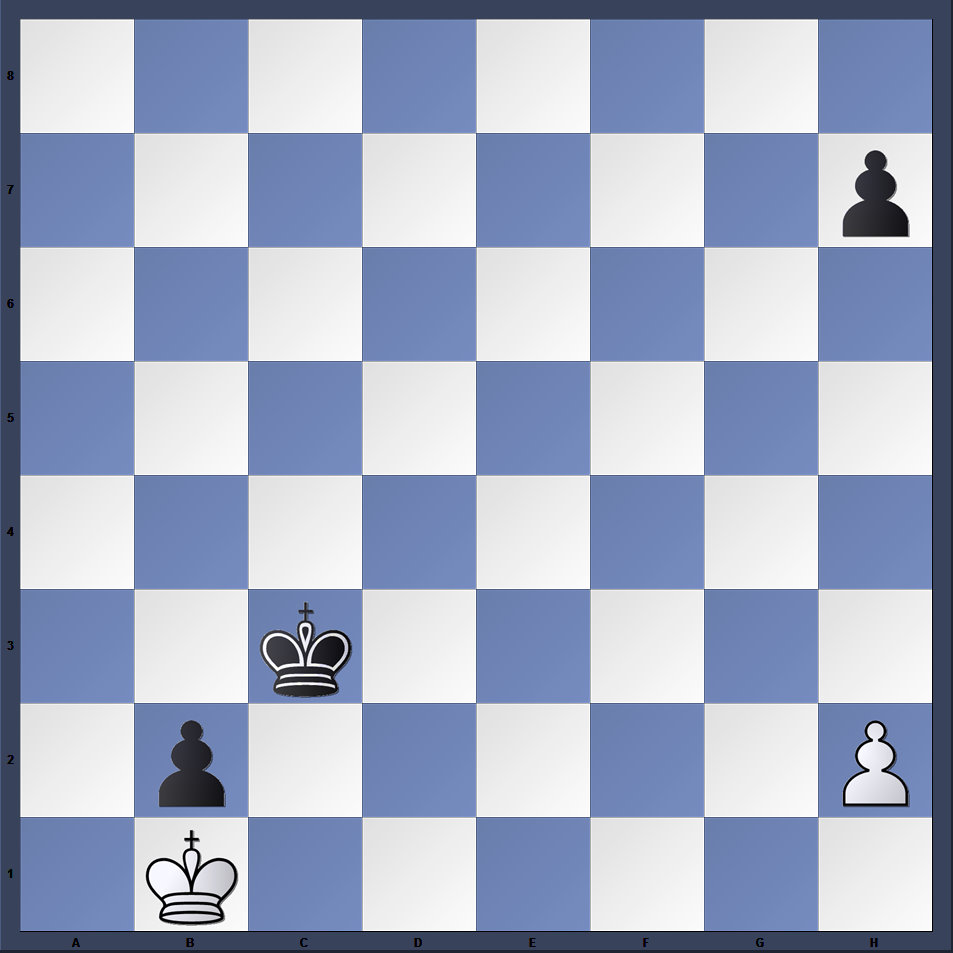
Black to move. How should Black proceed? Can Black win this endgame?
8/7p/8/8/8/2k5/1p5P/1K6 b – – 0 1

Chess Daily News from Susan Polgar

Black to move. How should Black proceed? Can Black win this endgame?
8/7p/8/8/8/2k5/1p5P/1K6 b – – 0 1
Kb3 h4
h6 h5
Ka3
Kb3 h3
h5 h4
Ka3
funny little problem… took about 30 seconds.. its one of those giggling problems because its so silly..you go first.. no you go first.. lol
after Kb3 the white pawn must move. Black moves his pawn so, that white has the last move before both pawns block each other. E.g. h3 is answered with h5. Finally black can force the white king to leave his place with Kc3 or Ka3 and wins.
Easy
Black plays 1……Kb3 and if
2. h3 Kc3 3.h4 h5 and wins. If
2. h4 Kc3 3.h5 h6 and wins
This is a draw by stalemate.
1…Kb3 puts White in Zugzwang:
If 2. h3 h5 3. h4 Kc3 4. Ka2 Kc2 wins;
If 2. h4 h6 3. h5 Kc3 4. Ka2 Kc2 wins.
KB3 win for black.
The key seems to be creating zugzwang for white.
1…Kb3
2.h3 h5
3.h4 Kc3
4.Ka2 Kc2
5.Ka3 b1Q
6.Ka4 Qb6
7.Ka3 Qb3#
if 2.h4 h6!
3.h5 Kc3
4.Ka2 Kc2
5.Ka3 b1Q
6.Ka4 Qb6
7.Ka3 Qb3#
Yah this one isn’t hard (and chances are high that we all played something like this at least once).
1. … Kb3
2. h4 h6
3. h5 Kc3
4. Ka2 Kc2
5. Ka3 b1=Q
…
0-1
If the rook pawns were not on the board
this would be a draw because 1. …Kb3
stalemates the white king and any other
move allows white to capture the b pawn.
However, there are pawns on the board so
we have to play in such a way that black
can get his king back to c3 after locking
the white king in place by 1. …Kb3.
1. …Kb3
2.h4 h6!
3.h5 Kc3
4.Ka2 (only move) Kc2
5.Ka3 b1=Q
6.Ka4 Qb6
7.Ka3 Qb3#
Instead of 2.h4 white tries:
2.h3 h5!
3.h4 Kc3 the rest as above.
Yes, Black can win:
1. ..Kb6
2.a3 Kc6
3.a4 a5
4.Ka2
2.a4 a6
3.a5 Kc6
4.Ka2
1… Kb3 wins…
2. h4 h6 3. h5 Kc3 -+
or
2. h3 h5 3. h4 Kc3 -+
I solved this one by the process of elimination. Ok, the theme is that if the pawns are locked and it’s white’s move, black wins by forcing the king off the queening square; but if it’s black’s move it’s a stalemate (or draw from black losing the pawn).
Both pawn moves h5 and h6 lose, as white mirrors black (h5 h4, or h6 h3 and then h5 h4). So the only choice is to move the king back and forth with Kb3, Kc3.
After those two moves, black chooses to move the pawn either one or two squares, and does the one which will leave white to move when the h-pawns are finally locked, and then the king is forced to a2 and black wins.
Sorry anonymous but it’s not stalemate but a mate .I will give you my solution( it’s more easy than some pawns study of chess endgame of Lazlo Polgar). Solution : …Kb3 ! (2 h4 h6! 3 h5 Kc3 4 Ka2 Kc2 5 Ka3 b1=Q 6 Ka4 Qb6 7 Ka3 Qb3 mat) 2 h3 h5! 3 h4 Kc3 4 Ka2 Kc2 5 Ka3 b1=Q 6 Ka4 Qb6 7 Ka3 Qb3 mat.
Kb3; if h4, then h6; if h3, then Kc3 and meet h4 with h5
Black needs to force white to play Ka2 so that the black king can play to c2 and support the b-pawn’s advance, but to do this, he must take away the pawn moves white has available at the right time. Now, it might appear that black has two first moves- h6 and h5, but this isn’t so- black can play Kb3 as long as white still has a pawn move. Indeed, I am certain he will have to do so (and on the first move) since white moves second in this position, and if only pawn moves are played before the h-pawns face off on each other, then white can change the order of who moves from what position by replying to h6 or h5 appropriately with h3 or h4. Let me demonstrate what I mean:
1. …..h5
2. h4!
And, now, black either stalemates white by playing Kb3, or he loses the b-pawn and white’s king makes it to h1 in time to draw against the black h-pawn. Or:
1. …..h6
2. h3!
And, as above, if black plays h5 on move 2, white replies with h4 setting up the same drawn position as before. So, in this line, can black do better with a king move on move 2? No, it is too late- he has already conceded to white the optional move motif:
2. …..Kb3 (Kd3 or Kd2 3.Kb2=)
3. h4
And, now, on black playing h5, white is stalemated, and on Kc3 or Ka3, white plays h5 and sets up a position essentially the same as that seen in the first line above, but with the h-pawn faceoff at h6 and h5. Clearly, black’s only possible winning option is to play Kb3 with his first move, thus reserving the right to play h6 or h5 himself in reply to what white plays on his first move:
1. …..Kb3!
2. h3
And knowing that white will have to play h4 on his next move unless black moves his king, the winning move is
2. …..h5!
3. h4 Kc3
4. Ka2 Kc2 and the b-pawn queens. And, at move 2, white cannot draw by playing h4:
2. h4 h6!
3. h5 Kc3 and white loses.
It is important to consider carefully in endgames whether or not it matters when you have a pawn on it’s original square. Sometimes it does, sometimes it doesn’t. Here, it is the critical factor.
1. … Kb3! and now 2.h3 h5! 3.h4 Kc3 wins; 2.h4 h6 3.h5 Kc3 wins too.
Not a draw, because black can force white to ‘waste’ the pawn moves.
Black must use the pawn moves to force the original position with white to move.
Black starts with Kb3 forcing white to move his pawn first.
If h4, then h6!
1. … Kb3
2. h4 h6
2. h5 Kc3 winning
1. … Kb3
2. h3 h5
3. h4 Kc3 winning
the idea here is make white move his king to a2
So,
1…Kb3
2. a3/a4 – Kc3/Ka3
3. a4/a5 – a5/a6
4. Ka2/Kc2
And black wins..
1..Kb3
2. h4 h6 2. h3 h5
3. h5 Kc3 3. h4 Kc3
4. Ka3 Kc2 4. Ka3 Kc2
black wins
1. Kb3 wins…
either
1. h4
2. h6 h5
3. Kc3
or
1. h3
2. h5 h4
3. Kc3
kb3 thereby forcing white to move h pawn?
-HH
No stalemate, Black wins.
1…Kb3!
2.h4 h6
3.h5 Kc3 -+
or 2.h3 h5
3.h4 Kc3 -+
1…Kb6 looks winning, with the idea of responding as appropriate to White’s moves of the h-pawn to make sure White has the last move on the h-file. For example, 1…Kb6 2.h4 h6 3.h5 Kc6 wins. Or 1…Kb6 2.h3 Kc6 3.h4 h5 wins. Phil
1…Kb3! and then:
2. h4 h6 3. h5 Kc3 -+;
2. Ka2 Kc2 -+;
2. h3 Kc3 3. h4 h5 -+.
1…Kb3 wins because you’re making white commit to making the first pawn move. Depending on what white does you then have the choice between h6 and h5. After white’s last pawn move you then move your king back to c3 and force the white king to the side.
The trick is to get to this position with white to move. So create a zugzwang in which white makes the last pawn move and black moves his king to c3. The only way to do that, as far as I can figure out, is to start with:
1. Kb3
This forces white to move a pawn, and whether he moves it h3 or h4 black can now force white to make the last pawn move, allowing Kc3, forcing white to vacate the queening square.
Result 0-1.
Yes Black can win he just has to create a position where there are no more pawn moves and it’s white to play . Not difficult.
@Anon 21, 2011 1:25:00 PM
You should try to buy one time. I hope I explained it well.
Congratulations Susan
“Endgame improvement” is very important.
I apologize for my too many comments.
Susan, sweet greetings.
Stef
.. Kb3
then if white pushes pawn 2 square, push the pawn one square and vice-versa,
then .. Kc3.
and white will be in Zugzwang
For black to win, white must be forced to move the king to a2.
So
1… Kb3 now forces white to move the pawn.
IF
2. h4 then 2 … h6
3. h5 forced 3… Kc3 forcing white king to move to a2 and 4… Kc2 wins.
IF
2. h3 then 2… h5 with the same idea.
Try Kb3 then do the opposite of whatever White does with his RP.
Si las negras mueven su peón, las blancas encontrarán la forma de lograr tablas por ahogo. De manera que las negras deben jugar 1…Kb3! y ahora son ellas las que tienen la oportunidad de jugar 1 ó 2 casillas su peón, lo que les permitira ganar un tiempo y hacer que las blancas queden en ‘zugzwang’
The key feature of this position is that both the black and white pawn has the option of one or two moves. If black plays
1…h5 then 2.h4 leads to a draw
and 1… h6
2.h3 h5
3.h4 draws
So the important move is
1…Kb3
2.h4 h6
3.h5 Kc3
4.Ka2 Kc2 will queen the b2 pawn
or 1…Kb3 and if white responds
2.h3 then h5
3.h4 Kc3 winning
1….Kb3!
a) 2.h3 h5 3.h4 Ka3 -+
b) 2.h4 h6 3.h5 Ka3 -+
… 1. Kb3
The idea here is eliminate whites pawn moves and if the king moves in the current position , its an easy win.
White has two choices.
2. h3 h5
3. h4 (only move) Kc3 Winning
2. h4 h6
3. h5 (only move)Kc3 winning.
1…h6 also seems to work out in terms of allowing Black to give up a tempo. Phil
Ok,
1… Kb3 must be the move, moving the h-pawn removes the choice of double move versus single move:
2. h4 Kc3 3. h5 Kb3 4. h6 Kc3 wins, 5. Ka2 Kc2
2. h3 h5 3. h4 Kc3 wins as well.
1 … Kb3
if 2. h4, h6; 3. h5, Kc3 and the white king has to give way.
if 2. h3, h5; 3. h4 Kc3 and the same result
Black can win by forcing White to move his h-pawn first, after which Black moves her h-pawn the opposite number of squares.
1 … Kb6!
Now if White moves his h-pawn one square, Black moves her h-pawn two squares, or vice-versa. That way, White makes the last pawn move. After that move, Black plays Ka6 or Kc6 and removes the stalemate, forcing White away, and promotes.
Here are the two possible move sequences:
1… Kb6!, 2 h4 h6!, 3 h5 Ka6, 4 Kc2 Ka7
1 … Kb6!, 2 h3 h5!, 4 h4 Ka6, 4 Kc2 Ka7
Note that a pawn move or going after the h-pawn won’t work. If Black moves a pawn first, then White can force the last move for himself by moving his pawn the SAME number of squares as Black does, making the last pawn move and forcing Black to stalemate or abandon the pawn. For example:
1 … h3, 2 h6!, 2 h4 h5, and now Black can’t save the b-pawn.
Or 1 … h4, 2 h5, and Black can’t save the b-pawn.
Going after the pawn doesn’t work, either:
1 … Kd2
2 Kxb2 Ke2
3 Kc2 Kf2
4 Kd2 Kg2
4 Ke2 Kxh2
5 Kf2
Now White simply moves from f2 to f1 until it’s possible to go to g1, or until Black stalemates himself. Examples:
1 … Kh1, 2 Kf1 h5, 3 Kf2 h4 4 Kf1 Kh2, 5 Kf2 h3, 6 Kf1 Kg6 ( 6 … Kh1, 7 Kf1 h2, 8 Kf2 stalemate), 7 Kg1, and White draws.
1…Kb3 wins. It puts White in zugzwang and he has to use his moves up:
A. 2.h4 h6 3. h5 Kc3 4.Ka2 Kc2
B. 2.h3 h5 3. h4 Kc3 4.Ka2 Kc2
…Kb3! should win
a)h3 Kc3 h4 h5 zug
b)h4 Kc3 h5 h6 zug
The key is which player has the option of changing the move order. Once an h-pawn is moved, this option is lost.
I think the trick is 1.Kb3 winning a tempo with 2.h6 if either 1…h4 or h3 is played.
First Kb3, to the stalemate position… white must move his pawn: if h4, black replies h6, h5 – Kc3 0-1, if h3, then h5, h4 – Kc3 and again 0-1
1…Kb3
2.h3 Kc3
3.h4 h5
4.Ka2 Kc2 0-1
2.h4 Kc3
3.h5 h6
4.Ka2 Kc2 0-1
There is no way for Black to lose a tempo. Whether Black plays 1…h5 2. h4, or if 1…h6 2. h3 h5 3. h4, he is forced to move his King, either stalemating White or abandoning his extra Pawn, leaving him with only a Rook’s Pawn.
Only move to win is 1…Kb3! and 2…Kc3 and then third move with the pawn (h5 or h6 if white pawn is on h5 already) will put white in zugzwang.
1…h6 does not work. White would just play a3 and so on
Marijan
Goal is to move white king from B1 square, black wins in any case..
Kb3, h3
h5, h4 (forced)
Ka3 or Kc3… both wins for black
Kb3, h4
Ka3 or Kc3, h5 (forced)
h6 …. black wins
1…Kb3
2.h4 h6 [or 2.h3 h5 3.h4]
3.h5 Kc3
1-0
kb3 h3
h5 h4
ka3
1…Kb3!!