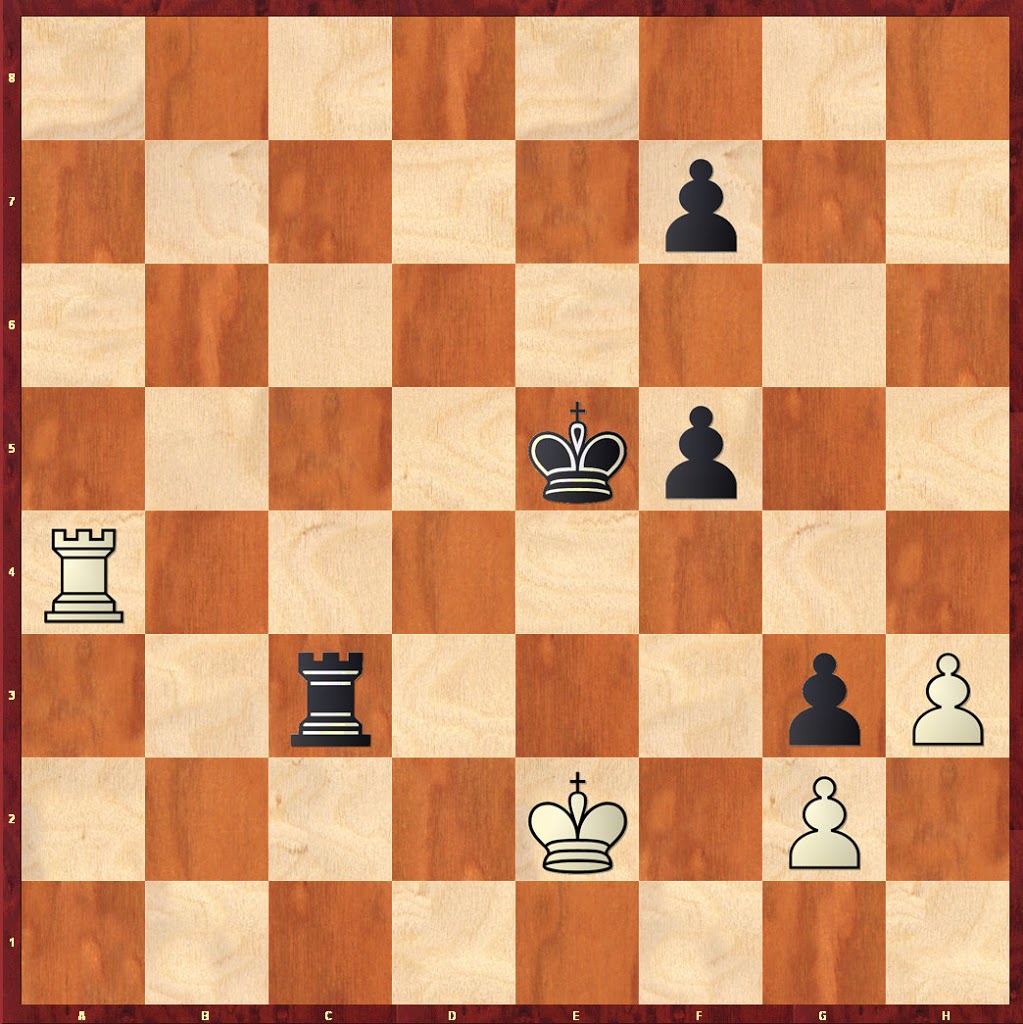
This is the actual position in the Kosteniuk – Khukhashvili game earlier today. It is Black to move. Is this a win or draw for Black? How should Black proceed?
8/5p2/8/4kp2/R7/2r3pP/4K1P1/8 b – – 0 83

Chess Daily News from Susan Polgar

This is the actual position in the Kosteniuk – Khukhashvili game earlier today. It is Black to move. Is this a win or draw for Black? How should Black proceed?
8/5p2/8/4kp2/R7/2r3pP/4K1P1/8 b – – 0 83
Kosteniuk can win this while tweeting and posting on her blog during the game. She can do it all. She’s the best.
Kosteniuk played the endgame really weak. She had several changes to turn the game in het favor. In this position she even should have LOST !!
1. …, f4 ! White has several ways to defend in the short run, but they all cannot prevent that black will will the white g-pawn and the game.
Erik Fokke
Amsterdam, Netherlands
Well, if I were playing this as black, I would want to take advantage of that lonely g2 pawn by checking from c2, and if white plays Kf1 to protect g2, I would play Rf2 to either box the king in at g1 or win g2. The problem, though, is that white doesn’t need to cooperate by playing 2.Kf1. White would do far better by playing 2.Kf3!:
1. …..Rc2?
2. Kf3!
And, now, if black tries to play
2. …..f4
3. Re4
Here, 3. Ra5 might draw, but I hate to let black win g2 in exchange for f4:
3. …..Kd6(Kf5 4.Rf4 5.Re4 6.Re3)
4. Rf4 and white will have the advantage, though I doubt it is decisive.
Now, one should see from the above that the real problem with 1. ….Rc2 is that black loses the opportunity to play f4 protecting g3. So, what about playing f4 immediately?
1. …..f4
And it is hard to find a really good move for white now. White could play Ra5, Ra2, Ra1, Ra8, Kd2, Kd1, Ke1/f1, or h4. Let’s deal with the really bad king moves first:
2. Kf1 Rc1
3. Ke2 f5 (Rg1 4.Ra5 Kf6 5.Kf3!)
4. Ra5
Every alternative for white looks similar to the main line:
4. …..Kf6
5. Ra4 Kg5 (the point of 3. …f5)
6. Ra8 Rg1
7. Rg8
Everything loses. 7.Kf3 loses to Rf1 followed by Rf2 winning g2.
7. …..Kf6
8. Rf8 Ke6! (protecting f5 and f4)
9. Re8 Kf7
10.Re5
Here, white could go back to the a-file and check from a distance, but black will just repeat the hiding maneuver at g5 gaining a move for Rg2 anyway.
10. ….Kf6
11.Ra5 Rg2 and this position is hopeless for white. The same technique will work when white plays 2.Ke1. Now for 2.Kd1:
2. Kd1 f3!
3. gf3
Here, black wins even more easily if white plays 3.Ra2 as black replies with f2, and black will queen at f1 or force white to sacrifice his rook at f2 (4.Kd2 loses to Rc1! followed by f1(Q). Continuing:
3. …..Rf3
4. Ke2 Rf2
5. Ke3 f5! (preventing Rg4)
6. Ra5 Kf6
7. h4 Kg6
8. Ra4
What else here? Black is going to win the h-pawn regardless, and there are no good ways to even prevent the following line, anyway. Continuing:
8. …..f4!
9. Ke4
Here, Rf4 loses Rf4 after which black queens the unstoppable g-pawn. Continuing:
9. ….g2
10.Ra6
Here, Ra8 loses to Rf1 followed by g1(Q). Continuing:
10. ….Kh5 and this is clearly a win for black. I will continue with white’s other, better alternative moves at move 2.
Black looks won.
f4 and to many threats to handle the king can try to infiltrate, a timely f3 could detroy white’s position, and the rook can usually challenge the white rook along the e file when supported by one of the f pawns as white cannot afford to give black a passed pawn.
In my last comment, I discussed the line that starts with 1. …..f4 and I showed that all the move two replies of white where he moves the king the first rank are quick losses. Now I will cover some of the better alternatives.
1. …..f4
2. Kd2
Here, as black, needing to move the rook, I can’t really see any better move than one that prevents a check by the white rook:
2. …..Rc5 (preventing Ra5+)
Now, here, the main threat against white is black playing f3, and the secondary threats are f5 and Rb5 (with the idea of Rb2+ and Rg2). Unfortunately for me, there are a large number of variations here. To make this a bit more manageable, I am going to show the main lines preventing each of the above, and show the general method I think black should proceed with. Continuing:
3. Ra3
This is prevent 3. ….f3. Continuing:
3. …..Rb5 (threatening Rb2)
4. Kc2 Rd5
And, now, black has the white king cut off from the king side of the board. It will do white no good to exchange rooks at d3 since black will play f3 after white retakes at d3, and there will be no way to prevent a pawn from queening at g1. A move like 5.h4 is just going to lose the pawn to the black king eventually. A move like 5.Rb3 could lose quickly to the reply Ra5 which threatens Ra2 and Ra1 followed by Rg2 and Rg1 respectively, and if white tries to answer this threat with Kb1 or Kb2, black plays Kf5 opening the e5 square to the rook that can now penetrate to e2 and/or e1. And on a move like 5.Kc3, black wins quickly with (5. …f3 6.gf3 g2 7.Ra1 Kf4). And if the white rook moves off the third rank, black should also win with 5. …f3 and 6. ….Kf4 if necessary. I see two main alternatives here- 5.Kc1 and Rf3:
5. Rf3 Rc5!
6. Kd3
On 6.Kd1 or Kd2, black will play Ra5 and penetrate via Ra2 and/or Ra1- eventually reaching g1 and finally g2. Continuing:
6. …..Rc1
7. Ke2 Rg1 and white is going to lose his g2 pawn no matter what he does.
Back at move 3, if white plays to prevent the penetration of the black rook by taking away the first rank with
3. Ra1
Then black wins by
3. …..f3!
4. gf3
Here, I think white still loses with Ke3 after Rc3+ followed by Rb3, at which point, white will still have to play gf3. Also, white should lose after 4.Re1+ after black replies with Kf4. Now, for black at this move, I spent a good 50 minutes looking at 4. ….Kf4, but ran into a major snag I have been unable solve in that the white king eventually ended up at g1 with the black pawn at g2 protected by the rook on the second rank. However, I could never solve the problems of both shielding the black king from the the white rook and winning the two remaining white pawns and advancing the f-pawn. I think f5 here is superior in every way:
4. …..f5
5. Ke2 Rc2
6. Kf1 Kf4
7. Ra3 Rf2
8. Kg1 Rh2
I think it might be necessary to get rid of the h-pawn first, but I am not even 80% sure of what is best here:
9. h4
Every alternative is similar but for Ra4+, but then black just takes at f3 and wins quickly:
9. …..Rh4
And, now, this should be easily won as there is nothing white can do to prevent black from bringing the rook back to f2 and winning the f-pawn giving an easily won endgame with the connected passed pawns.
I will continue the analyses in my next comment due to length.
Erik is right. After playing through the game I would be very dissapointed if I had played either side of this game at anthing over game in 25 minutes and Im only 1974 USCF.
Everyone has off days though.
Too bad the Polgars sisters are not playing. Then we would see some true championship caliber level of play.
I think it’s a draw.
In my preceding comment, I had analyzed the following line:
1. …..f4
2. Kd2 Rc5
And I hope I had mostly proven that white will lose with the moves 3.Ra3 and 3.Ra1. I think 3.Ra2 will lose in a similar manner to that seen with 3.Ra1 after black plays f3, so I think we are left with moves like Kd3:
3. Kd3 f5
Of all the moves black might be able to play here- like Rb5, f3, or Kf5- I like this one best simply because so many of the lines I have already looked at require this move at some point anyway. Now, black is again threatening to penetrate with his rook by playing a move like Rb5. If white tries to prepare for this with Ra2 or Ra1, black will now play f3 again leading to lines very similar to those I have already described, so I think this is clearly already lost for black.
Back at move 2, I don’t see how things are materially changed by playing a move like Ra2 or Ra1. For example:
2. Ra2 f5
Again, I like this move because it keeps suggesting itself later anyway!
3. Ra5 Kf6
And, I just don’t see how things are going to be different than before- the white king and rook will just get in each other’s way trying to protect g2 from the black rook:
4. Ra1 Rc2
5. Kf1 Kg5
6. Kg1
White is close to zugzwang anyway:
6. …..f3
There might be better moves here, but I am getting tired and want to wrap this up quickly:
7. gf3
Everything else is worse for white. Continuing:
7. …..Kf4
8. Ra3
Here, Ra4 is met by Kf3, Ra5 is met by Rh2 like before. Continuing:
8. …..Rh2
And we saw this position in my last comment, and it was a loser for white.
This analysis isn’t exhaustive- there were simply far too many variations and branches for me to be 100% sure, but I think black missed a win by not playing 1. …f4
Thank you for sharing! ^_^
1…f4
I am not sure the position is won, but I think it is.
Now black’s threat is Kf5, and then f3+ gxf3 Rb1 and g2 (not immediately f3 because of f4+)
White should answer with Kf1 on 2-nd or 3-rd move, or more passive Ra2 or Ra1 (He can give some checks, but king then will go to g5 and defend with f5).
Black plan is Kf5-Kg5 and on Ra5+ – f5.
Now black threat would be Ra1+ – Ke2 – Rg1 – Kf3 – Rf1+ winning g2 pawn.
So white has to put his rook to passive place on first rank.
Then , I think, black can win with Rb2, Kh4, and f3
Natural looking to me is:
1. … Rc2+
2. Kf3 Rf2+
3. Ke4 Rxg2
4. Ra5+ Kf6
and I can’t see what white can do here. But I could have overlooked something…
I certainly did overlook something in my first solution:
1. … Rc2+
2. Kf1 (not Kf3) and the g2 pawn is protected. Now, what about
2. … Rf2+
3. Kg1 Rf4
4. Rxf4 Kxf4
5. Kf1 Ke4 pushing f pawn and it will reach f2 i think. Now black king can go to e3, but not e2 because of the h pawn. With white king on f1, white kan be zugzwanged to push h pawn, black king goes and takes it, on h6. Then:
Ke2 Kg5
Kf3 Kh4 and black king is stuck there.
All this looks like a draw.
So we have this line:
1. … f4
2. Ra5+ Kf6
3. Ra6+ Kg5
4. Ra5+ Kh4
5. Rf5 Rc2+
6. Kf1 Rf2+
7. Kg1 f3
8. Rf4+ Kg5
9. Rxf3 Rxf3
10. gxf3 Kh4
11. Kg2 f6
12. K somewhere Kxh3.
But I might still have overlooked something 🙂
Rybka 4x4x3Ghz says:
32 +5.97 14581.5M 511:10.70 f4 Ra5+ Ke4 Ra4+ Kf5 Ra8 Rc2+ Kf1 Rf2+ Kg1 Rb2 Ra5+ Kg6 Ra1 Kg5 Kh1 f5 Kg1 Rb3
and is at +6 2/3 after 28h work.