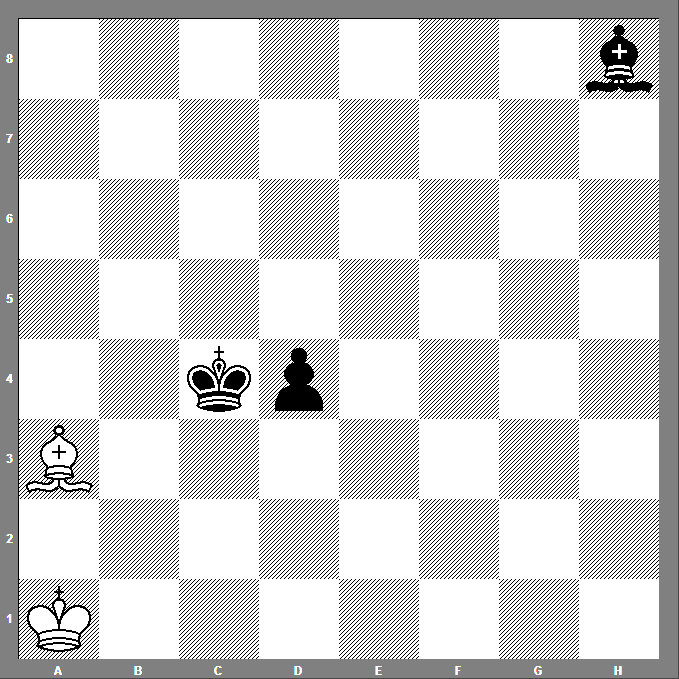
Black to move. Is this a win or draw? How should Black proceed?
7b/8/8/8/2kp4/B7/8/K7 b – – 0 1

Chess Daily News from Susan Polgar

Black to move. Is this a win or draw? How should Black proceed?
7b/8/8/8/2kp4/B7/8/K7 b – – 0 1
1…Kb3 to help the pawn along, rather than 1…d3+. the pawn should make it and convert to a white squared bishop (or knight, depending on how you like to play it).
Ok, we can immediately eliminate the moves of Kc3 and Kd3 as both lead to draws after white plays Bb2 followed by Bd4 removing black’s pawn and his winning chances.
In this position, black must prevent the white king from reaching the queening square while still holding his bishop since, once there, the white king will never be dislodged since he will be sitting on a white square. Let’s look at Kb3 first:
1. …..Kb3
Here, black has two threats-Ka3 and Kc2 (Kc2 permanently cuts off white’s king from defending the queening square). Here, white must move the bishop, but where? Let’s first look at Bc1 and Bb2:
2. Bc1 Kc2
And, again, the bishop must be moved. Moves like Bf4, Bg5, and Bh6 are essentially the same:
3. Bf4 d3
4. Ka2 Bb2 (preparing for Bc1)
5. Be3
Here, Bd2 loses to Kd2, and any move off of the c1/h6 diagonal loses to d2. Continuing:
5. …..Bc1
And now white must give up control of d2, and the pawn cannot be stopped.
At move 3 in the line above, white still loses with the alternatives:
3. Bb2 d3 (nothing else)
4. Ka2 d2 (Bb2?? is stalemate)
5. Bc1 dc1(R) (dc1Q is stalemate)
Or
3. Ba3 d3
4. Ka2
Or (4.Bb2 Bb2 5.Ka2 Bc3). Continuing:
4. …..d2
5. Bb2 d1(Q) wins.
Now, back to move # 2 for white, but from the top:
1. …..Kb3
2. Bb2 d3 (else, 3.Bd4=)
3. Kb1
This is the only move that doesn’t lose. Now, black has a problem- he can’t take at b2 since white would be stalemated. Black has only moves like Bg7/f6/e5/d4/c3, king moves like Ka4/b4/c4, or playing d2. Let’s take these in order:
3. …..Bf6 (Bg7/e5 etc. same)
4. Bc1
Of course, 4.Bf6 loses to d2, and 4.Kc1 loses to Bb2+. 4.Bc1 is the only move I see. Continuing:
4. …..Bb2
Here, Kc3 is no win since white plays Bf4 followed by Kc1 and Kd1 with a clear draw. On other bishop moves along the a1/h8 diagonal, white can just return the bishop to b2, or play Bf4/g5 etc. and the king subsequently to c1 and d1 with a draw in both cases; and bishop moves off the a1/h8 diagonal are draws after Bf4 followed by Kc1 and Kd1. Continuing:
5. Bf4
And what can black do? White has d2 covered, and any attempt to bring the king to e4 and the bishop to e3 will be far too slow as the white king moves over to d1, and
5. ….Ba3 is a draw after
6. Bd2 Kc4
7. Ka2 Bb4 (Bc5 8.Kb1 Ba3=)
8. Bg5 Kd4 (Kc3 9.Kb1 Ba3=)
9. Kb1 Ba3 (else, 10.Kc1=)
10.Ka2=
So, at move 3 in the line above, black must try one of the other alternatives. I win continue in my next comment due to length.
In my previous comment, I had started an analysis on the only forward moving king move of black’s that isn’t a quickly proven draw-Kb3, and had shown that the following line was a draw:
1. …..Kb3
2. Bb2 d3
3. Kb1 Bf6 (Bg7/e5 etc. are same)
4. Bc1 Bb2
5. Bf4 and see my previous comment for the analysis of this line. At move 3, black had two other basic alternatives to the bishop moves along the a1/h8 diagonal- king moves like Ka4/b4/c4 and the pawn move of d2. I will now continue with those:
3. …..Kc4 (Kb4 and Ka4 are same)
4. Bh8 d2 (else, 5.Kc1=)
5. Kc2 with a draw.
Finally, for this line:
3. …..d2
4. Bc1
This is the only move for white that doesn’t lose. Black cannot take at c1, obviously, and playing d1(Q) or d1(R) both are stalemate as white’s bishop is pinned. Since white is threatening Bd2 on the next move with a draw, then this leaves only the two underpromotions to knight or bishop- d1(N) and d1(B). Taking each in order:
4. …..d1(N)
5. Bg5 and I simply don’t see a mate here at all after looking at it for 15 minutes. As soon as white’s king escapes the edge of the board, he will be in a known draw for sure, and I don’t see how black can prevent this from happening with the white bishop in control of c1, d2, and e3.
The underpromotion to bishop is more promising, however:
4. …..d1(B)
And, now white is in deep trouble as black is threatening Bc2# and white has only bishop moves to b2 or a3, or along the other squares of the c1/h6 diagonal, but it is easy to see these are all mates or forced loss of the bishop:
5. Bb2 Bc2 (Bb2?? is stalemate)
6. Kc1 Bb2
7. Kd2 and this is a mate that is much, much easier to enforce than the knight+bishop mate as the two bishops are easily coordinated with the king to push white back onto the edge of the board and finally into a corner. Or
5. Ba3 Ka3 with a win, of course. Or
5. Bf4 Bb2 with mate on the next move. This of course holds for all the other bishop moves at move 5 along the c1/h6 diagonal.
So, black can win with 1. ….Kb3.
I haven’t looked at the other possible lines for black, but why bother?
I think it should be a win for black. There seems to be one trick in this (stalemate).
1 … Kb3
2. Bb2 d3
3. Kb1 d2
4. Bc1 d1B (this is the trick – d1Q or D1R is stalemate d1N is probably a draw).
Now it’s a won game.
5. Bb2 Bc2+ (Bxb2 is stalemate)
6. Kc1 Bxb2 (now it’s a KBB v K mate)
5. Ba3 Kxa3 (now it’s a KBB v K mate)
5. Any other Bishop move Kb2
6. Any Bishop move Bc2++
This is a win for black.
The first few moves are
1… Kb3
2.Bc1 Kc2
3.Bg5 (or another sq on that diag)
3… d3+
4.Ka2
Now the winning method is to force the white B to defend on the a5-e1 diagonal and then intercept with Bc3 e.g.
4… Bc3
5.Bf4 Bd2
6.Bc7 Bg5
7.Ba5 Bf6
8.Be1 Bc3
And now the pawn pushes through.
White can move his king instead of his B at a couple of points but iti makes no difference to the method.
1…Kb3 wins.
1) 2.Bc1 Kc2 3.Bh6 d3+ 4.Ka2 Bb2 , after that Bc1 and d2 and wins
2) 2.Bb2!? d3 3.Kb1 d2 4.Bc1 – interesting chance, but :
4.d1=B! Bh6 5.Bb2! and next Bc2#
It’s win for black:
1…Kb3 2. Bb2 d3! {2…Bxb2? stalemate} 3. Kb1 d2 0-1
1…Kb3! 2.Bb2 d3! 3.Kb1! d2! (3…Bxb2? stalemate) 4.Bc1! d1(B)!! (queening or rooking the pawn is stalemate, and knighting only draws) 5.Bd2 (or Be3, Bf4, etc.; 5.Bb2 Bc2+! wins) Bb2! 6.any Bc2#. Instead of 2.Bb2, 2.Bc1 is also a try, but after 2…Kc2! Black wins easily, e.g. 3.Bf4 d3+ 4.Ka2 Bc3 5.Bg5 Bd2 6.Be7 Bh6 7.Bb4 Bf8! 8.Be1 Bg7 followed by 9…Bc3 and the pawn queens.
A very nice underpromotion in Bishop does the trick!
Raw solution:
1… Kb3 2. Bb2 d3 3. Kb1! d2!! (Bxb2?) 4. Bc1! d1B!! (d1Q?; d1R?) 5. Bb2! Bc2+ (Bxb2?) 6. Kc1 Bxb2+.
Explanations:
1… Kb3 (important move, because takes the c2 square. 1…d3+ is useless because of 2.Kb1 d2 3.Kc2)
2. Bb2 d3 (seems decisive, because 3.Bxh8 d2 and the pawn is unstoppable but…)
3. Kb1! and black must work hard
3… Bxb2? Stalemate!
3… d2!! and the promotion IS unavoidable but see the spectacular
4. Bc1!
4… d1Q? (d1R?) Stalemate again! Black must there work harder because of the threat 5.Bxd2 but a promotion is still possible…
4… d1B!! Over? White has a last gasp with
5. Bb2! again, with a deja-vu stalemate if 5…Bxb2? but this is the end after
5…Bc2+
6. Kc1 Bxb2+ and the rest is I hope an elementary win for all the readers here.
After having trying solving it WTB (without the board), I’ve checked my trusty database…
Although the idea is old (Centurini in 19th century), this very position (with colours reversed naturally) is from Merkin, 1934, source unknown.
And (sob, sob) I’ve forgotten two lines in my analysis.
1) How Black wins fast after 1…Kb3 2.Bc1 ?
2) What is the main line after 4…d1B!! ?
For the solution being complete, I must’ve seen these two lines. Can you analyse and explain them?
Regards!
Cortex
PS : I’ve found the underpromotion idea only because I was aware of it… An OTB player who doesn’t work his tactical skill with (yesteryear) studies can easily miss it. So thanks, webadmins!
It seems not very difficult
1. … Kb3 (get a tempo)
and now some variants
(A)
2. Bb2 d3, d2, d1Q
(B)
2. Bc5 (d6,e7,f8) d3+
3. Kb1 d2 etc.
(C)
2. Bc1 Kc2 (get another tempo)
3. Bf4 d3+
4. Ka2 Bb2
5. Bg5 Bc1 etc.
1…Kb3 2.Bc1
(2.Bb2?? d3! -+ 2.B b4-f8 d3+ 3.Kb1 d2 -+ )
2….Kc2! 3.Bh6 d3+ 4.Ka2
now just for fun you improve the position of the bishop
4…Bg7! 5.Bg5 Bf6 6.Bf4 even if it is completely irrelevant…..
6….Bb2! and the diagonal is taken away from the White bishop from c1, which means the pawn isn’t blocked = White bishop doesn’t have time to go towards a5-e1 diagonal
0-1
Black wins.
1. …Kb3
2.Bc1 Kc2
3.Bg5 d3+
4.Ka2 Bb2
5.Be3 Bc1
and the bishops are exchanged and the
pawn promotes or the bishop abandons
the c1-h6 diagonal and the pawn goes
to d2 and then d1=Q and white should
win easily. White could try
2.Bb2 d3
3.Kb1 d2 and the pawn is unstoppable
3.Bc3 Kxc3
4.Kb1 Kd2
5.Ka2 Kc2 and the pawn promotes.
If at move 3 the bishop goes to any
other square along the a1-h8 diagonal
including taking the bishop at h8, the
pawn moves to d2 and then promotes on
the next move.
If at move 2 the white king tries to get
in front of the pawn, then black just takes
the bishop at a3 then moves to the c2 ore2
square to advance the pawn to promotion using
the bishop at h8 for tempo moves.
There’s no point asking “Is this a win or a draw” if you then ask “How should black proceed”, since it’s as good as telling everyone that with best play, black wins.
😉
The obvious move- Pawn push check- Gives white the oppurtunity to control the pawn’s path and take it or exchange the bishops causing ablack to lose its pawn…
Therefore..
1)…. Kb3( attacking the bishop and gaining a tempo which gives black the oppurtunity to give the pawn a safe passage to the 8th rank)
2)Bc1 ( If Bb2 blakh pushes the pawn forcing the bishop out of the pawn’s way or simply beat the white king to the 8th rank)… Kc2 3)Bg5 (is the best move because if Bb2 same thing will happen as explained before, if Ba3 black will simply beat the bishop to the 8th rank due to another tempo with D3+)…. D3 + 4)Ka2 Bb2 or c3 with te plan to exchange the whites bishop leaving the pawn no obstacles in its way, therefore black wins.
😀