It looks to me like 1. Kg7 wins. If 1… a3 then 2. f8=Q. Then if 2…a2, 3. Qb4 and get the king over (the bishop keeps it from being stalemate.) If 2… Kb2 then 3.Qb4+ Ka2, as above.
stalemating the black king and pawn. White then marches his king to a3 (whilst black shuffles his bishop about), and once it gets there, white plays Qe1+, and the interposing …Bb1 is met by Qc3 mate.
Well it is not that easy. 1. Ke7 a3 2. f8Q a2 and what is next? Without the bishop it is a theoretical draw due to stalemate mottifs, so black would actually like to get rid of the bishop. 3. Kxd7 therefore cannot win and approach like 3. Qb8 (with the intention of getting king closer) Bb5! does not apparently help much.
This helps us to find the better first move. King on e7 is blocking queen! So it seems as: 1. Kg7! a3 2. f8Q a2 3. Qb4! (this is the difference – black cannot put bishop in front of queen and he loses vital tempo) Ba4 4. Kf6 Bb3 5. Ke5 and now the king is in winning zone! so white does not mind to take bishop anymore 5. … Kb2 6. Qd2+ Bc2 7. Qd4+ Kb1 8. Qb4+ etc.
The game is not as easy as it appears. White can clearly queen his pawn but will have lots of difficulty preventing the black pawn from queening too. I think i have seen similar positions to this that were draws however in those positions black did not have an extra bishop. The bishop seems to be the key piece working against black!! White should not capture the bishop but rather keep it on the board to avoid stalemating the black king. If white can get his queen to the b file while the black king is trapped on the a file then white can simply march his king down the board to assist in the checkmate.
Probably 1. Kg7 is the best first move, since it doesn’t block the a3-f7 diagonal. This win will have to happen very precisely. Because of 1.Kg7, black must play 1. … a3 or they will not be able to play it after 2. Q=f8. 2… a2 since leaving the pawn on the third rank loses it.
The question is, where does black move the bishop in order to draw, when the position would be drawn without the bishop.
A tempting plan would be 3. Qb4, and march the king to c1 after which Qb2#, but what can black do to stop this? Cannot see anything, so perhaps there is a fortress without moving the pawn so far? Ah, can’t see it.
White wins becasue the normal R-pawn stalemate defences don’t work with the B on the board.
1. Kg7 a3 2. f8=8 a2 3. Qa3 threatening Qc1 mate. 3… Kb1 4. Qb3+ Ka8 5. Qc2 this would be stalemate without the B 5… Bf5 6. Qc1+ Bb1 7. Qc3 mate
BTW my 1st idea was to trap the black K and calmly walk the W K down the board to deliver mate but black can defend against that by saccing the B or blocking the b-file. E.g. 1. Ke7/g7 a3 2.f8=q a3 3.Qb8 Bb4 or 1.Kg7 a3 2.f8=q a3 3.Qb4 Ba4 followed by Bb3
Hmm, there could be the idea that if white errs 1. Ke7, then the bishop can later obstruct: 1. …a3 2.f8=q Ba4! This would not be possible if the a3-f8 diagonal were not blocked.
The issue is, whether the bishop can, on the a4-d1 diagonal block checks so that black will actually be threatening to queen, once black has placed the pawn on a2.
But still can’t see a drawing line there, i feel white must be able to win.
Before the winning continuation is given, I’ll show why the obvious move doesn’t work:
1 Ke7? a3 2 f8=Q a2 3 Kd6
In order for White to win the Q vs RP ending, the King has to get to b3 the move after Black promotes the pawn, with Black’s King on b1 and White’s Queen on d2. Therefore, White can be no farther than two squares away from b3 after Qd2+ Kb1. Capturing the Bishop won’t work here, as the King won’t be nearly close enough.
3 … Kb1 4 Qf1+ Kb2 5 Qe2+ Kb1
Black must stay on the first and second ranks. A move such as 5… Kb3?? is met by 6 Qe5, and Black’s Queen will get to a1 and block the pawn until the King arrives to help.
6 Qd1+ Kb2 7 Qd2+ Kb1 8 Qb4+ Kc2!
And not 8… Ka1??, 9 Kd5 , followed by Kc4 and mate soon.
9 Qa3 Be6!
Black can’a afford to get behind the Pawn. 9… Kb1??, 10 Qb3+ Ka1, and White marches the King right in to c3 and mates shortly after.
10 Kc5
If White takes the Bishop, the King won’t be within 2 squares of b3 and therefore White won’t be able to win.
10 … Kb1!
Other moves lose. As one example, we’ll examine:
10… Bc5?? 11 Kxc5!
White is now withing two squares of b3.
11 … Kb1 12 Qb3+ Ka1 12 Qd1+ Kb2 13 Qd2+ Kb1
Now the White King advances.
13 Kc4 a1=Q 14 Kb3
White has arrived at the desired postion. And Black must give up the ueen to avoid mate.
With 10 … Kb1, White can make no progress.
In the original position, White wins with a simple maneuver.
1 Kg7! a3 2 f8=Q a2 3 Qa3
The point of Kg7: the diagonal is clear for White’s Queen to reach a3
3…. Kb1 4 Qb3+ Ka1
The silly 4… Kc1 would last a little longer, but the result wouldn’t change.
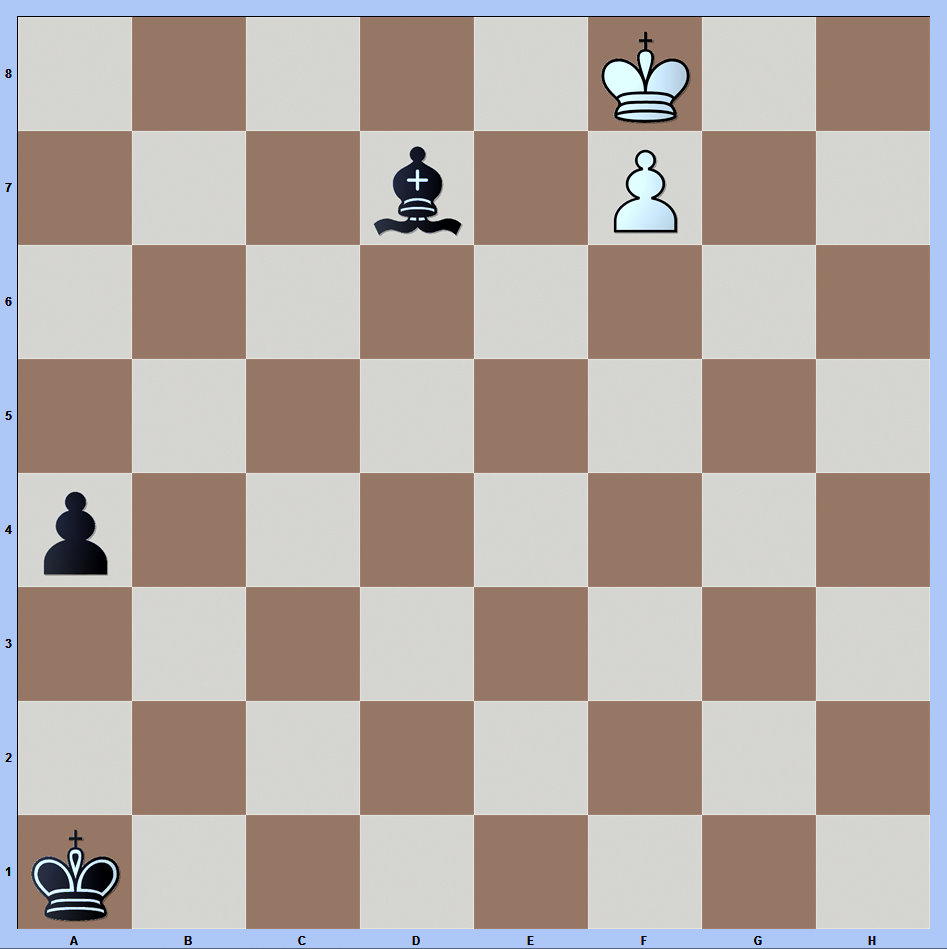


It looks to me like 1. Kg7 wins. If 1… a3 then 2. f8=Q. Then if 2…a2, 3. Qb4 and get the king over (the bishop keeps it from being stalemate.) If 2… Kb2 then 3.Qb4+ Ka2, as above.
Too easy. 1. Ke7 wins. Queen next move.
But, the black pawn could promote to Queen if White miss something.
At the end, you must to have a Q vs B endgame.
1.Ke7 a3
2.f8(Q) a2
3.Qf1+ Kb2
4.Qe2+ Ka1 (or Kc1)
5.Qd1+ Kb2
6.Qd2+ Ka1
7.Qb4,
stalemating the black king and pawn. White then marches his king to a3 (whilst black shuffles his bishop about), and once it gets there, white plays Qe1+, and the interposing …Bb1 is met by Qc3 mate.
1.Ke7 Be6 2.f7=Q #Black resigned
Well it is not that easy.
1. Ke7 a3 2. f8Q a2 and what is next?
Without the bishop it is a theoretical draw due to stalemate mottifs, so black would actually like to get rid of the bishop. 3. Kxd7 therefore cannot win and approach like 3. Qb8 (with the intention of getting king closer) Bb5! does not apparently help much.
This helps us to find the better first move. King on e7 is blocking queen! So it seems as:
1. Kg7! a3 2. f8Q a2 3. Qb4! (this is the difference – black cannot put bishop in front of queen and he loses vital tempo) Ba4 4. Kf6 Bb3 5. Ke5 and now the king is in winning zone! so white does not mind to take bishop anymore
5. … Kb2 6. Qd2+ Bc2 7. Qd4+ Kb1 8. Qb4+ etc.
The game is not as easy as it appears. White can clearly queen his pawn but will have lots of difficulty preventing the black pawn from queening too. I think i have seen similar positions to this that were draws however in those positions black did not have an extra bishop. The bishop seems to be the key piece working against black!! White should not capture the bishop but rather keep it on the board to avoid stalemating the black king. If white can get his queen to the b file while the black king is trapped on the a file then white can simply march his king down the board to assist in the checkmate.
Probably 1. Kg7 is the best first move, since it doesn’t block the a3-f7 diagonal. This win will have to happen very precisely. Because of 1.Kg7, black must play 1. … a3 or they will not be able to play it after 2. Q=f8. 2… a2 since leaving the pawn on the third rank loses it.
The question is, where does black move the bishop in order to draw, when the position would be drawn without the bishop.
A tempting plan would be 3. Qb4, and march the king to c1 after which Qb2#, but what can black do to stop this? Cannot see anything, so perhaps there is a fortress without moving the pawn so far? Ah, can’t see it.
White wins becasue the normal R-pawn stalemate defences don’t work with the B on the board.
1. Kg7 a3
2. f8=8 a2
3. Qa3 threatening Qc1 mate.
3… Kb1
4. Qb3+ Ka8
5. Qc2 this would be stalemate without the B
5… Bf5
6. Qc1+ Bb1
7. Qc3 mate
BTW my 1st idea was to trap the black K and calmly walk the W K down the board to deliver mate but black can defend against that by saccing the B or blocking the b-file. E.g. 1. Ke7/g7 a3
2.f8=q a3 3.Qb8 Bb4 or 1.Kg7 a3 2.f8=q a3 3.Qb4 Ba4 followed by Bb3
The only move that wins seems to be Kg7 according to the tablebases. Ke7 draws and Kg8 even loses (to Be6).
Hmm, there could be the idea that if white errs 1. Ke7, then the bishop can later obstruct: 1. …a3 2.f8=q Ba4! This would not be possible if the a3-f8 diagonal were not blocked.
The issue is, whether the bishop can, on the a4-d1 diagonal block checks so that black will actually be threatening to queen, once black has placed the pawn on a2.
But still can’t see a drawing line there, i feel white must be able to win.
1Kg8 a3 2e8=Q a2 3 Qb4 ka2
Black king will come
NO qestion of stale mate
Why are things like this called “endgame improvement”? These composed positions do little to improve your endgame.
Before the winning continuation is given, I’ll show why the obvious move doesn’t work:
1 Ke7? a3
2 f8=Q a2
3 Kd6
In order for White to win the Q vs RP ending, the King has to get to b3 the move after Black promotes the pawn, with Black’s King on b1 and White’s Queen on d2. Therefore, White can be no farther than two squares away from b3 after Qd2+ Kb1. Capturing the Bishop won’t work here, as the King won’t be nearly close enough.
3 … Kb1
4 Qf1+ Kb2
5 Qe2+ Kb1
Black must stay on the first and second ranks. A move such as 5… Kb3?? is met by 6 Qe5, and Black’s Queen will get to a1 and block the pawn until the King arrives to help.
6 Qd1+ Kb2
7 Qd2+ Kb1
8 Qb4+ Kc2!
And not 8… Ka1??, 9 Kd5 , followed by Kc4 and mate soon.
9 Qa3 Be6!
Black can’a afford to get behind the Pawn. 9… Kb1??, 10 Qb3+ Ka1, and White marches the King right in to c3 and mates shortly after.
10 Kc5
If White takes the Bishop, the King won’t be within 2 squares of b3 and therefore White won’t be able to win.
10 … Kb1!
Other moves lose. As one example, we’ll examine:
10… Bc5??
11 Kxc5!
White is now withing two squares of b3.
11 … Kb1
12 Qb3+ Ka1
12 Qd1+ Kb2
13 Qd2+ Kb1
Now the White King advances.
13 Kc4 a1=Q
14 Kb3
White has arrived at the desired postion. And Black must give up the ueen to avoid mate.
With 10 … Kb1, White can make no progress.
In the original position, White wins with a simple maneuver.
1 Kg7! a3
2 f8=Q a2
3 Qa3
The point of Kg7: the diagonal is clear for White’s Queen to reach a3
3…. Kb1
4 Qb3+ Ka1
The silly 4… Kc1 would last a little longer, but the result wouldn’t change.
5 Qc2 Bc5
6 Qc1+ Bb1
7 Qc3#