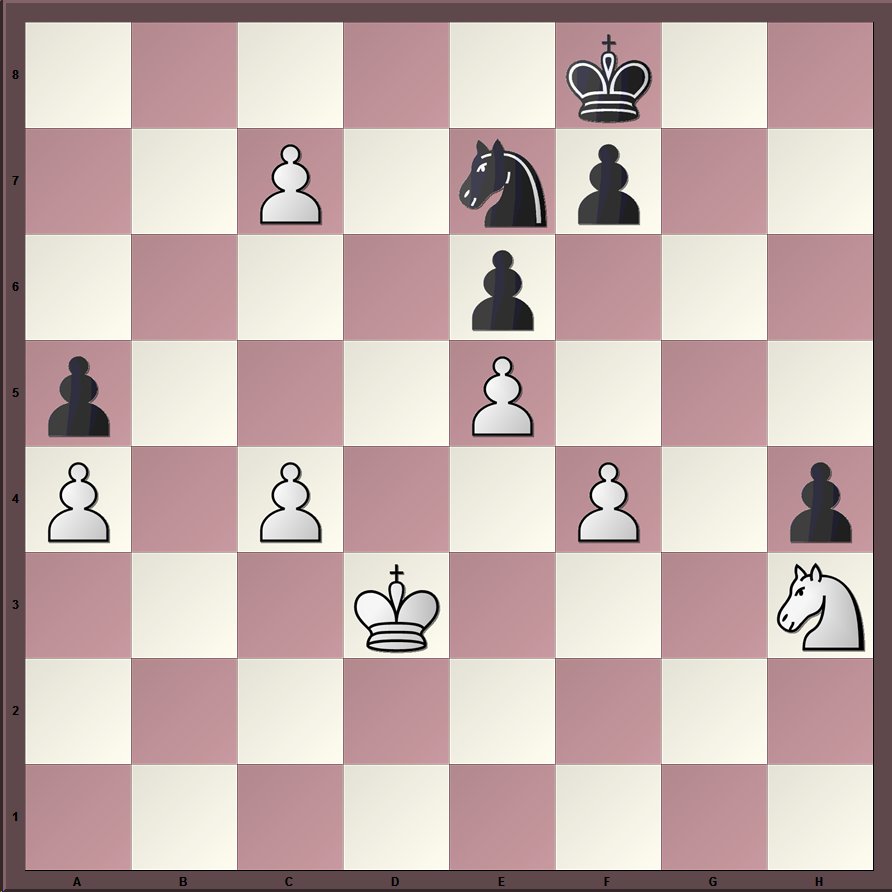
White to move. How should White proceed?
5k2/2P1np2/4p3/p3P3/P1P2P1p/3K3N/8/8 w – – 0 64
Wang Hao – Rublevsky (China – Russia match 2010)

Chess Daily News from Susan Polgar

White to move. How should White proceed?
5k2/2P1np2/4p3/p3P3/P1P2P1p/3K3N/8/8 w – – 0 64
Wang Hao – Rublevsky (China – Russia match 2010)
Black wins due to the outside passed pawn. White should resign. Or, play a pawn to b8 quickly and hope that he gets away with it.
Kd4 then Kc5 – White wins.
Anon above:
I don’t think Kd4 and Kc5 wins. Ex:
1. Kd4 Ke8
2. Kc5 Kd7
3. Kb6 Kc8
and it isn’t clear to me how white wins. Maybe the two passed pawns are good enough, but the knight is still tied down so I doubt it.
I think there is a pretty simple plan for white here though.
1. c5 Ke8
2. c6!
Black is basically stuck. The king can’t stop the pawn from queening, and the knight can’t move. So white is free to march the K to b7 and promote the pawn.
1.c5 followed by c6 of course, and black is doomed. Hardly a puzzle at all.
The key is to block the Black King from the Queenside.
1. c5! Ke8 (or Kg7)
2. c6!
Now the black King is cut off. If the black Knight takes on c6, the pawn Queens on c8. The rest is easy, White moves his King to stop pawn on h4 and then his Knight picks off the black pawns.
Obviously white wants to promote on the queenside. The black knight can’t move far at least until the king can secure c8. So Kd4 Nc6+ (Ne6) don’t accomplish much after Kc5. The knight has t go back or white will get a queen.
So Kd4 Ke8 Kc5 Kd7 lets try Kb6 black should probably block with the king since Nb8 is vulnerable to Kb7 followed by c5 c6 chasing the black king.
Kd4 Ke8 Kc5 Kd7 Kb6 Kc8 Kxa5 Kxc7 Kb6 Nc6 and if white can win it will be a long time coming, longer than an puzzle.
The problem with that line was the king getting into d7. Can white keep him out?
Lets try c5 and c6. With the second pawn on c6 the king can’t approach. If the knight takes on c6 it’s a queen on c8. The black knight has no checks so any move will result in a queen.
Much better, I don’t see how black stops that. Once the second pawn is on c6 with the frozen knight white just marches the king over to complete the win
c5, c6. and black can’t get at the pawns, so white then grabs the a-pawn with the king and wins.
Avanzar el peon de c5, haciendo hasta llegar a c6 haciendo una barrera que no permite pasar al rey, mientras que el caballo se mantiene inmovilizado por cuidar c8, mientras tanto el rey blanco puede acercarse a la coronacion mediante su diagonal hacia el flanco de dama para apoyar a la coronacion en c8.. Facilisimo
White wins by playing c4 and then c5. Then he can pick up the h-pawn before brining his knight to d6 and promote the pawn.
1.c5 Ke8 only move 2.c6! and now White can capture all the pawns because black is completely tied to the c pawns
the c4-c6 advance will lock down black entirely: the knight can´t move, the king can´t access the d-file, the white king can easily walk up, take the a-pawn or help queening the c-pawns or maybe even not bother with them and queen the a-pawn rightaway. greets, jan
c4-c5-c6 blocks out black king while the white king can make merry with the a pawn.
Just saw the actual game and can’t believe it was missed in the game.
Let’s play with the most obvious line or two just to see where we stand:
1. Kd4 Ke8
2. Kc5 Kd7
3. Kb6
Now, the question is, what moves can black make at this point? He has Kc8, Ke8, Nf5, Ng6, Ng8, Nc8, and Nc6. From just 1st principles, I favor Kc8, but let’s look at the others to see why one should prefer it:
3. …..Ke8
4. Ka6 Ke7 (what else has chance?)
5. Kb6 and how does black stop the a-pawn? Or
3. …..Nf5
4. Kb7 Ne7 (what else?)
5. c5 and it is zugzwang for black. The same fate awaits the options of Ng8 and Ng6. Or
3. …..Nc6
4. c8(Q)Kc8
5. Kc6 wins easily for white. Or
3. …..Nc8
4. Kb7 Ne7 (f6 or f5 lose, too)
5. c5 and black is in zugzwang again. So, this leaves only the move that I liked best:
3. …..Kc8
And now white needs an additional plan. The obvious move to create the passed a-pawn:
4. Ka5 Kc7 (forced, I believe)
5. Kb5 Here, I can’t easily see what is best for black. The combination of the knight and the king should be enough to hold this with both white pawns only on the 4th rank, and white’s knight seems tied down to blocking or guarding h3. The simple
5. …..Kb7 looks ok to me
6. Kc5 Nf5 (keeps white out of d6)
Here, all I can see to try is a5 to force the black king to give up control of c6:
7. a5 Ka6
8. Kc6 Ka5
9. c5 Nd4
10.Kd7 Kb5
11.Ke7 Kc5
12.Kf7 Kd5 and I don’t see a win here for white, and I can’t be sure that black doesn’t have the upper hand here. So, this line starting with 1.Kd4 and 2.Kc5 looks drawish at best for white. However, I have another idea now that I have worked through this line. Continued in my next commnent.
In my previous comment, I looked at the line where white brings his king to b6, forcing black to bring his to c8. While not certain (I didn’t do a completely thorough analysis), that line looked drawish with proper play. What struck me as I was playing the ending part of it was just how slow everything white did on the queenside really was. The c7 pawn seemed to serve no real purpose, and white was force to give it up to make what little progress he was able to obtain. So, the question is, why even bother with? Black still has to come to get it or keep the knight watching it, so why waste valuable time going all the way to b6 to win a5 when there is a more direct approach that has the added benefit of coming with a true stinger of move in reserve?
1. c5!
Clears the way for Kc4, Kb5 and Ka5. Now black has poor choices- either try to defend on the queen side by bringing the king over, or trying for counterplay on the kingside. Counting moves suggest kingside counterplay won’t work, but trying bringing the king to the queenside is worse, because white now has a killer move in reply:
1. …..Ke8
2. c6!
Cutting the king off from the queenside altogether. The knight, obviously can’t take it due to c8(Q) winning. There is no defense now. The white king will march in and queen either a c-pawn or the a-pawn, and black can only watch helplessly.
The other plan, trying for kingside counterplay is just too slow by my count:
1. c5 Kg7
2. Kc4 Kg6
3. Kb5 Kf5
4. Ka5 Kg4
5. Ng1 Kg3 (h3 won’t help-Q needed)
6. Kb6 Kg2
7. a5 Kg1
8. a6 h3 (Nc8 is below)
9. a7 h2 (Nc8 is below)
10.a8(Q) and white will exchange the queens, win the knight in exchange for the c7 pawn, and queen the remaing c-pawn to win the game. At moves 8 and 9, black can do no better by trying to prevent the queening of the a-pawn with Nc8 by either getting the white king on a7, or taking at a7:
8. …..Nc8
9. Kb7 h3 (Na7 below)
10.Kc8 h2
11.Kb8 h1(Q)
12.c8(Q) and white will queen the a-pawn as well for a decisive edge. Or, at move 9 immediately above:
9. …..Na7
10.Ka7 h3
11.c8(Q)h2
12.Qh8 and white sacs at h1 and white queens another pawn. And, finally, at move 9 in the previous line
9. a7 Nc8
10.Kb7 Na7
11.Ka7 h2
12.c8(Q)h1(Q)
13.c6 Qe4
14.c7 Qd4
15.Kb8 Qf4 (Qb4 16.Qb7 Qf8 17.c8Q)
16.Qg8 Kf2
17.c8(Q)Qe5
18.Qc7 Qc7 (no perpetuals here)
19.Kc7 f5
20.Kd6 f4
21.Ke5 f3
22.Qg4 and there is no hope of a stalemate, either.
I may well have missed shorter wins for white above- there was at least one place where white probably could have gained an additional tempo by forcing black to take the knight at h3 at move 7 above.
White enjoys an extra pawn. However, that advantage is nullified by it being doubled, and his knight being on the rim (is dim). Draw.
White’s c7 pawn is a monster but Black’s Knight is holding it up and Black threatens Ke8/Kd7/Kxc7.
1. c5! followed by 2. c6 puts paid to that idea. White’s pawns cover d8, d7, and d6, barring the Black King entry. The Black Knight is tied to c8 and cannot wander far.
Of course, it is not enough to prevent Black from winning… White must also try to win!
First I looked at marching the King up Kc4/Kb5/Ka6/Kb7 followed by sacrificing one c-pawn for the Blcak Knight and then queening the other c-pawn but that seems to allow Black more counterplay on the Kingside than Black deserves.
Better – Ke2/Kf3 sealing up the kingside, then Nf2/Ne4/Nd6 followed by sacrificing one c-pawn for the Black Knight and then queening the other c-pawn. I don’t see a way for Black to counter this.