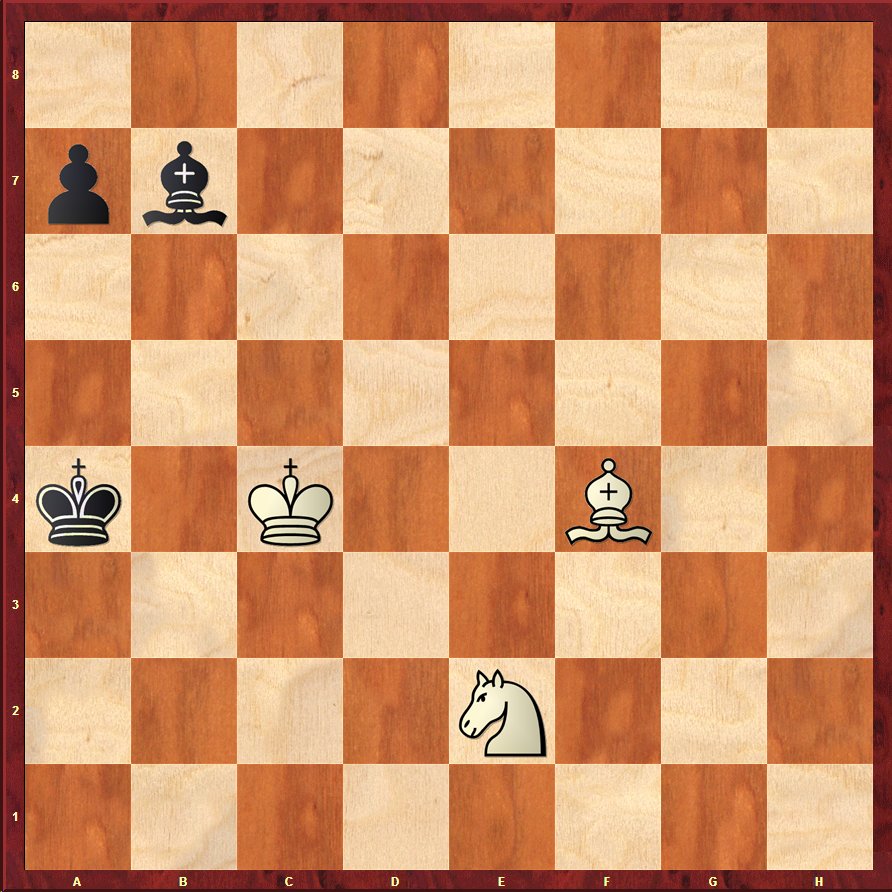
White to move. Is this a win or draw for White? How should White proceed?
8/pb6/8/8/k1K2B2/8/4N3/8 w – – 0 2

Chess Daily News from Susan Polgar

White to move. Is this a win or draw for White? How should White proceed?
8/pb6/8/8/k1K2B2/8/4N3/8 w – – 0 2
1. Nc3+
1. … Ka3
2. Bc1++
1. … Ka5
2. Bc7+ Ka6
3. Na4 (or e4) bishop must move
4. Nc5++
1.Nc3+ Ka3 2.Bc1 mate
or 1.Nc3+ Ka5 2.Bc7+ Ka6 3.Na4 and Black has to play 3..Bd5+ 4.Kxd5 when it’s a simple win for White
Its like 1.Nc3+ then if Ka3 2.Bc1#and if Ka5 3.Bc7+ Ka6 4.Na4 with idea of 5.Nc5#,but if 4..Bc5+ then its a technical .
Trap the King!
Nc3+
If Ka3 Bc1#
If Ka5 Bc7+ Ka6 Na4 and Nc5# next move
Well, White loses control if she doesn’t act promptly to either checkmate Black or force Black to give up her bishop. This can be
forced, and then White has to force the win of the pawn. Then it is a matter of proceeding with the “elementary” mate of bishop and knight versus lone king.
1. Nc3+ Ka3?
2. Bc1#
That’s the easy part. Only 1 point for that, right? 1/2 point, maybe?
1…. Ka5
2. Bb7+ Ka6
3. Na4 Bd5+
(The only move to prevent mate by 4. Nc5#)
4. Kxd5 1 point?
Now Black has 2 choices, Kb7 and Kb5.
4…. Kb7 loses fairly quickly in most variations but there is a
good stalemate try in one of the sub-variations.
5. Kd6
5…. Ka6 Nice try for a stalemate.
6. Nc3 Kb7
7. White wins but its going to take a long, long time in this variation.
5…. a6?
6. Nc5+ Ka7
7. Ba5 K moves
8. Nxa6 Then it’s “elementary”.
5…. Kc8??
6. Kc6 P moves
7. Nb6#
5…. Ka8
6. Kc6 a5
7. Nb6+ Ka7
8. Nc8+
8…. Ka8
9. Kb6 a4
10. Ka6 a3
11. Nb6#
8…. Ka6
9. Bb6 a4
10. Nd6 a3
11. Ne4 a2
12. Nc5#
The other 4th move for Black is
4…. Kb5, and I suppose that this is the
“main” variation.
4…. Kb5
Then White probably plays 5. Nc5 ,
and I can see that this is going to take hours and hours of analysis that the Nalimov database
(which I have refrained from accessing) can work in an instant, so I as a human, whose time is supposedly valuable, am going to retire, and go to sleep.
Lucymarie
Nc3 wins
Mate in 4 followed by Nc3+
1.. if Ka5
2. Bc7+ Ka6
3. Na4 black bishop moves (king cannot)
4. Nc5#
1.. if Ka3
2. Bc1#
I can see a draw here.
1. Nc3 Ka5 2. Bd2
White wins.The difficult bishop and night ending.
Initial moves are like this
1)Nc3+ Ka5
2)Bc7+ Ka6
3)Na4 Bd5+
4)Kxd5 Kb5
5)Nc3+ Kb4
6)Na2+ Kb3
7)Nc1+ kc2
8)Ne2 Kd2
9)Nd4 Kc3
10)Nb5+ Kd3
11)Nxa7 Ke3.
Now bishop and night ending.
White wins like this.
S.Krishnamurthy
I am guessing this is a win since why post it it otherwise:~)
How to start? The white king can’t move because this lets black off the edge, and once off, I doubt you can get him back there. This also means that the bishop can’t move either since it can’t check black, and black is threatening Ba6 to obtain an immediate draw. This leaves only moving the knight first. Of the knight moves, I would want a move that drives the black king one direction or the other, and takes control of a4. Of course, black has only one reply to this first move of white’s
1. Nc3 Ka5 (Ka3?? 2.Bc1#)
Now, here, there were few options like Be3, Bc7, Kc5 that keep black pinned down, but one looks better than the others
2. Bc7 Ka6
Now, I have the sort of position I wanted, the black king hemmed in against his pawn and bishop, and threatening a two hop knight maneuver to deliver the mate while cutting off the b7 escape hole.
3. Na4 Bd5 (anthing else is mate)
4. Kd5 And this should be a win. I was hoping to find a win with black’s bishop still on the board, but, alas, this will have to be the standard king, knight, bishop mate. A plausible continuation might be
4. …..Kb5
5. Nc3 Kb4
6. Kd4 Kb3
7. Ne4 Kb4
8. Bd6 Kb5
9. Bc5 a5 (Ka6 10.Nd6; a6 10.Kd5!)
10.Kd5 a4 (Ka6 11.Kc6 a4 12.Bd6)
11.Nd2 Ka5(Ka6 12.Kc6 Ka5 13.Nc4)
12.Nb1 a3 (Kb5 13.Na3 Ka6 14.Kc6)
13.Na3 and the pawn is gone. It is a good exercise to practice this mate against an engine if you have one. To be honest, I could probably work it all out from here, but there would be so many subvariations to cover, that it would take me the rest of the afternoon to do this exhaustively, and I am just too damned lazy.
Hello
1. Nc3+ , Ka5 ( Ka3 2. Bc1# )
2. Bc7+ , Ka6
3. Na4 , Bd5+ ( any other movement 4. Nc5# )
4. Kxd5 winning
Greeting from Spain
Hi can anyone tell me why i said it is a draw and my move sequence is 1. Nc3 Ka5 2. Bd2 ??