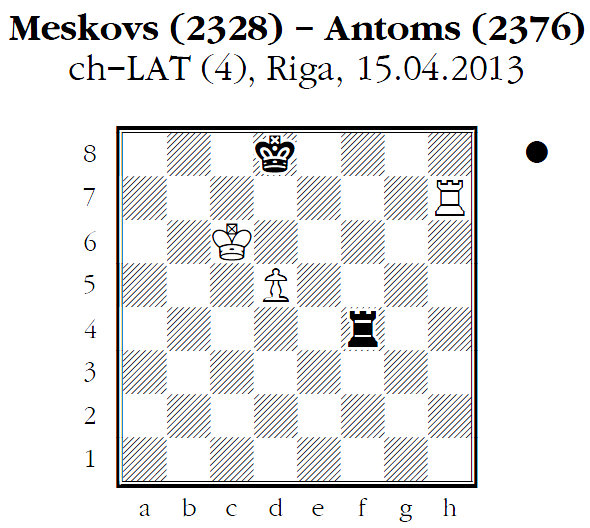
Black to move. Is this a loss or draw for black? How should black proceed?
Source: ChessToday.net
Chess Daily News from Susan Polgar


Black to move. Is this a loss or draw for black? How should black proceed?
Source: ChessToday.net
A classic R+P vs R ending, and I am pretty sure there is only one drawing move for black. However, let’s take a look at the two checking moves first to see how white hopes to win this:
1. …..Rf6??
2. d6!
And now white is threatening a back rank mate. If the king attempts to escape via e8, white is just going to win by queening, or threatening to queen the pawn. So, black can either preemptively block the threat of Rh8#, or prepare to block by playing Re6:
2. …..Re6
3. Rh8 Re8
4. Re8 Ke8
5. Kc7+-
Or
2. …..Rf8
3. Ra7
Threatening the mate from the other side:
3. …..Ke8 (only move)
4. Ra8 Kf7
5. Rf8+-
So, let’s back up to move 1 and examine the check from c4:
1. …..Rc4??
2. Kd6!
Again, threatening a mate on the back rank. We have already basically seen that the attempts to block this mate with the rook will fail, so let’s look at the king escapes:
2. …..Kc8
3. Rh8!
I am not completely sure this is the only winning move, but I am fairly confident it is. White, of course, cannot play Ke7 without allowing the skewer from c7, and he cannot play a move like Ke6 without allowing black to find the drawing positions I will discuss later. Finally, if white tries Ke5, black will wait for white to push d6, and then wait for white to play either d7 or Ke6 to begin the endless checks of the white king (more on these later). Continuing from 3.Rh8! above:
3. …..Kb7
4. Kd7
Moves like Ke6 or Ke7 are equally good since the lines can easily be transposed amongst one another. However, you should remember this position with the white king on d7 and the pawn on d5- it means a lot to how the drawing line succeeds. As things now stand, the black king has been forced away from the queening square, all the way over to the b-file. Continuing from 4.Kd7 above:
4. …..Rc7 (options later)
5. Ke6! Rc1 (what else now?)
6. d6 Re1
7. Kd7
White can still win with Kd5 (also keeps the black king off of c6 for one move), but he will still have to play Kd7 a couple of moves later to make progress. Continuing:
7. …..Rd1
Black does no better planning checks from f7 or g7 since white will just play Kd8 with lines that will be similar to what is coming below:
8. Rh2
Planning the to check from b2 to drive the king further away from the d8 square. There are certainly other winning moves for white by this point, but this one is the most direct. While moves like Rh3 are also winning, they actually will lose a tempo in some lines as the black king can attack in time to force white to make extra moves. Continuing:
8. …..Rb1 (foiling white’s Rb2)
Nothing better for black. If he keeps the rook on the d-file, white just checks from b2 and leaves it there, and then puts his king on d8 followed by d7, Kc8, and d8. Simply put, the black rook cannot hold up the pawn by himself. Continuing:
9. Kd8
Also, 9.Rd2 should be equally good. Continuing:
9. …..Kc6
Nothing really better. Black plays Rd1, white will just play d7 anyway and you will get a transposition to what follows:
10. d7 Rd1 (what else now?)
11. Kc8
A seemingly bad move, but the pawn is indirectly protected:
11. …..Rd7 (what else?)
12. Rc2! Kd6
13. Rd2 and black loses his rook. This is a classic ending motif in such positions.
In my next comment, I will discuss how black draws the initial position.
In my previous comment, I showed how black can go wrong, and do so with quite “obvious” moves like 1. …Rc4. The weakness of such moves is that it gives white time enough to drive the black king away from the queening square. However, black has one move that foils all of white’s plans:
1. …..Rd4!
2. Kd6
I will discuss the alternatives later. Continuing:
2. …..Kc8 (Ke8 no different)
3. Rh8
Nothing will win, but I want to discuss this line first:
3. …..Kb7
And it would seem that white has driven the black king away like he did in my previous comment, however, there is one big difference- white would love to be able to play Kd7 followed by d6, but he can’t without dropping the pawn. This is the point of black’s first move. White can try to put the king on the e-file and push the pawn, but this allows black’s king to get back into the action:
4. Ke5 Rd1 (Rg4, Rd3/d2 draw too)
5. Ke6
If white plays d6, black gets the draw with Kc6- check it out. Contininuing:
5. …..Kc7!
Not 5. …Re1+. If black tries that, white will put the king on d7 and have time to push his pawn to d6. That is the position black must prevent. Kc7 prevents an immediate d6. Continuing:
6. Rh7
What else for white is better? Black is threatening Re1+ driving the white king away. If white puts the rook on h5 to block this check, black can just exchange the rooks at e5 and be left with a drawn K+P vs K ending instead (see below). Continuing:
6. …..Kd8 (Kc8 ok, too)
7. d6
Of course, Kd6 is pretty much just back to where we were after white’s move at move 2, but only now white can’t play Kc5/e5 to even attack the rook who is now sitting on d1. Let’s just continue down the 7.d6 line a bit:
7. …..Re1!
Only move, of course, and now the white king cannot evade the endless checks without leaving the d-pawn unprotected. In other words, he cannot walk the black rook down- once the white king crosses over the 4th rank, black returns the rook to d1, forcing Rh6 by white which allows Kd7 double attacking and winning the white pawn. This position is clearly drawn.
Finally, it makes no difference if white plays 2.d6 with the rook still at d4:
1. …..Rd4
2. d6 Rc4! (only move)
3. Kd5 Rc1
I think black will draw with some moves along the fourth rank, too, but am not 100% sure of it. Rc1 is just more direct in my mind. Now, black is just set to check along the 1st rank, and there is nothing white can do about it. The only line left to examine is 4.Rh5:
4. Rh5 Rd1
5. Ke6 Re1!
6. Re5 Re5 (simplest draw)
7. Ke5 Kd7! (drawn K+P vs K)
8. Kd5 Kd8!
9. Kc6 Kc8!
10.d7 Kd8
11.Kd6 with stalemate.