

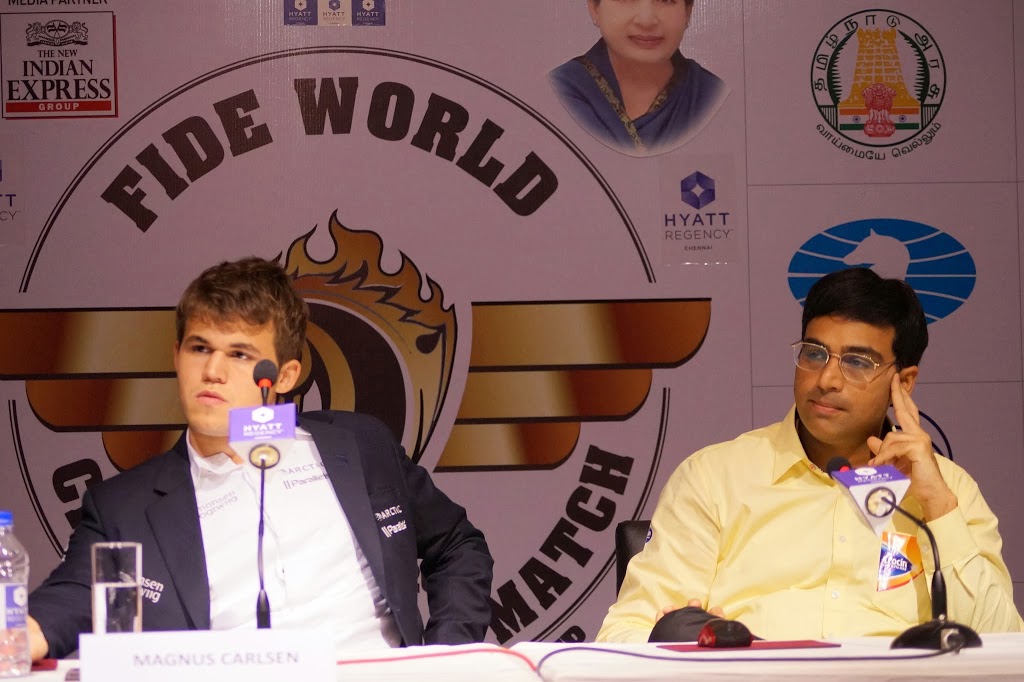
Viswanathan Anand’s endgame
In Anand’s failure, there are shades of Federer’s failure to come up with a viable strategy against the first player to challenge him when he was at his peak
G. Sampath
Viswanathan Anand has accomplished everything that a chess player could possibly want to. He has been a five-time world champion and in three different formats. He was the undisputed world champion for six years. He has been the world number one, and also the single biggest reason for a chess renaissance in his country. And he has been a tremendous ambassador for the game, having played at the elite level for well over a quarter of a century. He simply has nothing left to prove.
But today, as he turns 44 in a couple of weeks, he’s no longer the world champion. Many doubt that he could win the next edition of the Candidates Tournament so as to be able to challenge Magnus Carlsen for the world title in 2014. If his match play in the recently concluded world championship battle with Carlsen in Chennai is any indication, then Anand’s form is in clear decline. Grandmasters the world over have remarked how uncharacteristic were the blunders he made that eventually cost him the world title.
People have spoken of age as a factor in his downward slide. Another is his psychological vulnerability. Both these will be crucial when he sits down to figure out his future plans. Of course, there are tournaments he has already committed to, which he will play. But after having been the world champion for six years since 2007, to now compete with the next generation of players as one of the journeymen would be to embark on a laborious climb up a treacherous summit knowing full well that somebody younger, fitter, and stronger is waiting on top to shove you down immediately. It requires motivation and mental strength of an order of magnitude that was not in evidence during his title match with Carlsen which didn’t last the 12 games it was scheduled to.
The first clue that the champion was not at his prime any more was, of course, his strategy against the world number one. In his previous world title matches, Anand played to his strengths: his legendary opening repertoire and his supremacy in rapid chess. He played safe, and kept drawing games, knowing full well that if the scores were level at the end of the regular format, he could demolish the opponent in the tie-break or rapid games that would follow. Fully aware of this, and faced with draw after draw as the match progressed, his opponent would be forced to take more and more risks to force a victory and avoid a tie-break. In the process, in the later games, he would end up making mistakes, and play into Anand’s hands. This plan worked superbly against Veselin Topalov and Boris Gelfand. But it was never going to work against Carlsen. Yet Anand did not or could not move away from his tried and tested strategy.
So, rather than make his strengths count, by focusing on dictating the game through his superior opening preparations—which also happens to be the one area Carlsen could not match him—Anand chose to try and match Carlsen in end game wizardry. To his credit, he did manage to compete on an almost equal footing. But unfortunately he did not—and some would say, could not—have the staying power of someone two decades his junior.
The second problem Anand had was that Carlsen does not like to draw. He would rather play on and on for eternity in the expectation of squeezing out some advantage rather than settle for a draw. This meant that, from having to work hard for a win, Anand now found himself working hard for a draw—not exactly what you would expect of a world champion. And this is where the psychological battle was won by Carlsen. He has said as much in his many interviews—once he saw that the world champion was as nervous as he was, and playing conservative chess, the challenger knew he could relax and play his normal game, which he went on to do with devastating effect.
In Anand’s failure, there are shades of Roger Federer’s failure to come up with a viable strategy against the first player to challenge him when he was still at his peak—a younger, fitter and stronger Rafael Nadal. The only blemish in Federer’s glorious record is his failure to respond as a champion and stamp his superiority over Nadal. This failure, many would argue, has more to do with his mind than his game. Federer inevitably ended up playing to Nadal’s strengths—engaging in long rallies where the latter would eventually wear him out. Carlsen did the same to Anand. Just as Nadal kept the ball in play till the master committed an error, or ceded an opening for a winner, Carlsen kept moving the pieces around accurately till the champion made an error.
It was fairly evident that Anand’s safety-first approach was not going to take him very far. As Game 9 made clear, his only chance of beating Carlsen came when he played to his strengths—an all-out, blistering attack based on a strong opening preparation, and not letting go. It was a game he played like the “lightning kid” of yore, in the style his opponents feared and fans loved. He dominated, and he played fast and accurate chess—he was ahead of Carlsen on the clock for most of this game, up until the point where he spent 45 minutes over-analysing a move and blundered.
Anand lost that game—but it was also the closest he came to victory, and you cannot expect to be the world champion if you are not confident of going for a win every time. In almost all the earlier games, where Anand played safe, Carlsen comfortably equalized in the opening and middle games, and wore down the champion in the end game. Every time he lost, Anand basically succumbed to a combination of accurate play from Carlsen, exhaustion, and time pressure.
If instead, Anand had played attacking, high risk chess from Game 1, he might still have lost the title, but he would have played more like a champion than he did, and stood better chance of rattling his younger, less experienced opponent playing his first title match. Plus of course, it would have made for more scintillating chess.
It would be safe to say that if Anand chooses to continue playing competitive chess (Garry Kasparov retired at 41), then it can only be for the love of the game, for another world title would only make an incremental difference to his stature as one of the all time greats of the sport.
Given this, if he chooses to play on, he should consider reinventing his approach to the game; perhaps rediscover the fast and attacking style of play that distinguished the younger Anand. If he can manage that, one might even seen a second wind, where he might lose more but also win more. Besides, as the Federer-Nadal story showed us, there is no other way he can possibly compete with Carlsen, who, many say, is still some years away from his peak as a chess player.
Source: http://www.livemint.com
Anand should have asked Nakamura to help him.
Very poignant article, Susan. As someone who was rooting for Anand when playing Topolov, & now rooting for Carlsen to beat Anand, I think you’ve made some great points within this article. I’m curious to know, if YOU were Vishy, would you retire at this point, or take your suggestion and go for broke by reinventing your risk-taking tendencies?
As someone who was rooting for Anand vs. Topolov, and now rooting for Carlsen vs. Anand, I think you’ve hit the nail on the head. You’ve made some very poingnant remarks in this article, Susan.
I was curious to know, if YOU were Vishy, would you choose to retire at this point or go-for-broke & reinvent your risk-taking tendencies?
As someone who was rooting for Anand vs. Topolov, and now rooting for Carlsen vs. Anand, I think you’ve hit the nail on the head. You’ve made some very poingnant remarks in this article, Susan.
I was curious to know, if YOU were Vishy, would you choose to retire at this point or go-for-broke & reinvent your risk-taking tendencies?