Here’s a tutorial on how to solve problems like this really easily.
The first thing to try on every “is there a mate?” problem is: explore every possible check until you run out of them.
OK, let’s try that with this problem.
That forces our first move, the only possible check:
1.Qh8+ Ke7
(Black’s reply is forced.)
OK, apply the same reasoning again. Each of the Q, R and N can check. Since the Q checks look suicidal, let’s think about the R check (Rxe6+) and the N checks (Nxf5+,Nxc8+). If we do the R check, the black B can come into play; if we do Nxc8+, we don’t seem to get anywhere either, due to the recapture Rxc8; so that leaves Nxf5+:
2.Nxf5+ Kd7
Two features here tell us we’re “on the right track”: Black’s move is again forced (always a good sign, mid-problem-solving), and the e6 pawn “just happens” to be pinned by Re1, so we don’t lose our N.
Now apply our “explore the checks” approach again. We have a Q sac, Bb5+, or pawn move c6+. Of those, the most intuitive seems to be Bb5+, since it not only gets a piece into the action, it also opens the file for our Rd1:
3.Bb5+ Xc6
where “X” stands for “N or pawn”, one of the two forced moves.
Now the same again: explore checks. We have Bxc6+ or Rxd5+ (and the Q sacs). Since Rxd5+ opens new lines (the e file), whereas Bxc6+ seems not to, let’s try Rxd5+ first — and come back to Bxc6+ later if Rxd5+ leads nowhere:
4.Rxd5+ ed
Black’s move ed is forced, if it’s his N on c6 (ie, if X=N above). So our head doesn’t explode, let’s assume that for now, and deal with the pawn-on-c6 case later.
What checks do we have? The Q sac and the Bxc6+ are still there, but it makes sense to look for something new, given that we just chose Rxd5+. The only new check, that wasn’t already available on our last move, seems to be Rd7+. Well, well, well: that looks to be mate.
5.Re7#
Now we have to go back and tie up any loose ends. There’s only one of them: we had assumed black’s N was on c6 (X=N above), rather than his pawn. So what other options does black gain in the c6-pawn scenario? Well, the ed recapture is no longer forced after Rxd5+, so we have to explore:
4.Rd5+ Kc7
Again, surely we’re onto a good thing here, when Black declines a rook sac.
Same as ever: what checks do we have? Well, our Rd5 and Qh8 can get to the black K, with Rd7+ or Qxd8+. Since d7 is covered by black B, N, R and K, we should probably put our money on Qxd8+. Lo and behold, that appears to be mate:
Qxd8#
In the end, our tree had just a single branch in it. So it was a single forced line, with just the Kc7 branch to look at.
When you think this way, you’ll often discover that many problems are solvable quite routinely.
..and in the mean time, people still don’t understand why their moves aren’t good enough for a win too. Well here it is: after removing the knight from the d-file at the first move, black answers with 1…d4 and diagonal is blocked.
heres a tutorial on how to solve these problems. thats laughable. i suppose you have a tutorial on how to be a grandmaster???. come on its all about visualizing the moves in your head. theres also more than one variation to each problem. sometimes theres many ways to mate someone in a given position. you make it sound like every mate has one possibility for a mating sequence. the essential part to solving any problem is recognizing tactical concepts like pins, forks, deflections and discovered checks. here the most important part of the problem is the pin from both the rook and bishop. theyre used to find a mate. like ive always thought the most important tactic in all of chess is the pin. they always seem to lead to everything else.
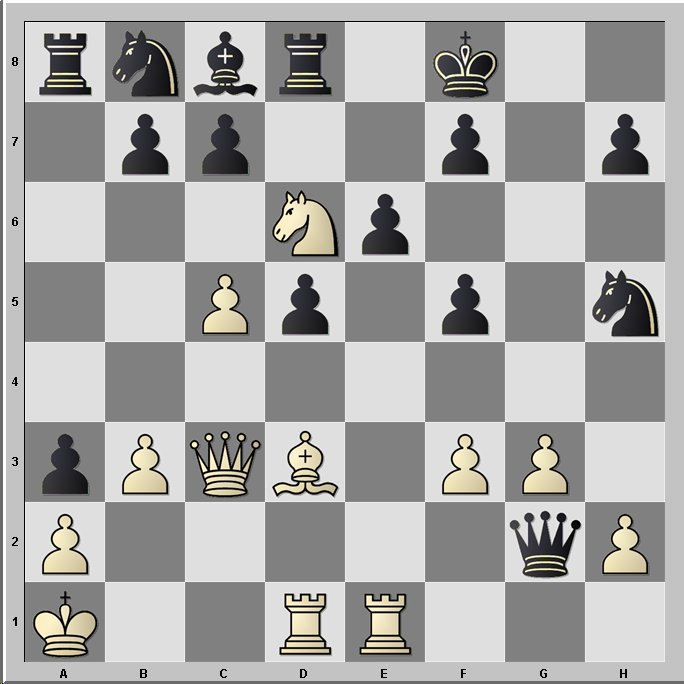


1. Qh8+ Ke7 2. Nf5+ Kd7 3. Bb5+ ~ 4. Rd5+ ~ 5.Re7xx
Am i correct?
Thanks,
karl
nf5
Why not 1. Nxc8 Rxc8 2. Qh8+ Kd7 3. Qxc8 ?
That looks like it wins to me. Theres probably a mate there, though I didnt spend too much time looking.
Yeah, there really is a mate, anonymous 3: it’s simple black queen on b2 and white is mate.
@anonym 1: i’ve got no chess board at hand to proof, but could 3. – c6 4.Rd5+, Kc7! save the black king from being mated?
Greetings,
Jochen
@anonym 1: i’ve got no chess board at hand to proof, but could 3. – c6 4.Rd5+, Kc7! save the black king from being mated?
Kc7! and Qxd8++
ok, does Nxf5 leads to a mate?
nxf5, ke8, bb5+…and qh8 mate
Dario
It looks like Nxf5? is refuted by Qb2+! and taking the knight.
There are a lot of comments here considering the problem was solved in the first one!
Here’s a tutorial on how to solve problems like this really easily.
The first thing to try on every “is there a mate?” problem is: explore every possible check until you run out of them.
OK, let’s try that with this problem.
That forces our first move, the only possible check:
1.Qh8+ Ke7
(Black’s reply is forced.)
OK, apply the same reasoning again. Each of the Q, R and N can check. Since the Q checks look suicidal, let’s think about the R check (Rxe6+) and the N checks (Nxf5+,Nxc8+). If we do the R check, the black B can come into play; if we do Nxc8+, we don’t seem to get anywhere either, due to the recapture Rxc8; so that leaves Nxf5+:
2.Nxf5+ Kd7
Two features here tell us we’re “on the right track”: Black’s move is again forced (always a good sign, mid-problem-solving), and the e6 pawn “just happens” to be pinned by Re1, so we don’t lose our N.
Now apply our “explore the checks” approach again. We have a Q sac, Bb5+, or pawn move c6+. Of those, the most intuitive seems to be Bb5+, since it not only gets a piece into the action, it also opens the file for our Rd1:
3.Bb5+ Xc6
where “X” stands for “N or pawn”, one of the two forced moves.
Now the same again: explore checks. We have Bxc6+ or Rxd5+ (and the Q sacs). Since Rxd5+ opens new lines (the e file), whereas Bxc6+ seems not to, let’s try Rxd5+ first — and come back to Bxc6+ later if Rxd5+ leads nowhere:
4.Rxd5+ ed
Black’s move ed is forced, if it’s his N on c6 (ie, if X=N above). So our head doesn’t explode, let’s assume that for now, and deal with the pawn-on-c6 case later.
What checks do we have? The Q sac and the Bxc6+ are still there, but it makes sense to look for something new, given that we just chose Rxd5+. The only new check, that wasn’t already available on our last move, seems to be Rd7+. Well, well, well: that looks to be mate.
5.Re7#
Now we have to go back and tie up any loose ends. There’s only one of them: we had assumed black’s N was on c6 (X=N above), rather than his pawn. So what other options does black gain in the c6-pawn scenario? Well, the ed recapture is no longer forced after Rxd5+, so we have to explore:
4.Rd5+ Kc7
Again, surely we’re onto a good thing here, when Black declines a rook sac.
Same as ever: what checks do we have? Well, our Rd5 and Qh8 can get to the black K, with Rd7+ or Qxd8+. Since d7 is covered by black B, N, R and K, we should probably put our money on Qxd8+. Lo and behold, that appears to be mate:
Qxd8#
In the end, our tree had just a single branch in it. So it was a single forced line, with just the Kc7 branch to look at.
When you think this way, you’ll often discover that many problems are solvable quite routinely.
..and in the mean time, people still don’t understand why their moves aren’t good enough for a win too. Well here it is: after removing the knight from the d-file at the first move, black answers with 1…d4 and diagonal is blocked.
mayadi
heres a tutorial on how to solve these problems. thats laughable. i suppose you have a tutorial on how to be a grandmaster???. come on its all about visualizing the moves in your head. theres also more than one variation to each problem. sometimes theres many ways to mate someone in a given position. you make it sound like every mate has one possibility for a mating sequence. the essential part to solving any problem is recognizing tactical concepts like pins, forks, deflections and discovered checks. here the most important part of the problem is the pin from both the rook and bishop. theyre used to find a mate. like ive always thought the most important tactic in all of chess is the pin. they always seem to lead to everything else.
wolverine
Of course simply Qd8 mates….
Thanks to anonym (number 4) for opening my eyes. 🙂
Greetings,
Jochen
I would play:
1. Rb2 Qxf3 or Qh3
and after that:
2. Qh8+ etc etc.
Pardon me:
1. Rd2 Qxf3 or Qh3
and after that:
2. Qh8+ etc etc.