The move that catches my eye first is the sacrifice at f2:
1. …..Bf2 2. Kf2 fg2 3. Kg2
But, now what for black? The only checking move on the king is Qg6:
3. …..Qg6 4. Kh1
And, I don’t see anything more in this line for black. Moves like Ng4 are just too slow:
4. …..Ng4 5. Bc6 Ke7 (Kf8 6.Qd8#) 6. Qd7 Kf6 7. Rf1 and I would be shocked there isn’t mate in here somewhere for white. Looking back over this line, I see only one realistic alternative for black, and it comes at move #2.
1. …..Bf2 2. Kf2 Qh4
I should have seen this right from the start. White has as possible moves, g3, Ke3, Kf1, and Kg1. In order:
3. g3 Qh2 4. Ke3
Or mate on the next move. Here black has two strong moves- Qg3 and f2. Of the two, f2 threatens Qg3 anyway, so I opt for it:
4. …..f2
White is in a pickle. Materially, he is up a R and a B for 3 pawns, so he can afford to drop the R at e1 if it saves his king, or he can drop the B at a8 for the same reasons. Let’s take a look at the moves that try to preserve the R:
5. Rh1 Qg3 6. Bf3
Here, Ke4 or Kd4, and I think black has time to O-O and bring his last piece into play against the horrible exposed white king, so I think Bf3 is probably the best move here. For a reply, black has O-Oing and bring the R into action, or Bc4 threatening to exchange at f3 and winning the rook with f1(Q), or Ng4 forcing the king to the d-file. Of these, I prefer O-O for the simple reason that black has time to play it, and O-Oing looks like a good option in all the other lines.
6. …..O-O
I don’t think it necessary to continue with this line- it looks hopeless for white. We need to go all the way back to white’s 3rd move to find a defense.
3. Kg1 f2 4. Kf1
Kh1 is # in 2:
4. …..fe1(Q) 5. Qe1 Bc4 and white will lose the Q. At move 3, white will do no better with
3. Kf1 Bc4 and regardless of what white does, he still loses the R and Q. So, we are left with 3.Ke3:
3. Ke3
And I have looked at this for a while and I am not really sure how to take advantage of the exposed king. I see 4 next moves for black-Ng4,Nc4,f2,fg2. Let’s look at them in order:
3. …..Ng4 4. Kd2
Here, 4.Kf3 is mate starting with Qf2+. The question is what is best for black here? I wrote above, white has significant material in hand, so he can sac some of it to break black’s attack, so a move like Qf2 might well lose after Re2 followed by exchanging the f-pawn for the rook. Also, O-O might not help, but I am pressed to find another continuation for black as white is threatening to hide the king at c2, sac the exchange at e6, or play a simple Bf3.
4. …..O-O (thr. Rd8) 5. Bf3
Kc2 might be ok, but it is complicated.
5. …..Rd8 (what else now?) 6. Kc2
And now, black is running out of attacking moves. Bf5 seems useless after white plays Kb3 and a3 to give the king a hole. On Nf2, white can just do the exchange at d8 and have a defensible, maybe even winning position. Of black’s options, I think Rd1 is probably best:
6. …..Rd1 7. Kd1
Only move. Cont.:
7. …..Nf2
Hard for me to see anything else for black, but to try to continue the attack. Nh2 allows Nd2 or maybe even Be3 mobilizing the pieces, but I might well be missing something good in that line for black, but I don’t know what it might be.
8. Kc2 Bf5 9. Kd2
Only move.
9. …..Ne4 (or g5) 10.Be4 Be4 11.Re2
I really can’t tell if black is bad here or not. If white can mobilize his pieces, I think white wins this. Or, maybe black can try for a repetition draw. In my next comment, I will take a look at black’s third move alternatives since I don’t see a clear cut win with 3. ….Ng4+.
And had looked at 3. ….Ng4 as a way to continue the attack. The key features of the position are the exposed white king and the fact that black has sacrificed a rook and a bishop, so far, for the attack. 3. ….Ng4 didn’t see to be a conclusive line. I actually liked white’s position a bit better at the end than I did black’s as he never recovered enough material to be clearly better. The other options at move 3 were Nc4, f2, fg2, and O-O.
3. …..Nc4 4. Kf3
And now what for black? Castling seems to be the only option now with white threatening Bc6:
4. …..O-O (threatens Bg4) 5. Ke2 and I see nothing here for black. White will begin to untangle his queen side. Or
Here, Ke2 might well lose to Qa8 as I think white will definitely lose the rook for the pawn and be materially behind as well as positionally behind.
6. …..Bf5 7. Kb3 Qa8 (I see nothing else) 8. Qf3 Be6 (Qe4 9.Qe4 Be4 10.Bf4) 9. Kc2 Qd5 (O-O much the same) 10.Qd5 Bd5 11.Bf4 Bg2 (anything else?) 12.Nd2 Bh1 (what else?) 13.Rh1 and black clearly hasn’t nearly enough compensation for the material disadvantage. Or
3. …..fg2 4. Bg2
Not sure if this is best for white, but it is all I can see. Now, black must bring the rook into action to have any chance. He could do this with O-O or Ke7, but I see no reason to leave the king on the e-file:
4. …..O-O
And, now, with it looking back at me, I can see that this choice at move 3 was very powerful. I am having a very difficult time finding a defense for white,now. Clearing the f-pawn out of the way is a benefit for black as it makes moves like Qh2 checks in certain lines I am looking at in addition to opening f2 for the knight or the queen in the main line. Of white’s moves here, I don’t see anything better than Nd2:
5. Nd2 Ng4 (plays itself) 6. Kd3
Anything else seems to be mate or close enough to it that I don’t need to do the analysis. White could just play Qg4, but black would still have an attack and a material advantage.
6. …..Bf5 7. Be4
I find nothing better. Ne4 still loses to Nf2, and Re4 loses even more quickly to Rd8+.
7. …..Nf2 8. Kc2 Nd1 9. Kd1 Re8 and white will lose another piece regardless of what he does.
The unanswered question with this line is whether or not white errs with 4.Bg2? I am going to go back and look at 4.Rg1 which was the only other move I could see that might make a material difference:
Here, Qg2 loses, I think, to Qe3+ followed by Bf5+. Continuing:
7. …..O-O (only hope, I think) 8. Kc2
Clears the way for the bishop and the knight:
8. …..Bf5 9. Be4 Re8 10.Nd2 Nf2
And, I don’t see how white avoids losing the extra piece he has and being down three pawns eventually along with having a naked king.
All in all, I find 1. ….Bf2 to be a winner, but black must follow up with 2. ….Qh4+, and, especially, 3. …..fg2. Black’s third move is the hard one to see as it goes against the grain to just give up the advanced pawn, but it clears lines and squares for black’s pieces. I would never have found that move over the board without trial and error.
To the anonymous commenter that suggested Bf2 followed by Ng4:
I don’t see how this is good for black:
1. …..Bf2 2. Kf2 Ng4
And, here, I might agree that Kg1 is weak for white:
3. Kg1 f2 4. Kh1
But, fe1 will not balance well for black since he is down a rook and a bishop at this point. Continuing:
4. …..fe1(Q) 5. Qe1 O-O 6. Bf3 Ne5 (what else?) 7. Nd2 Re8 8. Qf1 and black has nothing, and it is only a matter of time before white completes his development at which point he is up a bishop for a pawn. At move 4 in this line, black does better to castle first:
4. …..O-O
The point being that white cannot play Rf1 due to Qe5 threatening a mate that can only be prevented by sacrificing the queen for the knight at g4 or by sacrificing even more material with Bf4. For example:
5. Rf1 Qe5 6. Bf4
Here, 6.g3 Ra8 7.Nd2 Rd8 8.c4 bc4 leaves white with only the option of Qg4 any way. Continuing:
6. …..Qf4 7. g3 Qh6 8. h4 Ra8 And white will not survive this, in my opinion. At move 5 in this line, white must play
Best, I think, to preserve this bishop. White could preserve it with Bf3, but the line of Na2 is looking good materially for black to me. Continuing:
9. …..Bf5 (Na2 10.Ba6 c6 is ok) 10.Nd2
Here, 10.Qc1 Qb6 11.Kh1 Qb7 is ok for black, too. Continuing:
10. …..Nd3 11.Rf1 Nb2 12.Be4 Re8 13.Qc5 g6 (Re5 14.Qc7… 15.g4) 14.Bf5 gf5 15.Qc7 Na4 should leave black at least some chances of winning, however minor it might actually be- he is up a pawn but it is doubled, but this is partially compensated by the fact that white’s queen side pawns are unconnected and weak, as well.
However, all of the above, though interesting to work out it was, misses white’s best reply all the way back at move #3:
3. Kg3!
Here, black can play f2, fg2, or play the knight back to e5 at which point white then takes at f3 with the bishop or the queen:
3. …..f2 4. Bc6 Kf8 (Ke7 5.Qd7 Kf8 6.Qe8#)
And, here, I think Re6 is sufficient to win for white:
5. Re6
And 5….Qe6 loses to Qd8 followed by mate, f1(Q) loses to Re8#, and f1(N) loses to Qf1. So, black must play fe6:
5. …..fe6 6. Nd2
Here, black has h5 protecting the knight, Ne3 moving it, Nh2 trying to continue the attack, or Ne5 withdrawing it:
6. …..h5 7. Qf3 Rh6 (or resign) 8. Qf6 Rf6 (or resign) 9. Bf3 and I don’t see how black prevents h3 followed by the winning of the f2 pawn. Or
6. …..Ne3 7. Qf3 f1(Q) 8. Nf1 Nf1 9. Kh3 Qf5 (or resign) 10.Qf5 ef5 11.Bf4 and even the knight is lost by my eye.
Now, this is a complicated line, and I may well be missing something obvious, but if I am, I am completely blind to it.
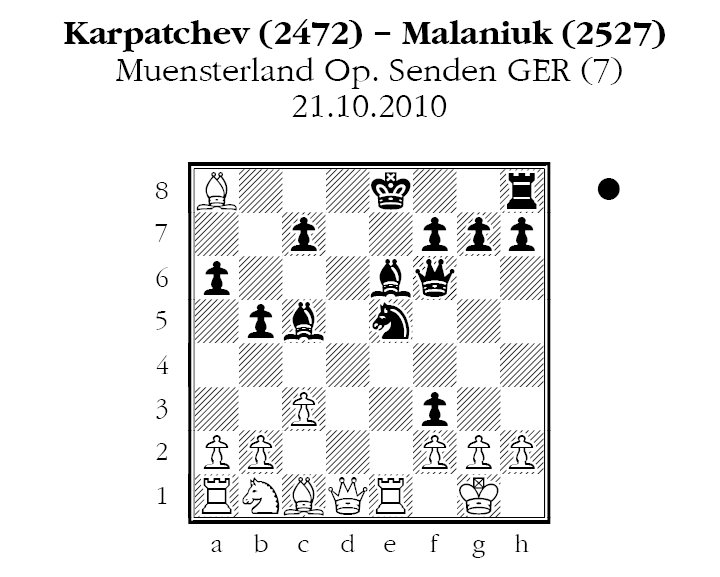


…Bxf2+ has to be the first move, as it exposes the king.
1.Bxf2+ Kxf2
2.Ng4+
2. .. Kg3?
3. f2!
2. .. Kg1?
3. f2+!
2. .. Kf1
3.fxg2+ Kg1
4.Qf2++
The move that catches my eye first is the sacrifice at f2:
1. …..Bf2
2. Kf2 fg2
3. Kg2
But, now what for black? The only checking move on the king is Qg6:
3. …..Qg6
4. Kh1
And, I don’t see anything more in this line for black. Moves like Ng4 are just too slow:
4. …..Ng4
5. Bc6 Ke7 (Kf8 6.Qd8#)
6. Qd7 Kf6
7. Rf1 and I would be shocked there isn’t mate in here somewhere for white. Looking back over this line, I see only one realistic alternative for black, and it comes at move #2.
1. …..Bf2
2. Kf2 Qh4
I should have seen this right from the start. White has as possible moves, g3, Ke3, Kf1, and Kg1. In order:
3. g3 Qh2
4. Ke3
Or mate on the next move. Here black has two strong moves- Qg3 and f2. Of the two, f2 threatens Qg3 anyway, so I opt for it:
4. …..f2
White is in a pickle. Materially, he is up a R and a B for 3 pawns, so he can afford to drop the R at e1 if it saves his king, or he can drop the B at a8 for the same reasons. Let’s take a look at the moves that try to preserve the R:
5. Rh1 Qg3
6. Bf3
Here, Ke4 or Kd4, and I think black has time to O-O and bring his last piece into play against the horrible exposed white king, so I think Bf3 is probably the best move here. For a reply, black has O-Oing and bring the R into action, or Bc4 threatening to exchange at f3 and winning the rook with f1(Q), or Ng4 forcing the king to the d-file. Of these, I prefer O-O for the simple reason that black has time to play it, and O-Oing looks like a good option in all the other lines.
6. …..O-O
I don’t think it necessary to continue with this line- it looks hopeless for white. We need to go all the way back to white’s 3rd move to find a defense.
3. Kg1 f2
4. Kf1
Kh1 is # in 2:
4. …..fe1(Q)
5. Qe1 Bc4 and white will lose the Q. At move 3, white will do no better with
3. Kf1 Bc4 and regardless of what white does, he still loses the R and Q. So, we are left with 3.Ke3:
3. Ke3
And I have looked at this for a while and I am not really sure how to take advantage of the exposed king. I see 4 next moves for black-Ng4,Nc4,f2,fg2. Let’s look at them in order:
3. …..Ng4
4. Kd2
Here, 4.Kf3 is mate starting with Qf2+. The question is what is best for black here? I wrote above, white has significant material in hand, so he can sac some of it to break black’s attack, so a move like Qf2 might well lose after Re2 followed by exchanging the f-pawn for the rook. Also, O-O might not help, but I am pressed to find another continuation for black as white is threatening to hide the king at c2, sac the exchange at e6, or play a simple Bf3.
4. …..O-O (thr. Rd8)
5. Bf3
Kc2 might be ok, but it is complicated.
5. …..Rd8 (what else now?)
6. Kc2
And now, black is running out of attacking moves. Bf5 seems useless after white plays Kb3 and a3 to give the king a hole. On Nf2, white can just do the exchange at d8 and have a defensible, maybe even winning position. Of black’s options, I think Rd1 is probably best:
6. …..Rd1
7. Kd1
Only move. Cont.:
7. …..Nf2
Hard for me to see anything else for black, but to try to continue the attack. Nh2 allows Nd2 or maybe even Be3 mobilizing the pieces, but I might well be missing something good in that line for black, but I don’t know what it might be.
8. Kc2 Bf5
9. Kd2
Only move.
9. …..Ne4 (or g5)
10.Be4 Be4
11.Re2
I really can’t tell if black is bad here or not. If white can mobilize his pieces, I think white wins this. Or, maybe black can try for a repetition draw. In my next comment, I will take a look at black’s third move alternatives since I don’t see a clear cut win with 3. ….Ng4+.
In my previous comment, I considered the line:
1. ….Bf2
2. Kf2 Qh4
3. Ke3
And had looked at 3. ….Ng4 as a way to continue the attack. The key features of the position are the exposed white king and the fact that black has sacrificed a rook and a bishop, so far, for the attack. 3. ….Ng4 didn’t see to be a conclusive line. I actually liked white’s position a bit better at the end than I did black’s as he never recovered enough material to be clearly better. The other options at move 3 were Nc4, f2, fg2, and O-O.
3. …..Nc4
4. Kf3
And now what for black? Castling seems to be the only option now with white threatening Bc6:
4. …..O-O (threatens Bg4)
5. Ke2 and I see nothing here for black. White will begin to untangle his queen side. Or
3. …..f2
4. Rh1
Best I see for white. Cont.:
4. …..Ng4 (anything else?)
5. Kd2 Qd8 (again, what else?)
6. Kc2
Here, Ke2 might well lose to Qa8 as I think white will definitely lose the rook for the pawn and be materially behind as well as positionally behind.
6. …..Bf5
7. Kb3 Qa8 (I see nothing else)
8. Qf3 Be6 (Qe4 9.Qe4 Be4 10.Bf4)
9. Kc2 Qd5 (O-O much the same)
10.Qd5 Bd5
11.Bf4 Bg2 (anything else?)
12.Nd2 Bh1 (what else?)
13.Rh1 and black clearly hasn’t nearly enough compensation for the material disadvantage. Or
3. …..fg2
4. Bg2
Not sure if this is best for white, but it is all I can see. Now, black must bring the rook into action to have any chance. He could do this with O-O or Ke7, but I see no reason to leave the king on the e-file:
4. …..O-O
And, now, with it looking back at me, I can see that this choice at move 3 was very powerful. I am having a very difficult time finding a defense for white,now. Clearing the f-pawn out of the way is a benefit for black as it makes moves like Qh2 checks in certain lines I am looking at in addition to opening f2 for the knight or the queen in the main line. Of white’s moves here, I don’t see anything better than Nd2:
5. Nd2 Ng4 (plays itself)
6. Kd3
Anything else seems to be mate or close enough to it that I don’t need to do the analysis. White could just play Qg4, but black would still have an attack and a material advantage.
6. …..Bf5
7. Be4
I find nothing better. Ne4 still loses to Nf2, and Re4 loses even more quickly to Rd8+.
7. …..Nf2
8. Kc2 Nd1
9. Kd1 Re8 and white will lose another piece regardless of what he does.
The unanswered question with this line is whether or not white errs with 4.Bg2? I am going to go back and look at 4.Rg1 which was the only other move I could see that might make a material difference:
4. Rg1 Ng4 (O-O also possible)
5. Kd2 Qf2
6. Qe2 Qg1
7. Bg2
Here, Qg2 loses, I think, to Qe3+ followed by Bf5+. Continuing:
7. …..O-O (only hope, I think)
8. Kc2
Clears the way for the bishop and the knight:
8. …..Bf5
9. Be4 Re8
10.Nd2 Nf2
And, I don’t see how white avoids losing the extra piece he has and being down three pawns eventually along with having a naked king.
All in all, I find 1. ….Bf2 to be a winner, but black must follow up with 2. ….Qh4+, and, especially, 3. …..fg2. Black’s third move is the hard one to see as it goes against the grain to just give up the advanced pawn, but it clears lines and squares for black’s pieces. I would never have found that move over the board without trial and error.
To the anonymous commenter that suggested Bf2 followed by Ng4:
I don’t see how this is good for black:
1. …..Bf2
2. Kf2 Ng4
And, here, I might agree that Kg1 is weak for white:
3. Kg1 f2
4. Kh1
But, fe1 will not balance well for black since he is down a rook and a bishop at this point. Continuing:
4. …..fe1(Q)
5. Qe1 O-O
6. Bf3 Ne5 (what else?)
7. Nd2 Re8
8. Qf1 and black has nothing, and it is only a matter of time before white completes his development at which point he is up a bishop for a pawn. At move 4 in this line, black does better to castle first:
4. …..O-O
The point being that white cannot play Rf1 due to Qe5 threatening a mate that can only be prevented by sacrificing the queen for the knight at g4 or by sacrificing even more material with Bf4. For example:
5. Rf1 Qe5
6. Bf4
Here, 6.g3 Ra8 7.Nd2 Rd8 8.c4 bc4 leaves white with only the option of Qg4 any way. Continuing:
6. …..Qf4
7. g3 Qh6
8. h4 Ra8 And white will not survive this, in my opinion. At move 5 in this line, white must play
5. h3 fe1(Q)
6. Qe1 Nf2
7. Kg1 Nd3 (Nh3 might draw, too)
8. Qe3 Nc1
9. Bb7
Best, I think, to preserve this bishop. White could preserve it with Bf3, but the line of Na2 is looking good materially for black to me. Continuing:
9. …..Bf5 (Na2 10.Ba6 c6 is ok)
10.Nd2
Here, 10.Qc1 Qb6 11.Kh1 Qb7 is ok for black, too. Continuing:
10. …..Nd3
11.Rf1 Nb2
12.Be4 Re8
13.Qc5 g6 (Re5 14.Qc7… 15.g4)
14.Bf5 gf5
15.Qc7 Na4 should leave black at least some chances of winning, however minor it might actually be- he is up a pawn but it is doubled, but this is partially compensated by the fact that white’s queen side pawns are unconnected and weak, as well.
However, all of the above, though interesting to work out it was, misses white’s best reply all the way back at move #3:
3. Kg3!
Here, black can play f2, fg2, or play the knight back to e5 at which point white then takes at f3 with the bishop or the queen:
3. …..f2
4. Bc6 Kf8 (Ke7 5.Qd7 Kf8 6.Qe8#)
And, here, I think Re6 is sufficient to win for white:
5. Re6
And 5….Qe6 loses to Qd8 followed by mate, f1(Q) loses to Re8#, and f1(N) loses to Qf1. So, black must play fe6:
5. …..fe6
6. Nd2
Here, black has h5 protecting the knight, Ne3 moving it, Nh2 trying to continue the attack, or Ne5 withdrawing it:
6. …..h5
7. Qf3 Rh6 (or resign)
8. Qf6 Rf6 (or resign)
9. Bf3 and I don’t see how black prevents h3 followed by the winning of the f2 pawn. Or
6. …..Ne3
7. Qf3 f1(Q)
8. Nf1 Nf1
9. Kh3 Qf5 (or resign)
10.Qf5 ef5
11.Bf4 and even the knight is lost by my eye.
Now, this is a complicated line, and I may well be missing something obvious, but if I am, I am completely blind to it.