Obviously, the twice-attacked-twice-defended Knight on c4 points us towards the classic deflection tactic: 1. … Nxc4 2. Qxc4 Rd1+! Calculating possible continuations tells us it works, for example: 3. Bf1 Qxc4 4. Rxc4 Rxa1 5. Rxb4 Black must now be winning. He is up an exchange, and the pin on f1 is also going to be a problem for White.
But I wonder if it isn’t more complicated than this because of White’s mate threat on c7. For example, if White had the first move Nb6+wins for White. So, we might try: 1 … Nxc4 2. Ne5!! Now what happens?? White will recover his lost Knight and the rest of his pieces are simply better. My feeling is that the amateur has a big advantage here (assuming he can avoid messing up): at least I can’t see anything else good for Black, while White has strong moves moves like Rab1 coming.
1… Nxc4! 2 Qxc4 Rd1+!! 3 Bf1 (if 3 Rxd1, still Qxc4!!!) Qxc4!!! 4 Rxc4 Rxa1!!!! and Black has three advantages: the exchange, more play and ten exclamation points in the previous four moves.
My first thought is to take at c4 and then undermine the defense of the white queen on recapture:
1. …..Nc4 2. Qc4 Rd1 3. Bf1
Of course, the entire idea is that the rook can’t take at d1 without leaving the queen at c4 unprotected. Continuing:
3. …..Qc4 4. Rc4 Ra1 5. Rb4 Bh3 6. Nd2 Rd8 7. Bd4 Rd1 and black is going to end up a rook when all the smoke clears.
However, I must be on the wrong track here since white doesn’t need to cooperate at move 2. I can’t find much for black after white defends with 2.Ne5- black’s knight is pinned by the mate threat of Qxc7:
1. …..Nc4 2. Ne5! Bd2 3. Bd2 Rd2 4. Qc4 and now Rd1 won’t work since the queen is protected by the knight, too.
Also, black cannot remove the knight at f3 by capturing on the first move with Bxf3 since white can play 2.Nb6+ to win black’s queen for two pieces.
I thought at first you might have stumbled onto the solution everyone was looking for yesterday. I had considered Be6 yesterday, but had dismissed it in light of the following:
1. …..Nc4 2. Ne5 Be6 3. Nc4!
Now, I am guessing your idea is to take with the bishop and have the same threat of undermining the queen’s guard as before:
3. …..Bc4 4. Qc4??Rd1
Right? However, again, white doesn’t have to cooperate:
4. Bf1?!
And black’s bishop at c4 is pinned and lost by the same threat of Qc2#, and Rd1 is no longer a threat since it doesn’t occur with check. However, on looking at this with a fresher mind, I think white does even better with 4.Rab1, and that looks like a nearly decisive edge for white, but I can’t be sure without a lot more work. We are either missing the solution outright, and black really does have a winner here, or black doesn’t have a winning tactic here at all (my suspicion now since no one has posted one).
Well, that would mean that no one thought to make sure white hadn’t just blundered. I see Cortex has confirmed via engine there is no solution giving black an edge.
After 1…. Nxc4 2.Ne5 black can still retain the piece by giving up exchange. 2….. Rd1+ 3.Q or RXd1 3.Bf1 Rxf1+ 4.Kxf1 Nxe3+ 3….. Nxe5.But white has devastating attack after 4.Rab1
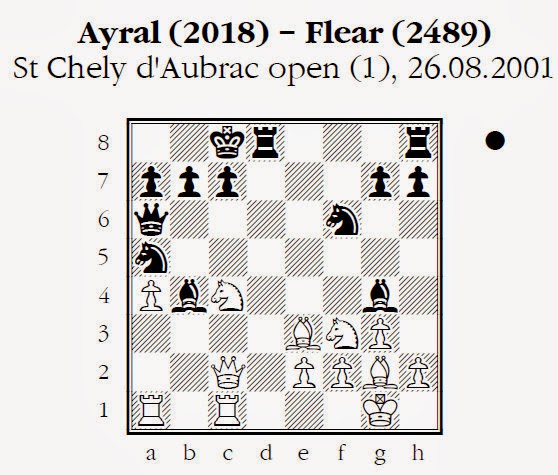


1. … Nxc4 2. Qxc4 Rd1+ 3. Bf1 Qxc4 4. Rxc4 Rxa1 5. Rxb4 and Black wins a quality. 0-1
1…. Nxc4
2.Qxc4 Rd1+
3.Bf1 Qxc4
4.Rxc4 Rxa1
5.Rxb4 Bh3
6.Nd2 Rd8
7.Bd4
(7.Rd4 Ne4
8.Rxd8+ Kxd8 and white has to lose material to prevent mate.)
7…. Rd1
8.Rb1 Rxb1
9.Nxb1 Bxf1
10.Bxf6 gxf6
11.Kxf1 Rd1+
12.Ke2 Rxb1 0-1
1…Nxc4, and black lost one piece.
Obviously, the twice-attacked-twice-defended Knight on c4 points us towards the classic deflection tactic:
1. … Nxc4
2. Qxc4 Rd1+!
Calculating possible continuations tells us it works, for example:
3. Bf1 Qxc4
4. Rxc4 Rxa1
5. Rxb4
Black must now be winning. He is up an exchange, and the pin on f1 is also going to be a problem for White.
But I wonder if it isn’t more complicated than this because of White’s mate threat on c7. For example, if White had the first move Nb6+wins for White.
So, we might try:
1 … Nxc4
2. Ne5!!
Now what happens?? White will recover his lost Knight and the rest of his pieces are simply better. My feeling is that the amateur has a big advantage here (assuming he can avoid messing up): at least I can’t see anything else good for Black, while White has strong moves moves like Rab1 coming.
1. … Nxc4
2. Qxc4 Rd1+
3. Rxd1 Qxc4
greets, jan
1… Nxc4! 2 Qxc4 Rd1+!! 3 Bf1 (if 3 Rxd1, still Qxc4!!!) Qxc4!!! 4 Rxc4 Rxa1!!!! and Black has three advantages: the exchange, more play and ten exclamation points in the previous four moves.
My first thought is to take at c4 and then undermine the defense of the white queen on recapture:
1. …..Nc4
2. Qc4 Rd1
3. Bf1
Of course, the entire idea is that the rook can’t take at d1 without leaving the queen at c4 unprotected. Continuing:
3. …..Qc4
4. Rc4 Ra1
5. Rb4 Bh3
6. Nd2 Rd8
7. Bd4 Rd1 and black is going to end up a rook when all the smoke clears.
However, I must be on the wrong track here since white doesn’t need to cooperate at move 2. I can’t find much for black after white defends with 2.Ne5- black’s knight is pinned by the mate threat of Qxc7:
1. …..Nc4
2. Ne5! Bd2
3. Bd2 Rd2
4. Qc4 and now Rd1 won’t work since the queen is protected by the knight, too.
Also, black cannot remove the knight at f3 by capturing on the first move with Bxf3 since white can play 2.Nb6+ to win black’s queen for two pieces.
Right now, I simply can’t see the solution.
Yancey doesn’t 1…Nxc4 2 Ne5 Be6 win for Black?
1…Nxc4
2.Ne5
and white is ok
Crazy puzzle. 1.-Nxc4 2. Ne5 or a bunch of moves except the big big blunder Qxc4 is more than ok for white. Hint: look at c7.
Chris,
I thought at first you might have stumbled onto the solution everyone was looking for yesterday. I had considered Be6 yesterday, but had dismissed it in light of the following:
1. …..Nc4
2. Ne5 Be6
3. Nc4!
Now, I am guessing your idea is to take with the bishop and have the same threat of undermining the queen’s guard as before:
3. …..Bc4
4. Qc4??Rd1
Right? However, again, white doesn’t have to cooperate:
4. Bf1?!
And black’s bishop at c4 is pinned and lost by the same threat of Qc2#, and Rd1 is no longer a threat since it doesn’t occur with check. However, on looking at this with a fresher mind, I think white does even better with 4.Rab1, and that looks like a nearly decisive edge for white, but I can’t be sure without a lot more work. We are either missing the solution outright, and black really does have a winner here, or black doesn’t have a winning tactic here at all (my suspicion now since no one has posted one).
@Yancey Ward: there is no solution because…
@Chris Rice: Your proposal is very good in practice, but I checked with an engine (yes, I know, I’m a bad boy…) and…
1…Nxc4 2 Ne5 Be6 doesn’t win!
In fact, White has a very annoying rejoinder and keeps an edge.
The question now is…
Which one?
Warning: this is crazy!
For the actual game please refer to
http://www.chessgames.com/perl/chessgame?gid=1195965
Prof.S.G.Bhat,
Well, that would mean that no one thought to make sure white hadn’t just blundered. I see Cortex has confirmed via engine there is no solution giving black an edge.
After
1…. Nxc4
2.Ne5 black can still retain the piece by giving up exchange.
2….. Rd1+
3.Q or RXd1
3.Bf1 Rxf1+ 4.Kxf1 Nxe3+
3….. Nxe5.But white has devastating attack after
4.Rab1