My idea looked “suspiciously optimistic”, I had to look for an error, and it certainly demands an improvement!
In my first line, I ended up sacking my queen, having forgotten that I don’t have a rook on h1 any more…
Trying again, g5 must be inserted somewhere:
1. Rxh6 Bxh6 2. Nf6+ it’s hard to imagine this move is not part of the solution… 2. … Kh8 (Kg7/Kg8 g5 gains the bishop) 3. g5! Bg7 4. Qh2! With the threat Bxf6?? exf6 any Qh8#.
Black must now move his queen to give king an escape field on e7.
4. … Qb7 (anything better?) 5. Qh7 and I don’t see how black protects Qg8+ Ke7 Qxg7.
Rxh6 looks ok at a glance, and is certainly the move that catches my eye first:
1. Rh6 Bh6 2. Nf6 Kg7
If the king goes to h8, white plays g5 anyway followed by Qh2+ if black then plays Kg7. If black plays the king to f8 on the second move, white can play Qh2 first, then follow up with Ng5 threatening a variety of forks on f8/f6. I think black does best in this line to simply allow the pawn push on the bishop. Continuing from Kg7 above:
3. g5 Bg5
Here, Rh8 looks ok to me, but I woul rather have the rook on the other flank, but I can’t say that Bg5 is actually better- they look quite similar to me right now. Continuing:
4. fg5 and white has two knights for a rook and pawn. Materially, white is clearly better, though this isn’t necessarily decisive.
Now, while working through this on my board, it did occur to me that white need not wait to play Nf6 on the second move, and on closer inspection, this is ok to play, too:
1. Nf6
The point is that white is still threatening Rxh6. By putting the knight in at f6 first, he also forces black to either play the king to f8 now, or to take at f6. The square of g7 isn’t available in the same amount of time as in the line above. Both alternatives look disadvantageous:
1. …..Kf8 (Kh8 2.g5+-) 2. Rh6! Bh6 3. Qh2
Now we have arrived a subvariation from the first line. If black retreats the bishop to g7, white just plays Ng5 with an overwhelming attack. If black plays Kg7, g5 wins easily. I think best is to just give up the bishop now at f4:
3. …..Bf4 4. Kf4 Qd8
I don’t a a better move here for black. White has threats like Qh8 and Qh7 in hand. Qd8 offers the only defense I see. Continuing:
5. Qh6 Ke7 6. Ne4 and the material balance is the same as in the first line. Hard to say which position is actually better for white- in this line, white’s pieces are a bit more active, but his pawn structure is less compact. Finally, at move 1, black will surely lose if he captures at f6:
1. Nf6 Bf6 2. gf6 Qf6
This is forced since Qf8 is met by Ne5: [2. …Qf8? 3.Ne5 Ra7 4.Qe4 Ra3 5.Ng6! Rb3 6.Kh4 Qe8 7.Kg5+-]. Continuing:
Not satisfied with the proposed solutions and not finding a better one of my own, I allowed Fritz 13 in infinite analysis mode to grind away at this starting position for a long time to see what it could come up with. It found quite an interesting line starting with Ne4+, with a very innovative choice of promoting the pawn to a knight at move 23 rather than a queen, which prevented black’s knight from forking the white king and knight and thus winning the promoted piece. That is, if white had promoted to a queen, then he would have lost it. FEN “r5k1/4qpb1/4p1pn/2p1P3/1pP1NPP1/1P3NK1/4Q3/7R w – – 0 0” 1. Nf6+ Kf8 2. Ng5 Qc7 3. Rd1 Rd8 4. Rxd8+ Qxd8 5. Ngh7+ Ke7 6. Qa2 Bxf6 7. Qa7+ Ke8 8. Qa4+ Ke7 9. exf6+ Kd6 10. Qa6+ Kd7 11. Qb5+ Kc7 12. Qa5+ Kc8 13. Qxc5+ Kb7 14. Qxb4+ Qb6 15. Qxb6+ Kxb6 {White has a decisive advantage.} 16. Nf8 e5 17. fxe5 g5 18. e6 fxe6 19. Nxe6 Nf7 20. Nxg5 Nh8 21. Kf4 Kc6 22. f7 Kd7 23. f8=N+ Ke7 24. Nge6 Kd6 25. g5 Nf7 26. c5+ Kc6 27. Nd8+ Nxd8 28. g6 Nf7 29. gxf7 Kb5 30. Ne6 Kb4 31. f8=Q Ka3 32. Qd6 Ka2 33. Qd4 Kxb3 34. Nf8 Ka2 35. Qc4+ Ka1 36. c6 Kb2 37. c7 Kb1 38. Qb4+ Kc1 39. c8=Q+ Kd1 40. Qb2 Ke1 41. Qcc1#
Just for fun, I decided to try promoting to a queen to see if I could save the promoted piece, playing as white against Fritz 13 from move 22 on — the answer was no, though I managed to win in 44 moves: 22. Ke5 Ng6+ 23. Ke6 Nf8+ 24. Ke7 Ng6+ 25. Ke8 Kd6 26. f7 Ke5 27. Nh7 Kd4 28. Nf8 Nf4 29. Nh7 Ng6 {Black’s knight is going to keep going back to g6, so we might as well promote the pawn.} 30. g5 Kc3 31. f8=Q Nxf8 {Failed to save the promoted piece, but white’s position still good.} 32. Kxf8 Kxb3 33. g6 Kxc4 34. g7 Kd4 35. g8=Q Kc3 {Now I try to mate black with just the knight and the queen. Should be quicker than using the king.} 36. Nf6 Kd3 37. Qd5+ Kc2 38. Ne4 Kb2 39. Qc4 Kb1 40. Qc3 Ka2 41. Ke7 Kb1 42. Nd2+ Ka2 43. Qb3+ Ka1 44. Qb1#
Amazing line after after 2.Ng5. I had looked at that briefly yesterday, but as a human, I was looking at that point only for a direct material gain and so thought 2.Rh6 had to be the way to go.
Thank you for your comments, Yancey. It’s nice to know someone looks at my postings and tries to understand them.
BTW, I was trying to think today from the viewpoint of black how would I bust up white’s attack. Bxf6 seems to do a pretty good job: 1. Nf6+ Bxf6 2. exf6 Qxf6 3. Rxh6 At this point, black has given up a knight to escape the attack, but has a pretty good position to attack the white king. But white eventually can win by capturing a few black pawns and then forcing a queen exchange. After that, white can promote one of his pawns and black is doomed. Black has a chance to do the same, but not, I think, if white plays accurately. The knight gives white too much of an advantage.
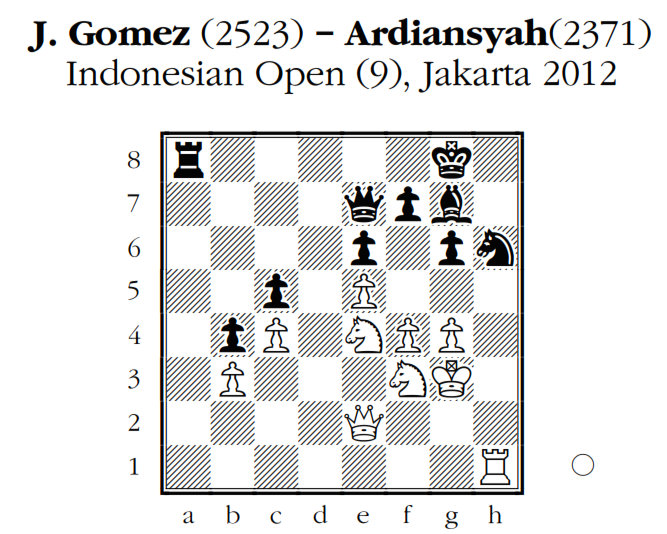


I guess white gets 2 minor pieces for a rook, or if black clings to an initial quality gain, white takes the a8 rook:
1. Rxh6! Bxh6
2. Nf6+ Kf8 (Kg8 deprives bishop of any escape, Kh8 g5 also hopeless)
3. Qh2 Bg7
4. Qh7! Bxf6 (only way to save the bishop, but better not?)
5. exf6 Qxf6 (enforced)
6. Qh8+ Qxh8
7. Rxh8+ Kg7
8. Rxa8!
My idea looked “suspiciously optimistic”, I had to look for an error, and it certainly demands an improvement!
In my first line, I ended up sacking my queen, having forgotten that I don’t have a rook on h1 any more…
Trying again, g5 must be inserted somewhere:
1. Rxh6 Bxh6
2. Nf6+
it’s hard to imagine this move is not part of the solution…
2. … Kh8 (Kg7/Kg8 g5 gains the bishop)
3. g5! Bg7
4. Qh2!
With the threat Bxf6?? exf6 any Qh8#.
Black must now move his queen to give king an escape field on e7.
4. … Qb7 (anything better?)
5. Qh7
and I don’t see how black protects Qg8+ Ke7 Qxg7.
Continuing by attacking f7 with g5, I guess.
Rxh6 looks ok at a glance, and is certainly the move that catches my eye first:
1. Rh6 Bh6
2. Nf6 Kg7
If the king goes to h8, white plays g5 anyway followed by Qh2+ if black then plays Kg7. If black plays the king to f8 on the second move, white can play Qh2 first, then follow up with Ng5 threatening a variety of forks on f8/f6. I think black does best in this line to simply allow the pawn push on the bishop. Continuing from Kg7 above:
3. g5 Bg5
Here, Rh8 looks ok to me, but I woul rather have the rook on the other flank, but I can’t say that Bg5 is actually better- they look quite similar to me right now. Continuing:
4. fg5 and white has two knights for a rook and pawn. Materially, white is clearly better, though this isn’t necessarily decisive.
Now, while working through this on my board, it did occur to me that white need not wait to play Nf6 on the second move, and on closer inspection, this is ok to play, too:
1. Nf6
The point is that white is still threatening Rxh6. By putting the knight in at f6 first, he also forces black to either play the king to f8 now, or to take at f6. The square of g7 isn’t available in the same amount of time as in the line above. Both alternatives look disadvantageous:
1. …..Kf8 (Kh8 2.g5+-)
2. Rh6! Bh6
3. Qh2
Now we have arrived a subvariation from the first line. If black retreats the bishop to g7, white just plays Ng5 with an overwhelming attack. If black plays Kg7, g5 wins easily. I think best is to just give up the bishop now at f4:
3. …..Bf4
4. Kf4 Qd8
I don’t a a better move here for black. White has threats like Qh8 and Qh7 in hand. Qd8 offers the only defense I see. Continuing:
5. Qh6 Ke7
6. Ne4 and the material balance is the same as in the first line. Hard to say which position is actually better for white- in this line, white’s pieces are a bit more active, but his pawn structure is less compact. Finally, at move 1, black will surely lose if he captures at f6:
1. Nf6 Bf6
2. gf6 Qf6
This is forced since Qf8 is met by Ne5: [2. …Qf8? 3.Ne5 Ra7 4.Qe4 Ra3 5.Ng6! Rb3 6.Kh4 Qe8 7.Kg5+-]. Continuing:
3. Rh6 and white has won a piece for pawn.
Not satisfied with the proposed solutions and not finding a better one of my own, I allowed Fritz 13 in infinite analysis mode to grind away at this starting position for a long time to see what it could come up with. It found quite an interesting line starting with Ne4+, with a very innovative choice of promoting the pawn to a knight at move 23 rather than a queen, which prevented black’s knight from forking the white king and knight and thus winning the promoted piece. That is, if white had promoted to a queen, then he would have lost it.
FEN “r5k1/4qpb1/4p1pn/2p1P3/1pP1NPP1/1P3NK1/4Q3/7R w – – 0 0”
1. Nf6+ Kf8
2. Ng5 Qc7
3. Rd1 Rd8
4. Rxd8+ Qxd8
5. Ngh7+ Ke7
6. Qa2 Bxf6
7. Qa7+ Ke8
8. Qa4+ Ke7
9. exf6+ Kd6
10. Qa6+ Kd7
11. Qb5+ Kc7
12. Qa5+ Kc8
13. Qxc5+ Kb7
14. Qxb4+ Qb6
15. Qxb6+ Kxb6 {White has a decisive advantage.}
16. Nf8 e5
17. fxe5 g5
18. e6 fxe6
19. Nxe6 Nf7
20. Nxg5 Nh8
21. Kf4 Kc6
22. f7 Kd7
23. f8=N+ Ke7
24. Nge6 Kd6
25. g5 Nf7
26. c5+ Kc6
27. Nd8+ Nxd8
28. g6 Nf7
29. gxf7 Kb5
30. Ne6 Kb4
31. f8=Q Ka3
32. Qd6 Ka2
33. Qd4 Kxb3
34. Nf8 Ka2
35. Qc4+ Ka1
36. c6 Kb2
37. c7 Kb1
38. Qb4+ Kc1
39. c8=Q+ Kd1
40. Qb2 Ke1
41. Qcc1#
Just for fun, I decided to try promoting to a queen to see if I could save the promoted piece, playing as white against Fritz 13 from move 22 on — the answer was no, though I managed to win in 44 moves:
22. Ke5 Ng6+
23. Ke6 Nf8+
24. Ke7 Ng6+
25. Ke8 Kd6
26. f7 Ke5
27. Nh7 Kd4
28. Nf8 Nf4
29. Nh7 Ng6 {Black’s knight is going to keep going back to g6, so we might as well promote the pawn.}
30. g5 Kc3
31. f8=Q Nxf8 {Failed to save the promoted piece, but white’s position still good.}
32. Kxf8 Kxb3
33. g6 Kxc4
34. g7 Kd4
35. g8=Q Kc3 {Now I try to mate black with just the knight and the queen. Should be quicker than using the king.}
36. Nf6 Kd3
37. Qd5+ Kc2
38. Ne4 Kb2
39. Qc4 Kb1
40. Qc3 Ka2
41. Ke7 Kb1
42. Nd2+ Ka2
43. Qb3+ Ka1
44. Qb1#
Craig,
Amazing line after after 2.Ng5. I had looked at that briefly yesterday, but as a human, I was looking at that point only for a direct material gain and so thought 2.Rh6 had to be the way to go.
Thank you for your comments, Yancey. It’s nice to know someone looks at my postings and tries to understand them.
BTW, I was trying to think today from the viewpoint of black how would I bust up white’s attack. Bxf6 seems to do a pretty good job:
1. Nf6+ Bxf6
2. exf6 Qxf6
3. Rxh6
At this point, black has given up a knight to escape the attack, but has a pretty good position to attack the white king. But white eventually can win by capturing a few black pawns and then forcing a queen exchange. After that, white can promote one of his pawns and black is doomed. Black has a chance to do the same, but not, I think, if white plays accurately. The knight gives white too much of an advantage.