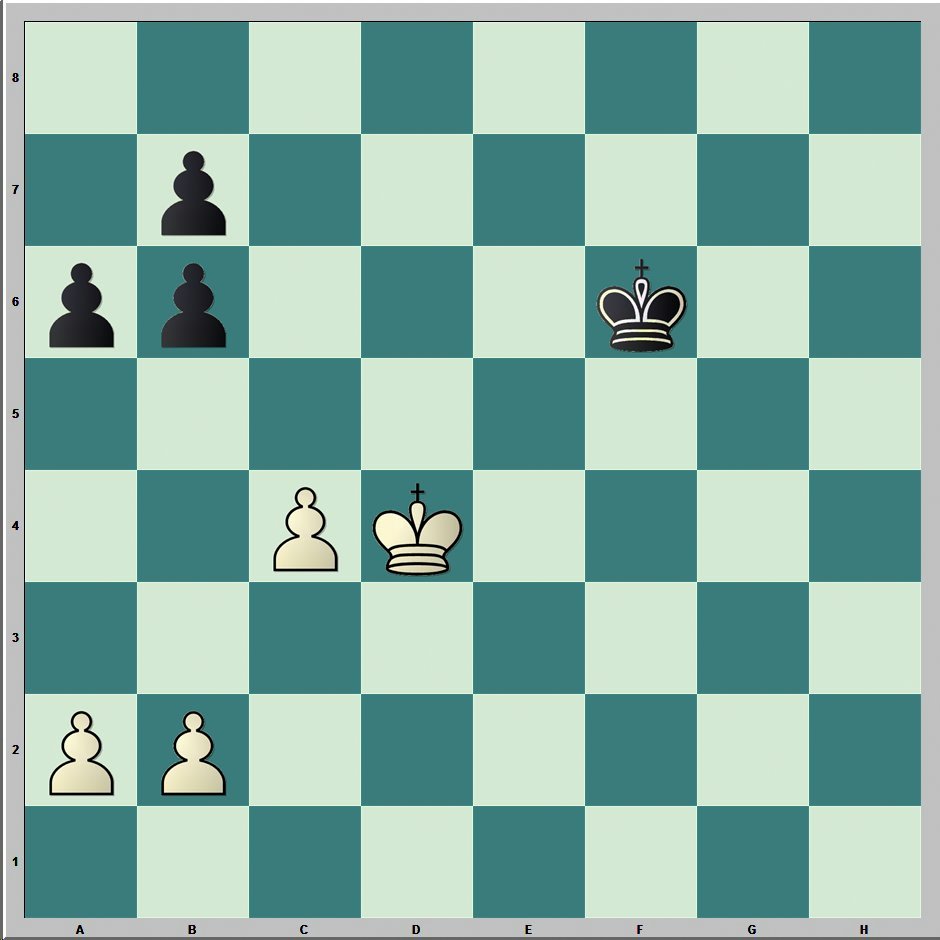
White to move. Is this a win or draw for White?
8/1p6/pp3k2/8/2PK4/8/PP6/8 w – – 0 1

Chess Daily News from Susan Polgar

White to move. Is this a win or draw for White?
8/1p6/pp3k2/8/2PK4/8/PP6/8 w – – 0 1
I’m going for White win. My difficulty is that two lines seem to win. I think an immediate c5 is good enough and also playing a4 with the idea of a5 (and if black plays a5 then I’ll stick c5 in again)
Paul D.
I guess my first thought would be to try to push black’s king back, or at least put him to a decision- either protect his pawns or go for white’s. Let’s see if this gets us anywhere:
1. Kd5 Ke7 (protect the pawns)
Now, white needs a way into the position since black can just move his king between d7 and e7 keeping the white king out. Moving either the a- or the b- pawn don’t immediately help (though I can’t discount the possibility that doing so might be useful at a later stage), so
2. c5
Now the question is back on black, take at c5, play b5 (a5 seems out of the question to me since cb6 creates a permanent weakness out of the a-pawn), or play the king to d7. I really have no clue what to do other than to play these lines out and see where I am at.
2. …..bc5
3. Kc5 Kd7 (Kd8 OK too)
4. Kb6 Kc8
5. Ka7
To make progress, this is a must. Now, black is put to a hard decision- any move of the b-pawn is going to drop both pawns, so black has to choose between Kc7 and a5 (offering the pawn to open the corner to the king since a draw is not out of the question a pawn down in this type of endgame). Let’s show why Kc7 is a loser first since it is the more complicated line, then we will deal with a5:
5. …..Kc7
6. b4! Kc6 (alternatives below)
7. a4! Kc7 (alternatives below)
8. b5 ab5 (alternatives below)
9. ab5 b6 (Kc8 10.b6 Kd7 11.Kb7)
10.Ka6 Kc8 (Kb8 11.Kb6 wins)
11.Kb6 Kb8
12.Ka6 Ka8 (Kc8/c7 13.Ka7 wins)
13.b6 Kb8
14.b7 and it is over. At move 8 in this line, the alternatives for black are no better:
8. …..a5
9. Ka8! Kb6 (Kc8 10.b6; b6 10.Ka7)
10.Kb8 Kc5
11.Kb7 Kb4
12.b6 and white wins the race to queen by four moves. Or
8. …..b6
9. Ka6 and the b-pawn falls, too. Or
8. …..Kc8
9. b6 a5 (what else?)
10.Ka8 with zugzwang. Or
8. …..Kd6 (Kd7 much the same)
9. Kb7 ab5 (what else?)
10.ab5 and the pawn can’t be stopped. At move 7 in this line, the alternatives again are no good for black:
7. …..a5
8. b5 Kc7 (Kc5 9.Kb7 wins)
9. Ka8 and we have already seen this wins for white above. Or
7. …..b6 (b5 8.a5 wins)
8. Ka6 Kc7 (what else?)
9. b5 wins the last black pawn. Or
7. …..Kd5
8. Kb7 Kc4 (what else?)
9. a5 Kb5
10.Ka6 Kc5
11.Kb7 and the pawn can’t be stopped. At move 6 above, the alternatives are all losing for black:
6. …..a5
7. b5 a4 (Kc8 8.b6 a4 9.a3 wins)
8. a3 Kc8
9. b6 wins. And Kd7 or Kd6 just lose both pawns.
So, we are back to move 5 where I thought black should just offer up the a-pawn for room to reach the corner:
5. …..a5
6. Kb6 a4
7. a3 Kb8 (what else?)
8. Ka5 Ka7 (Kc7, Ka8, Kc7 same?)
9. Ka4 Kb6
10.b3 Ka6
11.b4 Kb6
12.b5 Ka7 (nothing holds)
13.Ka5 Ka8
14.Kb6 Kb8
15.a4 Ka8
16.a5 Kb8
17.Kc5 Ka8
18.Kd6 Kb8
19.Kd7 Ka7
20.Kc8 Ka8 (b6 loses too)
21.a6 and this is the key position, and regardless of what black does after the 5th move, white can force this position or win even more quickly. I suppose there are ways that white can screw this up, but it isn’t easy other than blundering into stalemate. Continuing:
21…..b6 (ba6 22.b6 wins)
22.Kc7 Ka7
23.Kc6 and the last black pawn falls. After black’s second move near the top of this comment, white seems to me to have a forced win, so we need to look at black’s second move alternatives. I will do this in the next comment.
In my first comment, I had examined the plan that starts with the following line
1. Kd5 Ke7
2. c5
And, I hope I had shown that black could not take at c5 without losing the game in all variants. So, lets look at the 2nd move alternatives:
2. …..b5
3. c6! Kd8 (b6 or bc6 see below)
4. cb7 Kc7
5. b8(Q)Kb8
6. Kc6 Ka7 (what else?)
7. b4 a5 (Ka/b8 8.Kb6 wins)
8. a3
White must keep a b-pawn to win- rook’s pawns are no good here. Continuing:
8. …..Ka6 (ab4 9.ab4 Ka6 10.Kc5)
9. Kc5 ab4
10.ab4 Ka7
11.Kb5 Kb7
12.Ka5 Ka6
13.b5 Ka8
14.Kb6 Kb8
15.Kc6 Kc8 (Ka7/a8 16.Kc7)
16.b6 Kb8
17.b7 Ka7
18.Kc7 and it is over. Also, at move 2
2. …..Kd7
3. cb6 Ke7 (white still blocked)
4. Kc5 Kd7 (Ke6 ok too)
5. a4 Ke7
6. a5 Kd7
7. b4 Kc8
8. b5 ab5
9. Kb5 Kb8
10.a6 Ka8
11.ab7 Kb8
12.Kc5 Kb7
13.Kb5 Kb8
And I am stymied here. I have played with this line a long time, I just don’t see how to win it as white. I really believe I am on the right track with white’s first two moves, but I am missing something here after 2. …..Kd7. However, I am tired, hungry, and getting frustrated now. I need a break. Perhaps someone else can either show me where I have erred in this line, or show me where I erred right from the beginning. Hopefully Lucymarie will take this one on tonight and I can see the answer in the morning.
c4-c5-c6
1c5 b5 2c6
Draw
1c5 b5 2c6
1.c5? Ke6! 2.cxb6 Kd6 3.a4 a5! 4.b4 axb4 5.Kc4 Kc6 6.a5 b3 , draw
So ,
1.Kd5! Ke7 2.c5 bxc5 3.Kxc5 Kd7 4.Kb6 Kc8 5.Ka7 Kc7 6.b4 Kc6 7.a4 Kc7 (on a5 white plays b5)
8.b5 axb5 (8…a5 9.Ka8)
9.axb5 b6 10.Ka6 and white wins
1. Kd5 Ke7
2. c5 Kd7!
3. cxb6 Ke7
draw
I dont like c5 at once because of 1 .. Ke6 (2. c5xb6 Kd6 3. a4 a5! = ).
But what’s wrong with the natural 1. Kd5?
1. Kd5 Ke7 2. c5 bc5x 3. Kc5x Kd7 4. Kb6 Kc8 5. Ka7!
After that White moves a pawn to b6 and wins the b-pawn.
I am far from certain this morning, but I would have to vote for a draw with best play. The key line, in my opinion, is this one:
1. Kd5 Ke7
2. c5 Kd7 (bc5 loses, I think)
3. cb6 Ke7
And, now, white needs a plan. The only plan I can see that breaks through black’s fortress is to advance both pawns forcing black to exchange at b5 and to take at a6 clearing the path for the b6 pawn, but every line I have looked at seems to end in a draw. For example:
4. a3 Kd7
5. b4 Ke7
6. a4 Kd7
7. Kc5 Ke7
For now, black only need keep the white king from cutting him off from the corner. Continuing:
8. a5
This must be played now. If white tries 8.b5, black replies with a5 and white cannot get at the a5 pawn and the black king hides in the corner and forces white to stalemate him. Later, I will look at the plan where white plays b5 with the a-pawn still at a3 or a2 so that the king can come at a5 with the king. Continuing with the line above:
8. …..Kd7
9. b5
I will consider other moves below. Continuing with the above:
9. …..Kc8
10.ba6 ba6
Now, how does white win this position? I have spent a lot time looking at it and have come up with nothing at all. It looks like a dead draw to me. White can never bring the king to c7 or c8 unless the black king is at a8, but then black is stalemated. The only other way to support advance of the b-pawn is from c6, but this is also a draw:
11.Kc6 Kb8
12.b7 Ka7
And now white can exchange the b-pawn for black’s a-pawn, but the resulting rook pawn endgame is also a dead draw that even beginning chess players learn early on. If he plays 13.Kc7, black is stalemated immediately.
13.b8(Q) Kb8
14.Kb6 Ka8
15.Ka6 Kb8
16.Kb6 Ka8
17.a6 Kb8
18.a7 Ka8 and the pawn is lost or stalemate is enforced.
At white’s 9th move, the alternatives just seem as hopeless in producing a win:
9. Kd5 Kd8
10.Kd6 Kc8
11.Kc5 Kd7 and this position is one we have already seen is a draw.
The only other plan I could see for white is the hold his a-pawn back, but I don’t think this actually improves his winning chances in this line. Take the position after black’s 4th move:
5. b4 Ke7
6. b5 a5
7. Kc4 Kd6
8. Kb3 Kc5
9. Ka4 Kb6 and now it is white fighting for the draw. I see no variations in this line that white can initiate that changes things. It simply doesn’t seem possible to force-push black’s king far enough away for white to reach the a-pawn without losing b6 at the same time since black always has a4 in hand to gain a tempo.
If there really is another winning plan for white, I think it either has to start with another move at move 3 above (cb6 just creates a stalemate problem combined with a weak pawn), or must start at moves 1 or 2, and I simply don’t see what it could possibly be. I need a better chessplayer than myself to point it out.
Hi Yancey, you have to combine two ideas to win:
1.a4 threats 2.a5! and the white king goes collecting the pawns.
1…. a5 to prevent this idea.
But now there is a hole on b5 which can be exploited by white.
2.Kd5! Ke7 (what else?)
3.c5! Kd7 (obviously bxc5 4.Kxc5 let the black pawns unprotected.
4.cxb6 and the white king collects the black a-pawn as well with a winning position.
Cheers, Jean-Claude