I see no value in sacrificing the rook at f6 since the queen and rook are more than enough to protect the black king from the white queen and bishop. One might play 1.g5 sacrificing the bishop, but this seems too slow to me:
1. g5 Qd2 2. Rf6 Kg7 3. Qc7
Here, 3.Qf3 Qg5 4.Rf7 Kg8 just leaves white down a piece and a pawn with a very exposed king thrown in for good measure. Continuing:
3. …..Kh8 (Kg8?? 4.Qf7+-) 4. Qf7
What else? Continuing:
4. …..Re3 5. Rf3
Here, 5.Kh4 or Kg4 is mate in two starting with Qh2 or Qg2 respectively. Continuing:
5. …..Nf2! 6. Kg2
Here, 6.Kh4 Qd4 7.Kg3 looks no better than the above, and white can’t play, in this subvariation, 7.Qd4 since the white queen hangs as the white rook is pinned to the h3 square by the threat of Rh3#, nor can white play 7.Kh5 due to mate starting with Qg4+. Continuing:
6. …..Ne4 (obvious, even to me) 7. Kg1
Here, 7.Kh3 Ng5 wins. Continuing:
7. …..Qd1 8. Rf1
Or lose the rook or queen after 8.Kg2 Re2 9.Kh3 Ng5. Continuing:
8. …..Qg4 9. Kh1 Ng3 10.gh3
Here, 10.Kg1 or 10.Kg2 is just going to lose the exchange as well leaving white down a rook. Continuing:
10. ….Qh3 11.Kg1 Qg3 12.Kh1 Qh3 13.Kg1 Qg4 with mate following on the next move by either Rh3 or Qg3.
The above suggests the right plan, but white must act more quickly to achieve the win. Continued in my next comment.
1. Qc7 Re7 (alternatives below) 2. Qc4 is going to win a piece at a minimum for white. The same will apply when black plays the king to g8 or e6 (and white might have even better than winning the knight in those lines). This leaves Kf8 and Kg6:
1. …..Kf8 2. Bf6 with mate on the next move. Lastly,
1. …..Kg6 2. Rh5!
This is the move that took the longest to find (about 10 minutes). I got badly sidetracked by two different moves- Qc6 and Bh6. I don’t know if Bh6 offers white anything, but I think white can win with 2.Qc6 which I will include at the end. The point of 2.Rh5 is that there are twin mating threats Rh6# and Qh7#. There are no good ways to stop these other than just tossing away material. Probably the longest delay is
2. …..Nf4 3. Qf4
I think Bf4 wins too, but seems harder due to the loss of control of the e1 square, from which black can check the white king when he sits at h4- for example 3.Bf4 Qc3 4.Kh4 Qe1 5.Bg3 Qe7 leaving white up a piece, but parrying the immediate mate threat. Continuing:
3. …..Qe5
Here, Re5 seems an even shorter way to lose, but I am not 100% sure. Continuing:
4. Qh6
Of course, Re5 is almost as good, but you don’t need to hurry to take the queen here- she ain’t going anywhere just yet. Continuing:
4. …..Kf7 5. Qh7 Ke6 (Kf8 6.Bh6#) 6. Re5 Ke5 7. Qd7 and it is only a matter of time before black loses his rook to a double attack, or gets himself mated. Back at move 3, I mentioned the following continuation:
3. …..Re5 4. Rh6! Kf7 (Kg7 just as hopeless) 5. Qf6 Kg8 (Ke8 6.Qc6 as bad) 6. Qd8 Kg7 (Kf7 7.Rh7+) 7. Qd7 Kg8 (Kf8 8.Rf6) 8. Qh7 Kf8 9. Qh8 Ke7 (Kf7 10.Qf6) 10.Qg7 Kd8 11.Rh8 Re8 12.Bg5 is a forced mate. I just don’t know for sure if all the other variations I noted in parentheses are also forced in fewer moves, but they all looked like they were or interpolated into the main line I showed.
Last bit is the line back when white plays 2.Qc6. I am only including it because I spent so much time on it:
2. Qc6
Attacking the f6 pawn and the black rook, and threatening to play Rg5+ initiating an unsurvivable attack on the black king. Continuing:
2. …..Re7 (what else is better?) 3. Rg5 Kf7 (Kh6 4.Rg8 & # 1 or 2) 4. Qc4 Re6 (else is mate 1 or 2) 5. Qc7 Re7 (Kf8 6.Qg7 Ke8 7.Qg8) 6. Rg7 Kg7 7. Qe7 Kg6 (Kg8 8.Bh6 wins piece) 8. Qe8 Kg7 9. Qd7 wins at least a piece. This line was just not as forcing at 2.Rh5.
Reti said once that an Alekhine combination was a continuation of normal moves ended by an unexpected thrust. I feel pretty much the same about this position
1.Qc7+! Kg6
Neither 1…Re7 1…Kg8 1…Ke6 2.Qxc4+ or 1….Kf8 2.Bh6+ brings Black something enjoyable
2.Rh5!
That seems very simple, still doing simple things all the time without a single error or overlooking more complicated ones, that is something and it’s named being a grandmaster This move brings two mating threats 3.Rh6 mate ! or 3.Qxh7 mate
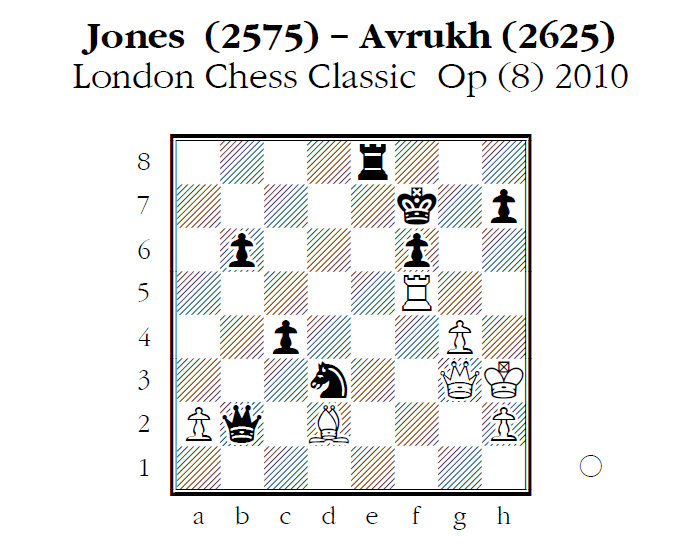


All I see is Qc7+ then unless black does something catastrophic, Qxc4
I see no value in sacrificing the rook at f6 since the queen and rook are more than enough to protect the black king from the white queen and bishop. One might play 1.g5 sacrificing the bishop, but this seems too slow to me:
1. g5 Qd2
2. Rf6 Kg7
3. Qc7
Here, 3.Qf3 Qg5 4.Rf7 Kg8 just leaves white down a piece and a pawn with a very exposed king thrown in for good measure. Continuing:
3. …..Kh8 (Kg8?? 4.Qf7+-)
4. Qf7
What else? Continuing:
4. …..Re3
5. Rf3
Here, 5.Kh4 or Kg4 is mate in two starting with Qh2 or Qg2 respectively. Continuing:
5. …..Nf2!
6. Kg2
Here, 6.Kh4 Qd4 7.Kg3 looks no better than the above, and white can’t play, in this subvariation, 7.Qd4 since the white queen hangs as the white rook is pinned to the h3 square by the threat of Rh3#, nor can white play 7.Kh5 due to mate starting with Qg4+. Continuing:
6. …..Ne4 (obvious, even to me)
7. Kg1
Here, 7.Kh3 Ng5 wins. Continuing:
7. …..Qd1
8. Rf1
Or lose the rook or queen after 8.Kg2 Re2 9.Kh3 Ng5. Continuing:
8. …..Qg4
9. Kh1 Ng3
10.gh3
Here, 10.Kg1 or 10.Kg2 is just going to lose the exchange as well leaving white down a rook. Continuing:
10. ….Qh3
11.Kg1 Qg3
12.Kh1 Qh3
13.Kg1 Qg4 with mate following on the next move by either Rh3 or Qg3.
The above suggests the right plan, but white must act more quickly to achieve the win. Continued in my next comment.
1. Qc7+ Re7/Ke6/Kg8
2. Qxc4+ …
3. Qxd3 and wins.
1. … Kf8
2. Bh6+ Kg8
3. Qg7#
1. … Kg6
2. Rh5 Re3+/Nf4+/Nf2+
3. Kh4 and the double mate threat Qxh7# and Rh6# can´t be covered. greets, jan
The right plan is to play Qc7 immediately.
1. Qc7 Re7 (alternatives below)
2. Qc4 is going to win a piece at a minimum for white. The same will apply when black plays the king to g8 or e6 (and white might have even better than winning the knight in those lines). This leaves Kf8 and Kg6:
1. …..Kf8
2. Bf6 with mate on the next move. Lastly,
1. …..Kg6
2. Rh5!
This is the move that took the longest to find (about 10 minutes). I got badly sidetracked by two different moves- Qc6 and Bh6. I don’t know if Bh6 offers white anything, but I think white can win with 2.Qc6 which I will include at the end. The point of 2.Rh5 is that there are twin mating threats Rh6# and Qh7#. There are no good ways to stop these other than just tossing away material. Probably the longest delay is
2. …..Nf4
3. Qf4
I think Bf4 wins too, but seems harder due to the loss of control of the e1 square, from which black can check the white king when he sits at h4- for example 3.Bf4 Qc3 4.Kh4 Qe1 5.Bg3 Qe7 leaving white up a piece, but parrying the immediate mate threat. Continuing:
3. …..Qe5
Here, Re5 seems an even shorter way to lose, but I am not 100% sure. Continuing:
4. Qh6
Of course, Re5 is almost as good, but you don’t need to hurry to take the queen here- she ain’t going anywhere just yet. Continuing:
4. …..Kf7
5. Qh7 Ke6 (Kf8 6.Bh6#)
6. Re5 Ke5
7. Qd7 and it is only a matter of time before black loses his rook to a double attack, or gets himself mated. Back at move 3, I mentioned the following continuation:
3. …..Re5
4. Rh6! Kf7 (Kg7 just as hopeless)
5. Qf6 Kg8 (Ke8 6.Qc6 as bad)
6. Qd8 Kg7 (Kf7 7.Rh7+)
7. Qd7 Kg8 (Kf8 8.Rf6)
8. Qh7 Kf8
9. Qh8 Ke7 (Kf7 10.Qf6)
10.Qg7 Kd8
11.Rh8 Re8
12.Bg5 is a forced mate. I just don’t know for sure if all the other variations I noted in parentheses are also forced in fewer moves, but they all looked like they were or interpolated into the main line I showed.
Last bit is the line back when white plays 2.Qc6. I am only including it because I spent so much time on it:
2. Qc6
Attacking the f6 pawn and the black rook, and threatening to play Rg5+ initiating an unsurvivable attack on the black king. Continuing:
2. …..Re7 (what else is better?)
3. Rg5 Kf7 (Kh6 4.Rg8 & # 1 or 2)
4. Qc4 Re6 (else is mate 1 or 2)
5. Qc7 Re7 (Kf8 6.Qg7 Ke8 7.Qg8)
6. Rg7 Kg7
7. Qe7 Kg6 (Kg8 8.Bh6 wins piece)
8. Qe8 Kg7
9. Qd7 wins at least a piece. This line was just not as forcing at 2.Rh5.
I like Qc7+ at first sight
Qc7+ Kf8 or Kg8 and Rxf6 starts to look dire.
Qc7+ Ke6 Qxc4+ Ke7 Qxd3
Qc7+ Re7 Qxc4+ Kg7 Qxd3
Qc7+ Kg6 Qc6 seems less conclusive
Well, the bishop is hanging with very few squares to go, and black’s king is kind of exposed. So let’s try checking him first.
1. Qc7+ Kg6
(other move like 1…Kg8 or Re7 2.Qxc4+ and wins the piece; 1…Kf8 2.Bh6+ mates)
Now, I was trying to be clever and play,
2.Bh6 hoping for 2…KxB 3.Rh5+ and mates follows, but black just simply plays 3….Rg8 and I couldn’t find anything for white)
That is when I realized by a thunderbolt from the sky and frying my brain that I could play,
2.Rh5 (with the double mate threat of 3.Qxh7++ & Rh6++)
The only way for black to stop this is by giving up the knight and give the white’s king some petty checks.
2….Nf4+
3.BxN Or QxN and white is winning, although, you know, he still have some work to do.
1. Qc7+ Re7
2. Qxc4+
and 3. Qxd3 wins a piece
The same happens if the black king instead goes to e6 or g8 after 1. Qc7+
if
1. Qc7+ Kf8
2. Bh6+ Kg8
3. Qg7#
So the only other alternative is 1… Kg6:
1. Qc7+ Kg6
2. Rh5
now there is the dual threat of Qxh7# and Rh6#
black cannot stop both. if
2. … Nf2+
3. Kh4
Reti said once that an Alekhine combination was a continuation of normal moves ended by an unexpected thrust. I feel pretty much the same about this position
1.Qc7+! Kg6
Neither 1…Re7 1…Kg8 1…Ke6 2.Qxc4+ or 1….Kf8 2.Bh6+ brings Black something enjoyable
2.Rh5!
That seems very simple, still doing simple things all the time without a single error or overlooking more complicated ones, that is something and it’s named being a grandmaster
This move brings two mating threats 3.Rh6 mate ! or 3.Qxh7 mate
2…Nf2+ 3.Kg2 and there are no checks
1-0
1. Qh4 QxB
2. Qxf6+ Kg8
3. Qf7+ Kh8
4. QxR+ Kg7
5. Qf7+ Kh8
6. Qf8# (if 5. … Kh6, 6. Rh5#)
I’m not good enough to work through the other possibilities. But Black would be a sucker to take the sacrifice.
Mark
1. Qc7+
wins the pawn on c4 and the Nd3 in all variations.