The idea is to divert black’s queen from defending the king, however, after black takes at g1 and a1, I can’t find a good and timely continuation for white:
1. …..Qg1 2. Ke2 Qa1
And, now what for white? The most direct attack is to put the queen on f7, but black’s own threats control:
3. Qf7 Qb2 4. Kf1
Every other move is worse. Continuing:
4. …..Qc1 5. Ke2 cd4 6. Qg8 Nd7 7. Nd7 d3 8. Kf3 Qh1 9. Ke3 Qe1 10.Kf3 Kd7 11.Ba8 Qh1 12.Ke3 Qa8 and this is surely lost for white. I may well be missing better moves for both players here, but I have no clue what they might be- most of this line more or less plays itself. My biggest question mark is whether or not black does better taking the knight at c3 early in the line, but I prefer the line above because it allows black to recapture at a8 when the time comes.
With the idea of capturing at b7 on the first move out of the way, I would be looking to put a rook on d1. Without a FEN for the position, I am left with two ways to do this, play Rd1 or castle long, and I don’t know which is appropriate for this position/problem. If possible, it is stronger to castle long:
1. OOO Bg2 (alternatives later) 2. dc5
The point of putting the rook on d1. Continuing:
2. …..Ke7
Does black have a better move here? I think white can play Rxg2 pretty much no matter what black does here to have a big attack that is going to win decisive material:
3. Rg2 Qe5 (Qg2 4.Qf7#) 4. Rg8 Nc6 (what else?) 5. Qg6 Rd8 (again, what else?) 6. Qh7 Ke8 7. Qh6 Rd1 8. Kd1 Qc5 9. Qe6 should win for white. I really can’t do this line exhaustively (too many variations), but I don’t really see better moves for black after his first move.
Now, back at move 1, black doesn’t have to take at g2, but could try a preemptive block of the coming rook check:
1. 000 Nd7 2. Bb7 Qg1 (nothing better) 3. Rg1
Probably not the strongest continuation for white, but I am pressed for time at the moment. Continuing:
1. …..Bd5 2. Nd5 ed5 3. Bd5 Qg1 4. Rg1 Rg1 5. Kc2 is also clearly decisive.
I really don’t see defense after white can castle long. Now, if white isn’t able to castle, then I would still play Rd1, though I don’t see a clearly decisive continuation for white right now, and I don’t have the time to study it well.
1.Bc6 is an interesting move, and I am bit mystified why it never occurred to me yesterday morning, however, on looking it over, I don’t think it wins for white as long as black doesn’t get too materially greedy.
1. Bc6 Qg1 2. Ke2 Nc6!
I won’t do a long look at 2. …Qa1, but I think the first commenter is probably right that 3.Qe8 is going to be a forced mate at some point. In any case, after 2. …Nc6, it is complex, but with the threat of Qe8 removed, I can’t imagine white can do better than to grab the queen now:
3. Rg1 Rg1
Maybe 3. …Nd4+ can be played here, but the material balance is bit worrisome after 4.Kf1. Continuing:
4. Nc6
Hard to say if this is the best for white with so many alternatives, but those alternatives don’t look obviously better to me- white can always later play to win at b5 and/or h6. Continuing:
And, I just don’t see how white wins this, and will extremely lucky to not lose. White can win at h6, but I doubt he has time to push an h-pawn after black takes at b2 and starts pushing the c/d combo.
1. Bc6 is interesting, but as long as black isn’t greedy, he should win:
1. Bc6 Qg1 2. Ke2 Nc6!
Too tired to reproduce the rest (probably the first time in months I didn’t save my work, and wouldn’t you know the comment would be lost), but black should be able to defend this well enough to end up in a won ending of 2R vs Q.
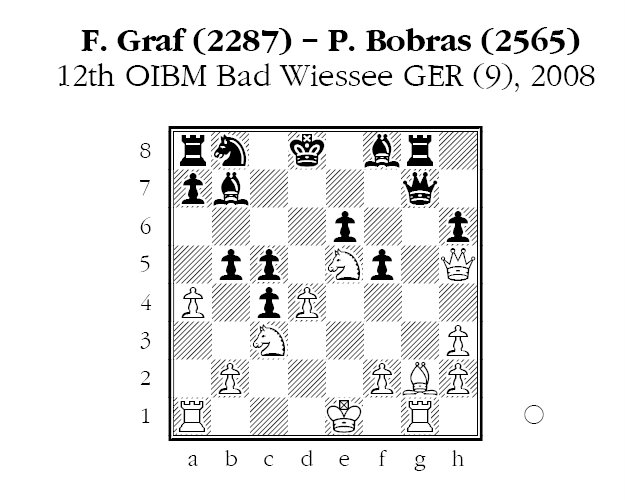


1.Bc6!!,Qg1.2.Ke2,Qa1.3.Qe8 and mate with both kinghts,the last in c4.
Bc6!! Qxg1
Ke2 Qxh1
Qe8+ Kc7
Nxg5+ Kg6
Nxc4+ Ka6
Nc7++
Don’t see a forced win for white, but a strong attack with
1. 0-0-0 Bxg2
(1… Qg5+ 2. Qxg5, hxg5 3. Bxb7)
2. dxc5+
now if
2… Ke7
3. f4! +/-
or if
2…. Kc8
3 Qe8+ +/-
of if
2…. Kc7
3. Nxb5+ +/-
Rd1 followed by.. Lorfa doesn’t know.
Nf7+
Well, my first instinct seems wrong:
1. Bb7
The idea is to divert black’s queen from defending the king, however, after black takes at g1 and a1, I can’t find a good and timely continuation for white:
1. …..Qg1
2. Ke2 Qa1
And, now what for white? The most direct attack is to put the queen on f7, but black’s own threats control:
3. Qf7 Qb2
4. Kf1
Every other move is worse. Continuing:
4. …..Qc1
5. Ke2 cd4
6. Qg8 Nd7
7. Nd7 d3
8. Kf3 Qh1
9. Ke3 Qe1
10.Kf3 Kd7
11.Ba8 Qh1
12.Ke3 Qa8 and this is surely lost for white. I may well be missing better moves for both players here, but I have no clue what they might be- most of this line more or less plays itself. My biggest question mark is whether or not black does better taking the knight at c3 early in the line, but I prefer the line above because it allows black to recapture at a8 when the time comes.
With the idea of capturing at b7 on the first move out of the way, I would be looking to put a rook on d1. Without a FEN for the position, I am left with two ways to do this, play Rd1 or castle long, and I don’t know which is appropriate for this position/problem. If possible, it is stronger to castle long:
1. OOO Bg2 (alternatives later)
2. dc5
The point of putting the rook on d1. Continuing:
2. …..Ke7
Does black have a better move here? I think white can play Rxg2 pretty much no matter what black does here to have a big attack that is going to win decisive material:
3. Rg2 Qe5 (Qg2 4.Qf7#)
4. Rg8 Nc6 (what else?)
5. Qg6 Rd8 (again, what else?)
6. Qh7 Ke8
7. Qh6 Rd1
8. Kd1 Qc5
9. Qe6 should win for white. I really can’t do this line exhaustively (too many variations), but I don’t really see better moves for black after his first move.
Now, back at move 1, black doesn’t have to take at g2, but could try a preemptive block of the coming rook check:
1. 000 Nd7
2. Bb7 Qg1 (nothing better)
3. Rg1
Probably not the strongest continuation for white, but I am pressed for time at the moment. Continuing:
3. …..Rg1
4. Kc2 cd4 (nothing better)
5. Ba8 is clearly decisive.
Or, at move 1:
1. …..Bd5
2. Nd5 ed5
3. Bd5 Qg1
4. Rg1 Rg1
5. Kc2 is also clearly decisive.
I really don’t see defense after white can castle long. Now, if white isn’t able to castle, then I would still play Rd1, though I don’t see a clearly decisive continuation for white right now, and I don’t have the time to study it well.
1.Bc6 is an interesting move, and I am bit mystified why it never occurred to me yesterday morning, however, on looking it over, I don’t think it wins for white as long as black doesn’t get too materially greedy.
1. Bc6 Qg1
2. Ke2 Nc6!
I won’t do a long look at 2. …Qa1, but I think the first commenter is probably right that 3.Qe8 is going to be a forced mate at some point. In any case, after 2. …Nc6, it is complex, but with the threat of Qe8 removed, I can’t imagine white can do better than to grab the queen now:
3. Rg1 Rg1
Maybe 3. …Nd4+ can be played here, but the material balance is bit worrisome after 4.Kf1. Continuing:
4. Nc6
Hard to say if this is the best for white with so many alternatives, but those alternatives don’t look obviously better to me- white can always later play to win at b5 and/or h6. Continuing:
4. …..Bc6
5. Qf7 cd4 (Be7 possible???)
6. Qf8 Kd7 (Kc7 7.Nb5 unclear)
7. Qf7 Kd6
8. Nb5 Bb5 (forced I think)
9. ab5 Rb1 (best looking to me)
And, I just don’t see how white wins this, and will extremely lucky to not lose. White can win at h6, but I doubt he has time to push an h-pawn after black takes at b2 and starts pushing the c/d combo.
This one has a lot of possible mating variations after the killer 1. O-O-O threatening the dangerous dxc5+. Here’s a bunch of them.
1. O-O-O
1. .. a6? to show the threat 2. dxc5+ Kc7 3. Bxb7 Qxg1 4. Qf7+
1. .. cxd4 2. Bxb7 Qxg1 3. Rxg1 Rxg1+ 4. Nd1 Bd6 5. Nf7+ Ke7 6. Nxd6 Kxd6 7. Bxa8
1. .. Qg5+ 2. Qxg5+ hxg5 3. Bxb7
1. .. Bd5 2. Bxd5 Qxg1 3. Rxg1 Rxg1+ 4. Kc2 exd5 5. Qf7 Bd6 6. Nxd5 Bxe5 7. Qe7+ Kc8 8. dxe5
1. .. Bxg2 2. Rxg2 Qxg2 3. dxc5+ Kc8
(3. .. Kc7 4. Qf7+ Kc8 5. Qxe6+ Kb7 6. Rd7+ Nxd7 7. Qxd7+ Kb8 8. c6 Qf1+ 9. Nd1)
4. Qe8+ Kb7 5. Rd7+ Ka6
(5. .. Nxd7 6. Qxd7+ Kb8 7. c6 Qg1+ 8. Nd1 Qg5+ 9. Kb1 Qe7 10. c7+ Kb7 11. c8=Q+ Kb6 12. Qxb5#)
6. axb5+ Ka5 7. Nxc4+ Kb4 8. Na2+ Kb3
(8. .. Kxc5 9. b4+ Kxc4 (9. .. Kxb5 10. Na3+ Ka6 (10. .. Kb6 11. Qd8+ Kc6 12. Qc7#) 11. Qc8+ Kb6 12. Qc7+ Ka6 13. Qa5#) 10. Qxe6+ Kxb5 11. Nc3+ Kxb4 12. Rd4+ Ka3 (12. .. Ka5 13. Ra4#) (12. .. Kc5 13. Rc4#) 13. Qa2#)
(8. .. Kxb5 9. Na3+ Ka6 10. Nb4+ Ka5 11. Rxa7+ Rxa7 12. Qb5#)
9. Nd2+ Ka4
(9. .. Kxa2 10. Qxe6+ Ka1 11. Nb3+ Ka2 12. Nd4+ Qd5 (12. .. Ka1 13. Nc2#) 13. Qxd5+ Ka1 14. Nc2#)
10. Rd4+ Ka5 11. Nb3#
I see my last comment seems to have vanished.
1. Bc6 is interesting, but as long as black isn’t greedy, he should win:
1. Bc6 Qg1
2. Ke2 Nc6!
Too tired to reproduce the rest (probably the first time in months I didn’t save my work, and wouldn’t you know the comment would be lost), but black should be able to defend this well enough to end up in a won ending of 2R vs Q.